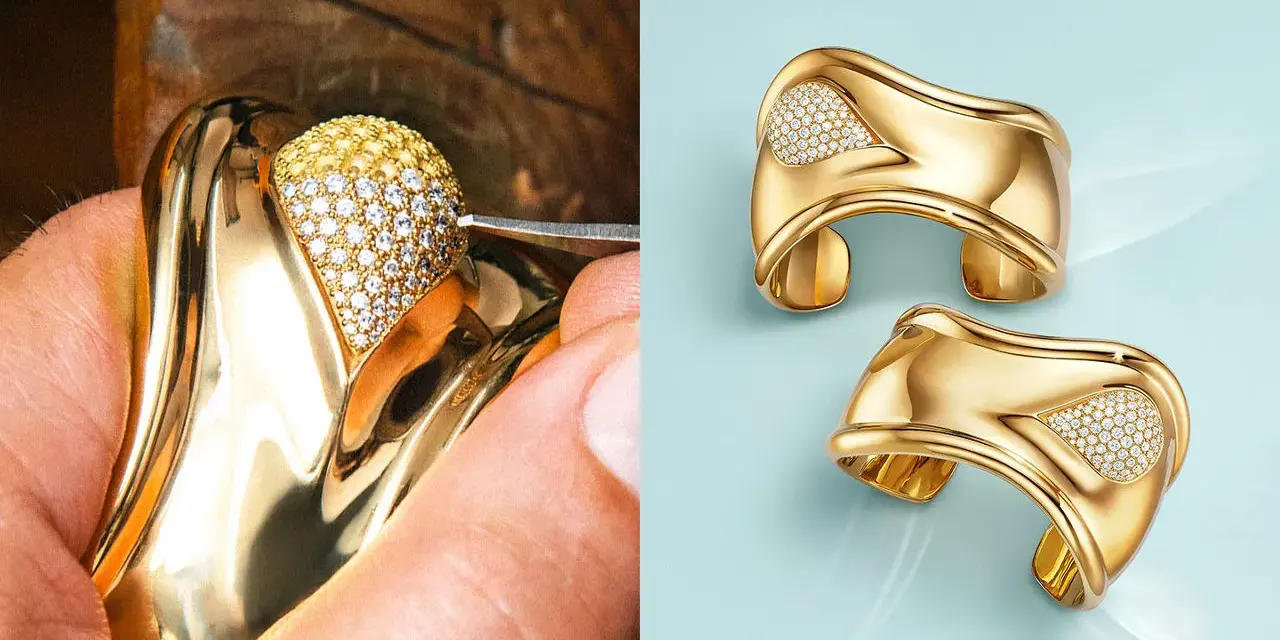
Elsa Peretti occupies a rare place in jewellery history: she made sculptural, organic forms feel modern, intimate and easy to wear. Her long collaboration with Tiffany & Co. changed how people thought about sterling silver, diamonds and everyday luxury, and it still shapes what collectors look for today. Here I focus on who she was, why her designs mattered, which collections became icons, and how to recognise the qualities that keep her work relevant in 2026.
Elsa Peretti’s legacy in a few essential points
- She joined Tiffany & Co. in 1974 and quickly shifted the brand’s design language towards something more fluid and sculptural.
- Her work made sterling silver feel precious, not secondary, which was a major change in modern jewellery history.
- Signature pieces such as the Bone cuff and Diamonds by the Yard are remembered because they are simple in form but exact in proportion.
- Her designs are still collected because they sit between fashion, architecture and wearable art.
- In the UK, her importance is reinforced by the fact that her work belongs in museum-level jewellery history, not just retail history.
Why Elsa Peretti changed modern jewellery
When I look at Peretti’s place in the Tiffany story, the key point is not just that she was successful. It is that she changed the emotional status of jewellery. According to Tiffany & Co., her arrival in 1974 signalled a genuine shift in design thinking: sterling silver became desirable, diamonds became easier to wear every day, and minimal shapes stopped looking spare and started looking luxurious.
That mattered because the market had long treated precious jewellery as either ornate or formal. Peretti offered another route. Her pieces were elegant without being fussy, sensual without being loud, and strong without feeling rigid. That is why her work still feels current: it solves a problem many jewellery lovers still have, which is how to wear pieces that feel personal rather than performative.
There is also a historical reason her work stands out. Tiffany had already built a reputation around fine materials and heritage, but Peretti brought a different kind of authority: one rooted in line, touch and the body. She did not simply decorate the wearer. She made the object and the wearer feel like one composition. That idea leads directly into the design language that defines her best-known pieces.
The design language behind her most recognisable pieces
Peretti’s jewellery is often described as organic, but that word can become vague if it is not handled carefully. In her case, it means forms that seem to grow naturally from the body: a curve that follows the wrist, a chain that falls like water, a surface that feels tactile rather than purely polished. I read her work as a meeting point between instinct and control. The shapes look effortless, but they are anything but casual.
The Bone cuff is the clearest example. Tiffany notes that Peretti first designed it in 1970, inspired by childhood visits to a Capuchin crypt in Rome and by Antoni Gaudí’s architecture. That background matters because the cuff is not a literal bone; it is a distilled curve, an anatomy-inspired form that feels both ancient and futuristic. It is also a reminder that she understood jewellery as sculpture for the body, not as decoration added on top of it.
Diamonds by the Yard works in a different way, but it follows the same logic. The fine chain and bezel-set stones create movement, light and space. A bezel setting is the metal rim that holds a stone in place, and here it does more than secure the diamond: it keeps the line soft and continuous, so the pieces read as fluid rather than rigid. That balance between security, lightness and visual quiet is one of the reasons the design lasted.
What ties the Bone cuff, Diamonds by the Yard and her other signatures together is restraint. She removed excess until the form carried the idea on its own. That leads naturally to the pieces collectors still ask about most often.
The collections that define her name
The easiest way to understand Peretti’s legacy is to look at the collections that keep reappearing in jewellery discussions, auctions and museum contexts. Each one answers a different design question, but all of them share the same disciplined simplicity.
| Collection | What defines it | Why it matters | What to notice |
|---|---|---|---|
| Bone cuff | A sculptural cuff shaped to echo the wrist | It turned an anatomical idea into one of the most recognisable modern jewellery forms | The curve, the ergonomics and the sense that the piece belongs to the body |
| Diamonds by the Yard | Fine chain with individually set stones | It changed the role of diamonds from formal jewels to everyday wear | The spacing, the lightness and the way each stone seems to float |
| Open Heart | An open outline rather than a closed symbol | It shows how a familiar motif can become fresh through proportion and negative space | The empty centre, which gives the design visual breathing room |
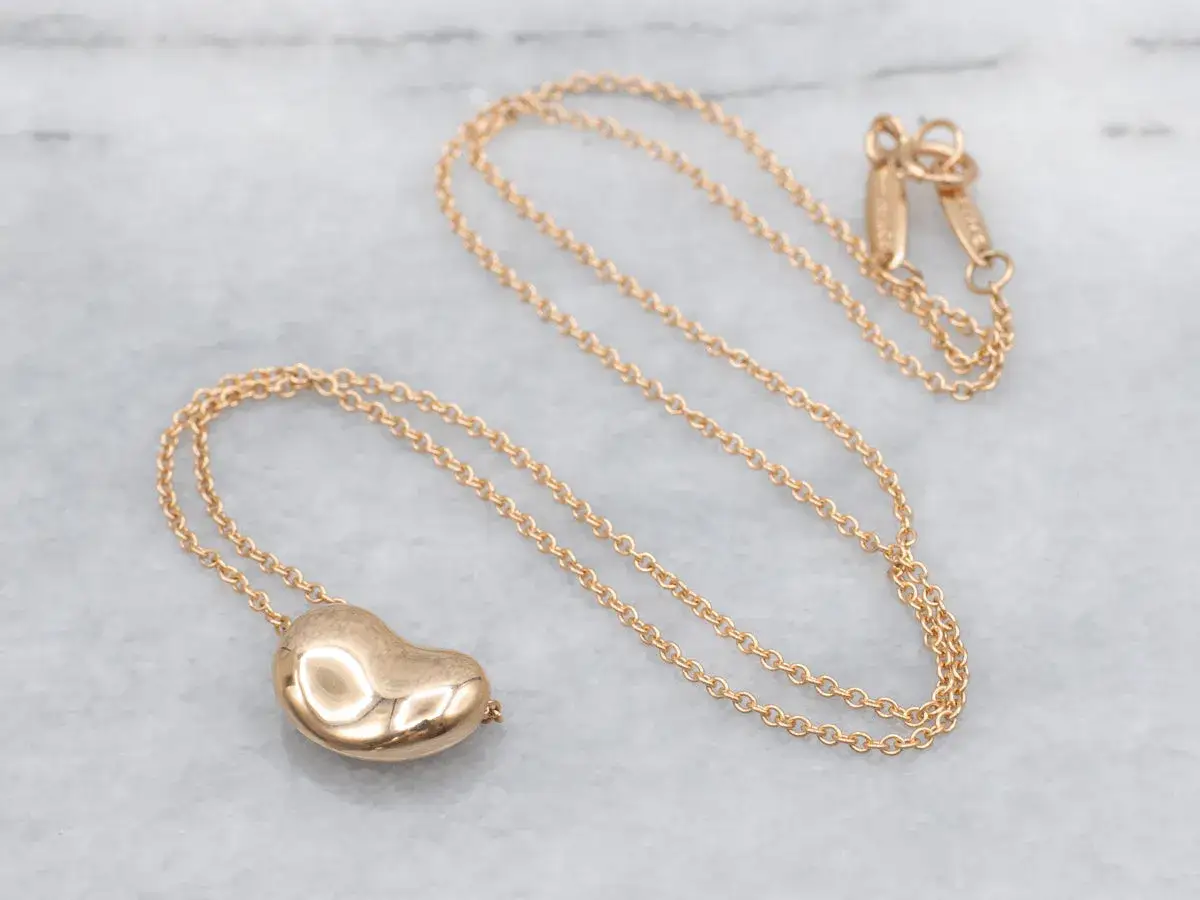
| Bean | A small, rounded, almost meditative form | It reduces shape to the simplest possible organic gesture | The softness of the outline and the absence of unnecessary detail |
| Mesh and Snake | Flexible, textural forms with strong movement | They show her interest in surface, drape and tactile luxury | How the material behaves rather than how heavily it is ornamented |
For collectors, the important point is that these designs are not memorable because they are complicated. They are memorable because the proportions are so carefully judged. In the UK market, that distinction matters: a well-kept Peretti piece often reads as refined at a glance, even before anyone checks the signature or provenance. From here, the practical question becomes how to assess a piece properly.
How to read a piece before you buy it
If I were advising someone on a Peretti purchase, I would focus on four things before anything else: the exact collection name, the material, the condition and the way the piece sits on the body. Those are the details that separate a meaningful find from a piece that simply carries a famous name.
- Check the collection name first. A seller should be able to identify whether the piece belongs to Bone, Open Heart, Diamonds by the Yard, Bean or another line.
- Confirm the material. Peretti designs exist in sterling silver, gold and gem-set versions, and the material changes both the look and the value profile.
- Study the proportions. Her designs rely on balance; if a cuff is too loose, too tight or visually distorted, the whole idea weakens.
- Look at wear and finish. Light patina on silver is normal, but deep scratches, bends or poor polishing can undermine the sculptural surface.
- Ask whether it is vintage or current production. The distinction matters because older pieces may have different stamping, sourcing history and collectible value.
One reason this matters is that Peretti’s work still sits in Tiffany’s living catalogue, while some older examples circulate through secondary sellers. That creates opportunity, but it also creates confusion. If a listing is vague about the exact model, I become cautious. Good design can survive time, but unclear documentation usually costs the buyer confidence. Once the piece is identified correctly, the next question is how to wear it in a way that respects its character.
How to wear her jewellery without overthinking it
Peretti’s strongest designs do not need heavy styling. In fact, they often look better when the rest of the outfit is quiet. A Bone cuff against a crisp shirt cuff, a single Open Heart pendant over knitwear, or a Diamonds by the Yard necklace layered over a plain neckline all work because the jewellery becomes the focal point rather than one note in a crowded arrangement.
I think this is where many people make a mistake: they try to build a complete “matched” look around a Peretti piece. Her work rarely needs that. It usually benefits from contrast instead. Smooth wool, white cotton, black tailoring and unembellished silk all give her forms enough room to read properly. In a British wardrobe, that means a silver cuff or fine chain can carry more visual weight than an entire set of highly coordinated jewellery.
There is also a practical side to wearing her cuffs and sculptural rings. Fit is not a small detail; it is part of the design. A cuff should feel intentional on the wrist, not precarious. A ring with a rounded organic shape should sit comfortably enough that you stop noticing it after a few minutes. If the piece interrupts movement, the design is failing its own brief. That emphasis on wearability is one reason her legacy still feels fresh.
What her legacy still teaches jewellery lovers in 2026
Peretti’s work endures because it solves a problem that never goes out of style: how to make jewellery feel timeless without making it stiff. More than five decades after her Tiffany debut, her pieces still look modern because they are built on fundamentals rather than trend language. Shape, proportion, touch and movement do the heavy lifting.
Her influence also extends beyond the shop floor. Tiffany has noted that her designs are part of museum collections, including the British Museum in London, which is an important marker of historical significance. That kind of presence tells you the work is being read not only as luxury goods, but as design history. For anyone studying jewellery in the UK, that distinction is worth taking seriously.
If there is one lesson I would keep from her work, it is this: the most powerful jewellery often does less, not more. It uses form with discipline, trusts the material and respects the body that wears it. That is why Elsa Peretti remains one of the most important names in modern jewellery history, and why her pieces still reward close looking rather than quick consumption.