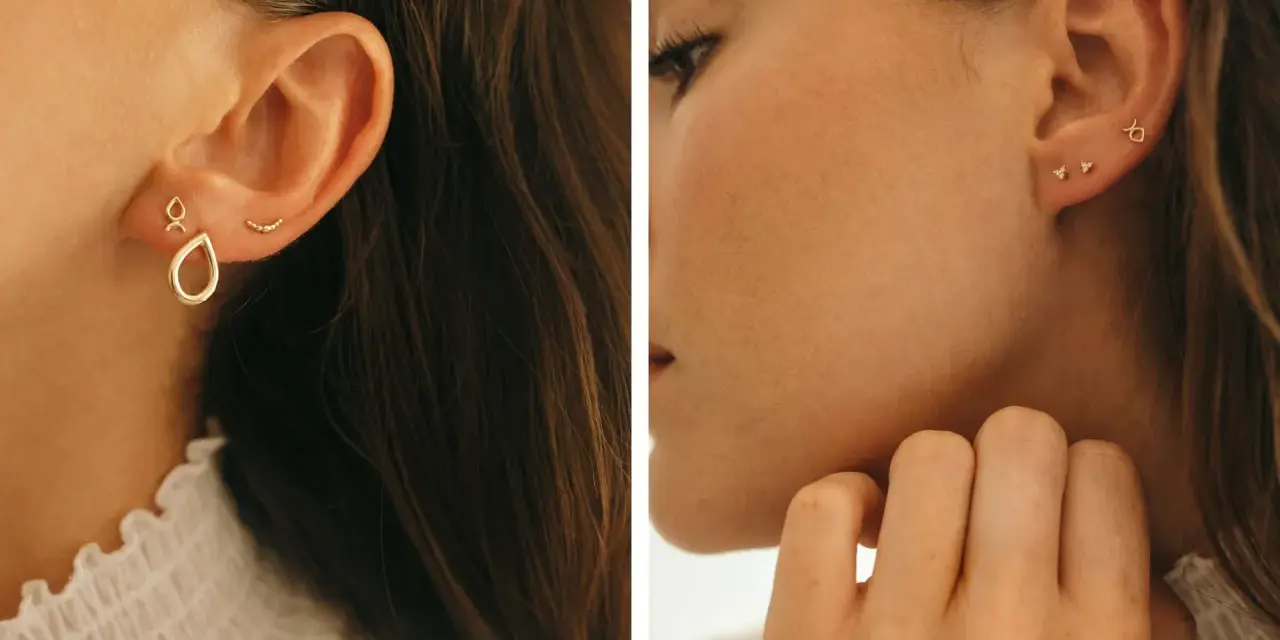
Well-built ear stacks are about balance, not volume. The most practical ear stack ideas follow the same rule: give each piece a job, then let the shapes, sizes, and finishes guide the eye upward. In this guide, I’m breaking down the combinations I trust most, how to match them to different piercing layouts, and the small mistakes that make a curated ear feel busy instead of polished.
What matters most before you start layering earrings
- Use one anchor piece, one supporting piece, and one lighter finish instead of matching everything perfectly.
- Three-piece stacks are the easiest to wear every day; add more only when the proportions still feel clean.
- Mixing metals can work, but one metal, stone colour, or texture should repeat to hold the look together.
- Low-profile studs, huggies, and flat backs are the most comfortable choices for daily wear in the UK, especially if you wear headphones or scarves.
- If you only have one piercing, an ear cuff or climber can still create the stacked effect without forcing extra holes.
What makes a stack look intentional
The difference between a thoughtful stack and a random cluster is hierarchy. I like to think in three layers: an anchor, a bridge, and a finish. The anchor is the piece with the most visual weight, the bridge connects the look, and the finish is the smallest or lightest detail at the top.
- Anchor usually means the largest hoop, huggie, or stud near the lobe.
- Bridge is the mid-size piece that keeps the eye moving.
- Finish is the smallest stud, cuff, or delicate shape closer to the cartilage.
If all three pieces are the same size, the stack flattens out. If one piece is huge and the others are too tiny, the balance breaks. The sweet spot is contrast with repetition, and that is what keeps the look modern rather than crowded. Once that logic clicks, choosing actual combinations becomes much easier.
With that structure in place, the next step is turning it into specific combinations you can actually wear.
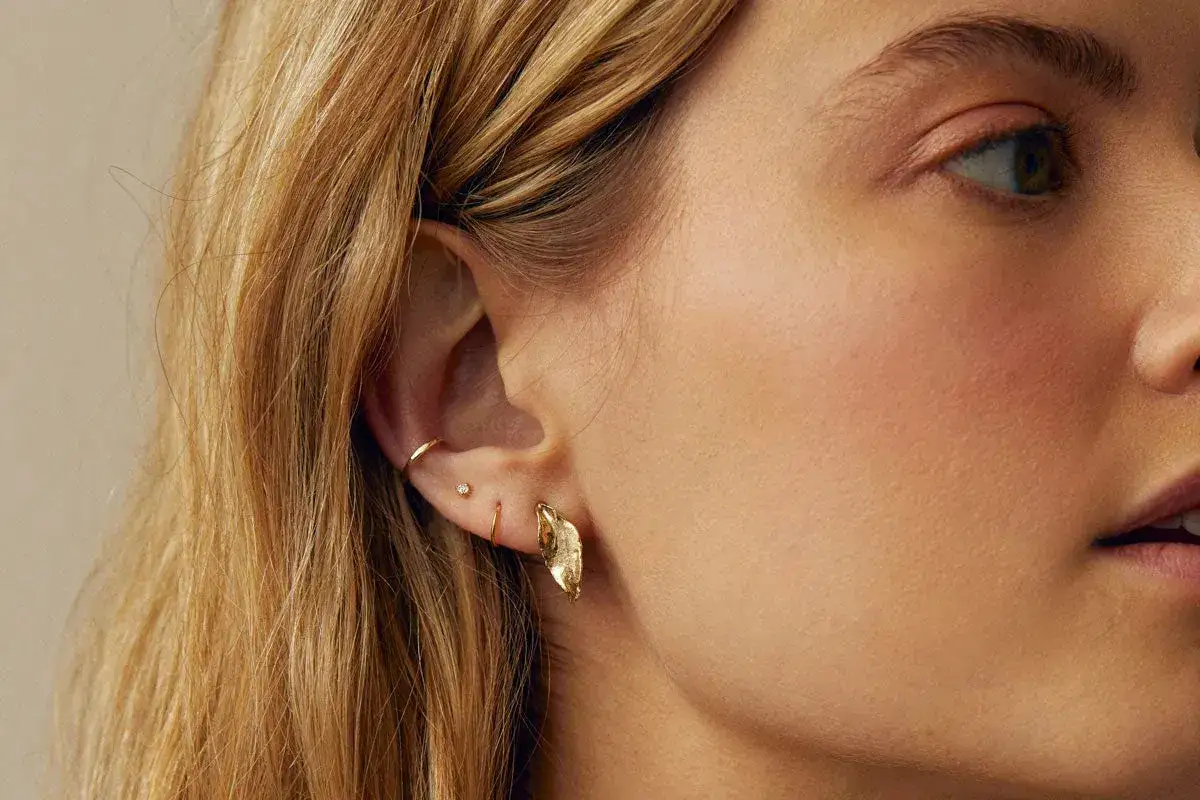
Five ear stack formulas that always look balanced
I prefer formulas over random pairings because they are easier to repeat, easier to adapt to your own piercings, and less likely to fail when you change outfits or hair length. If you want a reliable starting point, these five layouts work without looking overdone.
| Stack idea | Pieces | Why it works | Best for |
|---|---|---|---|
| Soft minimal | Tiny stud, slim huggie, polished cuff | Clean lines and very little visual noise | Everyday wear, office dressing, short hair |
| Modern gold mix | Bezel stud, rounded hoop, mini pavé huggie | Repeats warm metal while adding texture | Gold lovers who want polish without stiffness |
| Soft romantic | Pearl stud, small hoop, dainty drop | Gentle movement and a softer silhouette | Knitwear, dresses, and dressier evenings |
| Polished contrast | Geometric stud, oval huggie, smooth cuff | Sharp and round shapes keep each other in check | People who like a slightly editorial feel |
| Asymmetrical statement | One small hoop, one sculptural stud, one micro sparkle | Feels current because it is not perfectly matched | When you want one ear to do more than the other |
If you want the safest route, pick one of these formulas and wear it for a week before changing anything. That gives you a feel for how the stack sits, how it photographs, and whether it clashes with your wardrobe. Once the base works, you can make it more personal without losing the balance.
I usually recommend choosing the formula first and the individual earrings second. It is much easier to shop or edit with a structure in mind than to rescue a pile of beautiful pieces that do not speak to one another.
How to match a stack to your piercing layout
Your ear anatomy matters more than most people expect. A stack that looks perfect on a flat, evenly spaced lobe can look crowded on a smaller ear or feel unbalanced if the piercings sit close together. When I style a stack, I start with what is already there and build around it, not against it.
| Your layout | What usually works best | Why |
|---|---|---|
| One lobe piercing | Stud with an ear cuff or climber | Creates the layered effect without needing extra holes |
| Two lobe piercings | Small hoop or huggie below, stud above | Simple gradient that looks polished fast |
| Three lobe piercings | Largest piece at the bottom, medium in the middle, smallest at the top | Classic taper that keeps the eye moving upward |
| Lobe plus cartilage | Heavier visual weight on the lobe, slimmer pieces above | Prevents the ear from feeling top-heavy |
| Dense cartilage setup | Repeat tiny shapes and keep the metal tone consistent | Looks curated instead of cluttered |
If you only have one or two piercings, do not try to fake a full stack with oversized pieces. A single cuff, a neat huggie, or one well-placed stud can create more style than three earrings that fight for attention. The shape of the ear should lead the styling, not the other way around.
Once the layout is right, the next job is choosing materials and shapes that belong together.
Metals, stones, and shapes that play well together
You do not need everything to match, but you do need something to repeat. That repeated element can be metal colour, stone family, finish, or shape. If I am mixing gold and silver, I usually repeat one of them at least twice and keep the third piece visually quieter so the stack still feels deliberate.
- Round with round gives a soft, classic result.
- Round with geometric feels sharper and more editorial.
- Matte with polished adds depth without adding colour.
- Pearl with diamond reads elegant, but it works best when one piece stays small.
- Textured with smooth keeps a stack from disappearing in flat light, which matters in the UK where grey daylight can mute details.
In 2026, I am seeing more people move toward mixed textures and subtle asymmetry rather than perfect symmetry. That does not mean every ear has to look experimental. It simply means a stack can feel fresher when it has one unexpected element, such as a beaded huggie beside a plain stud or a sculptural hoop beside a tiny stone.
If the pairings are visually interesting but still calm, you are close to the sweet spot.
Comfort and daily wear are part of the design
A stack that needs constant adjusting is not a good stack, no matter how nice it looks in a photo. Comfort matters especially if you wear glasses, headphones, scarves, or chunky knitwear, because all of those can catch on earrings and make the arrangement annoying to live with. I would always rather see a slightly simpler stack that gets worn than an ambitious one that stays in a jewellery box.
- Flat-back studs are ideal for sleeping, travel, and healed cartilage piercings.
- Small huggies are useful for daily wear, but the hinge or clasp should feel secure.
- Ear cuffs are helpful when you want the stacked effect without extra piercings, though they can slip if they are too loose.
- Drop earrings work best as the statement layer, not as the base of the stack.
- Large hoops need quieter companions, otherwise the whole ear starts to feel heavy.
If a piercing is still healing, keep the styling simple and follow proper aftercare rather than forcing a look. That is the point where restraint matters more than creativity. Once everything is fully settled, you can bring in bolder shapes without irritating the ear.
Practical comfort is what lets the style last through a normal day, and that leads straight into the mistakes that most often undo an otherwise good arrangement.
The mistakes that make stacks look crowded
Most weak stacks fail for the same few reasons. The issue is rarely the jewellery itself; it is usually proportion, spacing, or the refusal to edit. I see people add more because something feels off, when the real fix is often to remove one piece and let the remaining earrings breathe.
- Using three earrings with the same visual weight.
- Placing multiple statement pieces on the same ear.
- Ignoring negative space, which makes the stack look dense.
- Mixing finishes and metals without repeating any one element.
- Choosing earrings that snag on hair, collars, or headphones.
- Forcing symmetry when the ear shape clearly wants a looser arrangement.
My rule is simple: if you have to keep touching the stack, it is too much. The best versions are the ones that stay put, frame the face, and still look good when you are not thinking about them. That is usually a sign the proportions are right.
When the stack looks clean and feels easy, you can start refining it rather than constantly fixing it.
Small choices that make the whole look feel finished
The quickest way to refresh a stack is to change one variable at a time. Swap a hoop for a huggie, a plain stud for a pearl, or one polished piece for a textured one. That keeps the ear recognisably yours while still making the styling feel current, and it is a smarter approach than rebuilding everything from scratch.
My own rule is that if I can describe the stack in one sentence, it usually works. Start with a clear anchor, repeat one visual thread, and stop before the ear feels overloaded. A stack that survives a commute, a jumper, and a late dinner is the one worth wearing, because that is where style becomes usable instead of just decorative.