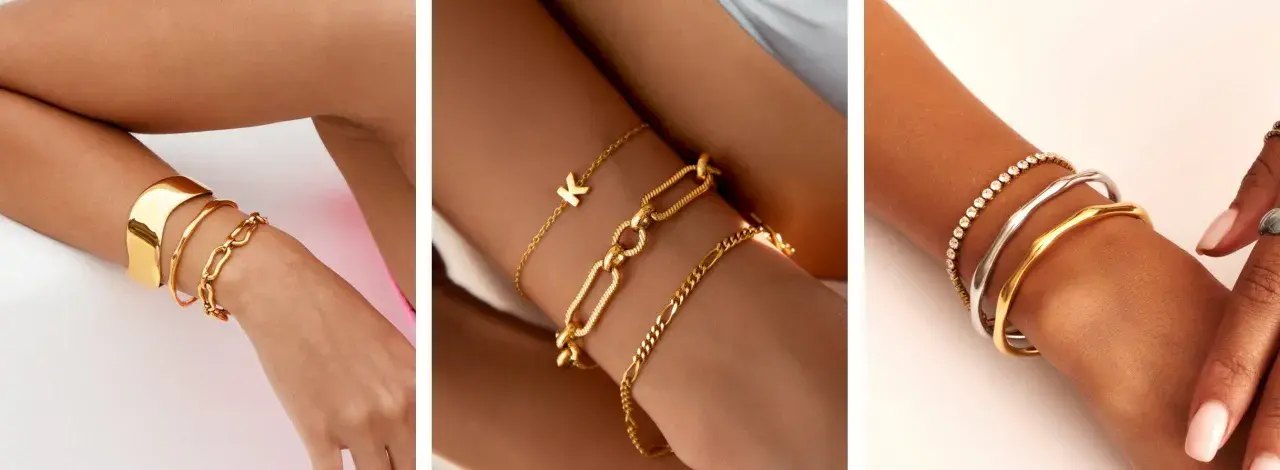
The stacking bracelets trend is less about piling on everything you own and more about editing the wrist like an outfit. Layering bracelets is hardly new; bangles, charm bracelets, and watch stacks have been around for decades. What feels different in 2026 is the balance: the mix is less about matching sets and more about deliberate contrast. Here I’ll break down how to build a stack that feels current, what to buy first, where the look can go wrong, and how to keep it wearable in everyday life.
What matters most before you start stacking
- Use one anchor piece, then build around it with 2-4 supporting bracelets.
- Keep some contrast in shape, finish, or weight so the stack looks deliberate.
- Mixed metals work best when you repeat each tone at least twice or bridge them with one two-tone piece.
- For comfort, the stack should move slightly but not spin freely on the wrist.
- Simple stacks usually look better with clean sleeves, while chunkier stacks work best when the outfit stays pared back.
- If you wear bracelets daily, choose materials that can handle water, friction, and storage properly.
Why bracelet stacks feel current in 2026
The reason this look has stuck is simple: it solves a styling problem. Jewellery in 2026 is more expressive again, with more colour, texture, and mixed finishes than the stripped-back minimalism that dominated the last few years. A bracelet stack gives an outfit a finished point of focus without demanding a full wardrobe change.
What I like about it is the range. You can go quiet with a slim chain and one bangle, or lean into a more playful wrist with beads, resin, charms, and a cuff. The same idea works for denim, tailoring, eveningwear, and even simple knitwear, which is why it reads as practical rather than gimmicky.
That flexibility is also why the trend is more than a passing styling trick. Once you understand the basic structure, the next question is how to build a stack that looks intentional rather than accidental.
How to build a bracelet stack that looks intentional
I usually start with one anchor piece and treat everything else as support. A watch, a cuff, a structured bangle, or a bracelet with a bit of visual weight can lead the stack. Then I add smaller pieces that echo one feature of the anchor instead of competing with it.
One useful distinction: a bangle is a rigid bracelet that slips over the hand, while a cuff usually has an opening and gives the stack a more architectural shape. That difference matters because it changes how the rest of the jewellery should sit around it.
Three to five bracelets is the sweet spot for most wrists. Two can look underdone unless one piece is very strong; six or more can work, but only when the bracelets are thin enough to leave some skin visible between them. That visible skin is the negative space, and it is what keeps the stack from turning into a single crowded band.
| Bracelet type | Best role in a stack | Why it works | Watch out for |
|---|---|---|---|
| Thin chain | Base layer | Adds movement without bulk | Can disappear if every other piece is heavy |
| Bangle | Structure | Gives the stack a clear outline | Too many wide bangles can feel noisy |
| Cuff | Anchor piece | Creates a focal point fast | Needs space, or it starts to look cramped |
| Beaded strand | Texture and colour | Makes the stack feel more relaxed and personal | Can tip into costume territory if the colours clash |
| Charm bracelet | Character piece | Brings narrative and movement | Best used sparingly when other pieces are already decorative |
If you want the stack to feel balanced, check the fit before the styling. You should still be able to slide one finger between the bracelets and your wrist. Too tight looks stiff; too loose makes the stack drift around and lose shape. Once that foundation is right, the combinations themselves become much easier to judge.
Bracelet combinations that work across outfits
The easiest stacks are the ones that solve a clothing problem. A T-shirt and jeans need a different level of polish from a silk shirt, and a knit sleeve changes the proportions again. I prefer to think in outfit formulas rather than in individual products, because that makes the look more repeatable.
- For everyday polish, pair one slim chain, one plain bangle, and one small textured bracelet. It is the safest formula and it works with officewear, denim, and simple dresses.
- For a relaxed weekend look, use beaded or resin pieces with one metal bangle. The softer materials add colour and stop the stack from feeling too serious.
- For evening, choose one sculptural cuff and keep the rest minimal. That gives the wrist one clear point of interest instead of a cluster of competing shapes.
- For warm-weather dressing, stack lighter pieces that move easily and keep the colour story tight. Bare arms can take more contrast, but a full rainbow usually works best when one shade is repeated.
- For sleeves and tailoring, a single cuff or a slim stack at the wrist often looks sharper than several loose bangles. You want the jewellery to frame the sleeve, not fight it.
If you wear a watch, treat it as part of the formula rather than an afterthought. A watch can anchor the whole stack and make mixed pieces feel more deliberate, especially when the rest of the jewellery is casual. From there, the next layer of judgement is less about outfit type and more about how you mix metals and textures.
How to mix metals, stones, and textures without visual noise
Mixed metals are no longer a mistake to correct; they are one of the most useful ways to make bracelet layering feel current. The trick is not to mix everything at once. Instead, choose one dominant metal and one accent metal, then repeat each tone so the combination looks planned. A rough 70/30 split works well when you are unsure.
I also like to separate metals by texture. A polished gold bangle reads differently from a brushed silver cuff, even if the colour difference is small. That gives you more room to combine pieces without needing every bracelet to look identical.
Use one bridge piece when the stack feels disconnected
A two-tone bracelet, a watch with mixed details, or a clasp that picks up both metals can make the whole stack feel connected. This is especially helpful if you wear gold most days but want to bring in silver without starting over.
Repeat one material to make the stack feel curated
If you add beads, repeat them somewhere else in the stack. If you add pearls, let them appear in more than one bracelet or keep the rest of the stack very restrained. Repetition is what turns a random collection into a style choice.
Read Also: Tennis Necklace Guide - Choose, Style & Wear with Confidence
Let one unexpected texture do the work
Wood, cord, resin, and glossy beads are popular because they loosen the look and stop it from feeling too precious. I would choose one of those textures as the playful element, then let the metal pieces do the heavier lifting. That balance keeps the stack wearable, which is usually what separates a good wrist stack from a costume piece.
Even a well-chosen mix can look wrong if the proportions are off, and that is where most bracelet stacks lose their shape. The good news is that the mistakes are predictable, so they are easy to avoid once you know what to look for.
The mistakes that make a stack look crowded
The biggest issue is usually not the bracelets themselves; it is the lack of editing. Too many people keep adding pieces until the wrist becomes a pile-up. If a stack looks heavy, it is often because every bracelet is trying to be the main character.
- Using too many wide pieces makes the wrist look boxed in. Balance one chunky element with thinner bracelets around it.
- Matching everything too exactly can flatten the look. A stack needs a little tension to feel styled.
- Ignoring sleeve length is a common miss. Long sleeves can swallow delicate pieces, while short sleeves can expose too much metal if the stack is oversized.
- Letting every piece clatter can make the stack feel clumsy. If you want movement, keep one or two louder bracelets and quiet the rest.
- Mixing too many colours at once can work, but only when there is a clear repeating shade. Without that repetition, the eye has nowhere to rest.
My own rule is simple: if I remove one bracelet and the whole stack gets better, the stack was too busy. That kind of editing matters even more if you plan to wear the look in everyday British weather, where sleeves, coats, and unexpected rain all change the equation.
Choosing pieces for British weather and daily wear
In the UK, jewellery often has to work across more layers and more temperature shifts than you might expect. A stack that looks perfect with a sleeveless top in the morning may need to sit comfortably under a cardigan, blazer, or coat by afternoon. That is one reason I lean toward bracelets with a bit of structure: they survive real life better than ultra-fragile pieces.For everyday wear, solid silver, gold, well-made plated pieces, and stainless steel all have their place. The practical difference is durability. Solid precious metals cost more, but they usually tolerate regular wear better. Fashion pieces are perfectly valid too, but they need more careful rotation and storage if you want them to last.
- Remove bracelets before showering, swimming, gym sessions, or heavy cleaning.
- Wipe them after wear, especially if they touched perfume, hand cream, or rain.
- Store each piece separately or in a soft pouch so chains do not scratch bangles.
- Keep plated bracelets for rotation rather than constant daily wear if you want to preserve the finish.
If you are styling for the long term, think less about one perfect stack and more about a small bracelet wardrobe. That brings me to the version of the look I would actually build from scratch.
What I would buy first if I were starting from scratch
If I were building a bracelet collection for this look, I would start with four pieces: one slim chain, one plain bangle, one textured or beaded bracelet, and one cuff or watch. That gives you enough range to create several different stacks without buying duplicates of the same idea. It is also the easiest way to test whether you prefer polished, bohemian, graphic, or mixed-metal styling.
As a rough budgeting guide, a starter stack on the UK high street can often be built for about £30 to £80 if you choose fashion pieces, while better-made plated or sterling silver versions usually move you into the £100 to £250 range. If you want solid precious metals, the budget will rise quickly, so I would only go there once you know which shapes you actually wear.
The look works because it leaves room for personality without asking for perfection. A bracelet stack does not need to be loud to feel current, but it does need a point of view. Start with one piece you love, add contrast carefully, and stop before the wrist loses its shape; that is usually where the look stops being trendy and starts looking like your own.