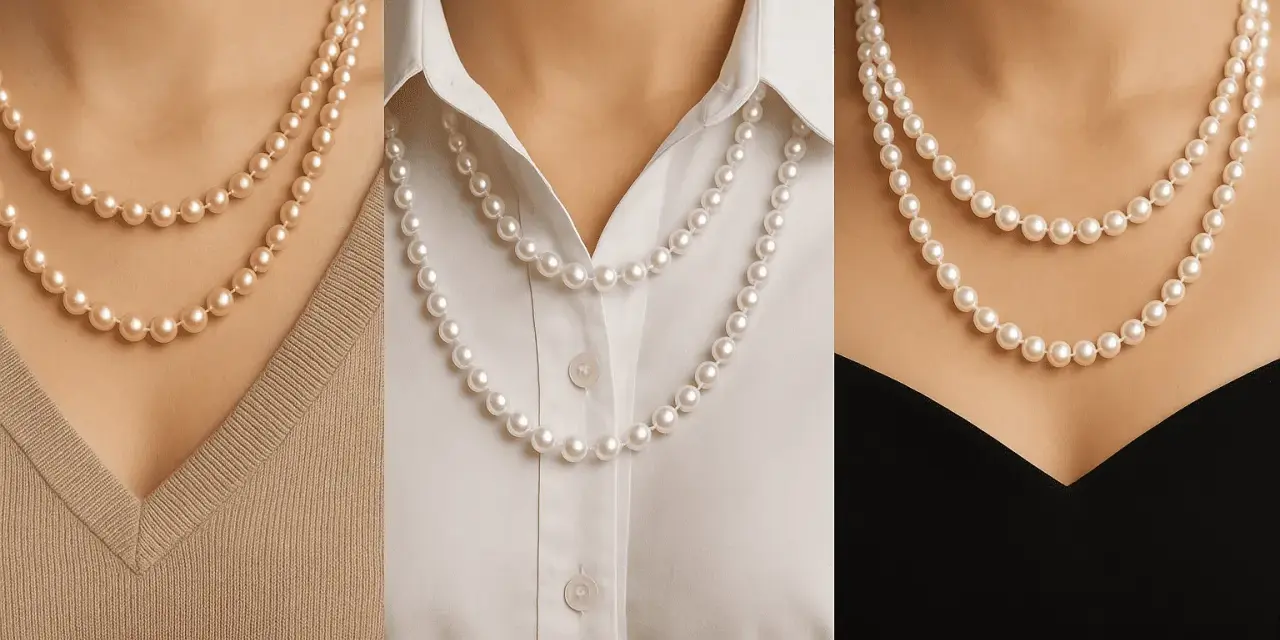
Pearl necklaces sit in a rare space: they can look formal, feel timeless, and still work in a modern wardrobe without much effort. In this guide, I break down what a pearl necklace actually is, how the main styles differ, what makes one strand better than another, and how to wear and care for it so the piece keeps its value and character.
The practical points that matter most
- A pearl necklace is a strand of pearls, usually strung on silk or a similar thread, and often finished with knots between each pearl.
- Most pearl necklaces sold today use cultured pearls, which are real pearls grown with human assistance, not imitation beads.
- Length changes the mood more than most people expect: a shorter strand feels sharper, while a longer one feels softer and more relaxed.
- Lustre, surface quality, matching, and nacre matter more than size alone when you want a refined-looking strand.
- Keep pearls away from perfume, hairspray, and hard knocks, and have regularly worn strands checked and restrung when needed.
What a pearl necklace really is
A pearl necklace is, at its simplest, a piece of jewellery made from pearls strung together into a wearable strand. The construction can be as plain as a single line of matched pearls or as elaborate as several strands, a graduated design, or a statement piece with mixed materials. What gives it presence is not only the pearls themselves, but the way the strand sits against the neckline and how the pearls are finished.
I usually separate three ideas that people often blur together: real pearls, cultured pearls, and imitation pearls. Cultured pearls are real pearls formed inside a mollusc with human assistance, so they are not fake just because they were farmed. Imitation pearls, by contrast, are made from glass, shell, plastic, or coated beads, and they may look convincing from a distance, but they do not have the same weight, lustre, or feel. That difference matters if you care about longevity, value, or the quiet depth that makes pearls look alive rather than merely shiny.
Once you understand the basic construction, the next question is why some pearl necklaces read as classic while others feel more fashion-led.
The pearl types that change the look
The pearl type has a bigger effect on style than many buyers expect. Some strands look crisp and traditional; others feel soft, organic, or dramatic. In practice, I think of pearl type as the personality of the necklace.
| Pearl type | Typical look | Style impression | Best suited to |
|---|---|---|---|
| Freshwater | Wide range of shapes, colours, and sizes | Versatile, relaxed, accessible | Everyday wear, layering, modern casual looks |
| Akoya | Usually round with sharp lustre | Classic, polished, formal | Traditional strands, office wear, occasion dressing |
| Tahitian | Grey, green, peacock, and black tones | Bold, moody, contemporary | Statement pieces and darker wardrobes |
| South Sea | Larger pearls with a soft, luxurious glow | Elegant, substantial, refined | Investment pieces and special occasions |
Baroque pearls deserve a mention too. They are not a separate species, but an irregular shape style, and that irregularity is the point. I like them when the goal is character rather than symmetry, because they soften the formality that people often associate with pearls. If you want a strand that feels less prim and more editorial, baroque pearls are usually the quickest way there.
From there, the length of the strand does just as much work as the pearl type itself.
The strand lengths that matter most
Length changes how a pearl necklace reads on the body. A shorter strand draws attention to the face and collarbone, while a longer strand can lengthen the silhouette and feel more relaxed. In other words, the same pearls can look formal, modern, or bohemian depending on where they land.
| Length | Approximate drop | Visual effect | When I would choose it |
|---|---|---|---|
| Choker | 35-41 cm | Close, sharp, structured | Open necklines, evening wear, tailored outfits |
| Princess | 43-48 cm | Balanced and versatile | The easiest first strand for most wardrobes |
| Matinee | 51-61 cm | More relaxed and elongated | Workwear, knitwear, polished day looks |
| Opera | 71-86 cm | Elegant with extra movement | Layered styling or formal outfits that need drama |
| Rope | 91 cm and longer | Highly flexible and statement-led | Wrapping, doubling, or building a stronger fashion look |
There are also design variations that shift the mood without changing the basic idea of the necklace. A graduated strand uses larger pearls toward the centre, which gives it a more ceremonial feel. A multi-strand necklace creates volume and reads more formal. A pearl pendant, by contrast, feels lighter and more contemporary because it uses one pearl as an accent rather than building the whole piece around repetition. Once you start reading lengths this way, buying becomes much less guesswork and much more about proportion.
That leads to the question I care about most when evaluating a strand: what actually makes one necklace better than another?
How I judge quality before buying
When I look at pearls, I do not start with size. I start with lustre. Good lustre means the surface reflects light cleanly and seems to glow from within; poor lustre looks chalky or flat. After that, I look at the skin of the pearl, the way the strand is matched, and whether the shape suits the intended style. GIA, for example, commonly assesses pearls by size, shape, colour, lustre, surface quality, nacre quality, and matching, and that framework is still a sensible one for everyday buyers.
| Quality factor | What it means | What to look for |
|---|---|---|
| Lustre | How sharply the pearl reflects light | Bright, mirror-like shine with depth rather than glare |
| Surface quality | How clean the outer skin looks | Few visible pits, scratches, or dull patches |
| Nacre quality | The thickness and beauty of the layered coating | Even coverage and a healthy, luminous finish |
| Matching | How well the pearls work together in one strand | Consistent tone, shape, and size across the necklace |
| Shape | The form of each pearl | Round for classic formality, baroque for character |
| Colour | The body colour and overtone | A tone that flatters the skin and suits the wardrobe |
If I had to simplify the buying decision, I would say this: better lustre usually beats bigger size. A slightly smaller strand with rich lustre and good matching often looks far more expensive than an oversized strand with dull surfaces or obvious mismatch. That is why two necklaces at the same price can feel completely different on the neck. The eye notices coherence before it notices dimensions.
Once quality is clearer, styling becomes easier, because the strand no longer feels like a costume piece but a deliberate part of the outfit.
How to wear pearls without making them feel dated
Pearls look modern when the contrast is right. I like them with crisp shirts, sharp tailoring, plain knitwear, and simple evening dresses, because those settings let the strand do the talking without turning the whole outfit into a vintage reference. A short, neat strand can feel polished and architectural; a longer one can soften a minimalist look; a baroque strand can make a plain outfit look considered rather than plain.
- Use a princess-length strand with a shirt or blazer when you want polish without stiffness.
- Choose a choker for open necklines or dresses that need a clear focal point.
- Wear longer strands over knitwear if you want a softer, more relaxed silhouette.
- Keep the rest of the jewellery simpler when the pearls are already large, dark, or highly lustrous.
- Mix pearls with modern textures such as denim, wool, or leather if you want to avoid a too-traditional look.
I think the biggest styling mistake is treating pearls as if they only belong to formalwear. They can absolutely be formal, but they become more interesting when the outfit around them has a little tension. That same logic also affects care, because the better you treat the strand, the more flexible your styling options stay.
Keeping pearls bright for years
Pearls are softer and more vulnerable than most gemstones, so care is not optional if you want the necklace to last. Tiffany recommends keeping pearl jewellery away from perfume, cosmetics, perspiration, and dirt, and that advice is sensible because pearls can dull or mark more easily than harder stones. I always tell people to put pearls on last and take them off first, so they avoid direct contact with sprays, creams, and makeup.
- Wipe the strand gently with a soft cloth after wearing it.
- Store it flat or gently laid out, not crushed with harder jewellery.
- Keep each strand separate so the pearls do not rub against metal or sharp edges.
- Avoid ultrasonic and steam cleaners, which can damage the surface and the thread.
- Have a regularly worn strand checked and restrung when the silk begins to stretch or look tired.
The thread matters more than many owners realise. On a well-made necklace, knots between the pearls reduce friction and help stop the whole strand from failing at once if the thread breaks. That is one reason a properly strung pearl necklace can last for decades, while a neglected one can fail surprisingly quickly. The final question, then, is which kind of strand is the smartest first buy.
The strand I would choose first for most wardrobes
If I were recommending one pearl necklace for the widest range of wardrobes, I would usually start with a princess-length strand in good lustre and a clean, balanced colour. It is the most forgiving length because it works with both simple tops and dressier clothes, and it is formal enough to feel special without becoming hard to wear. For most people, that balance matters more than chasing the biggest pearls or the most dramatic colour.
From there, the choice becomes personal. If you want classic elegance, go for round, well-matched pearls. If you want something more modern, look at baroque shapes or mixed-length designs. If you want a piece that can move from daytime to evening with minimal effort, choose a strand with strong lustre, thoughtful sizing, and a clasp that feels secure rather than decorative for its own sake. That is the version of pearls I trust most: not precious because they are difficult, but because they are well chosen, well made, and easy to live with.