Dangling earrings do one thing better than almost any other style: they add movement. When I group the types of dangling earrings, I look first at how they move, then at length, weight, and how much visual space they take up near the face. This guide breaks down the main styles, what makes each one different, and how to choose a pair that feels polished rather than fussy.
The essentials at a glance
- The real difference between a drop and a dangle is movement: a true dangle swings freely below the earlobe.
- The most useful style categories are drop, chandelier, threader, tassel, hoop-dangle, and linear designs.
- Comfort depends on more than looks; length, clasp type, and weight all change how the earrings wear.
- For most wardrobes, one refined everyday pair and one statement pair cover more ground than a drawer full of near-duplicates.
- Care matters because tangles, tarnish, and bent hooks can make even a beautiful design sit badly.
What makes a dangling earring different
The simplest way to think about it is this: a dangling earring hangs below the earlobe and has some visible movement. That movement might be subtle, like a small teardrop that shifts when you turn your head, or obvious, like layered strands that sway with every step. In practice, many brands use drop and dangle loosely, so I pay more attention to the structure than to the product label.
A drop earring usually falls below the lobe but stays relatively controlled, while a dangle has more freedom to move. A chandelier pushes the idea further by using branches, tiers, or openwork shapes that create drama without necessarily becoming heavy. Once that distinction is clear, the rest of the style categories become much easier to read.
The main styles you will see most often
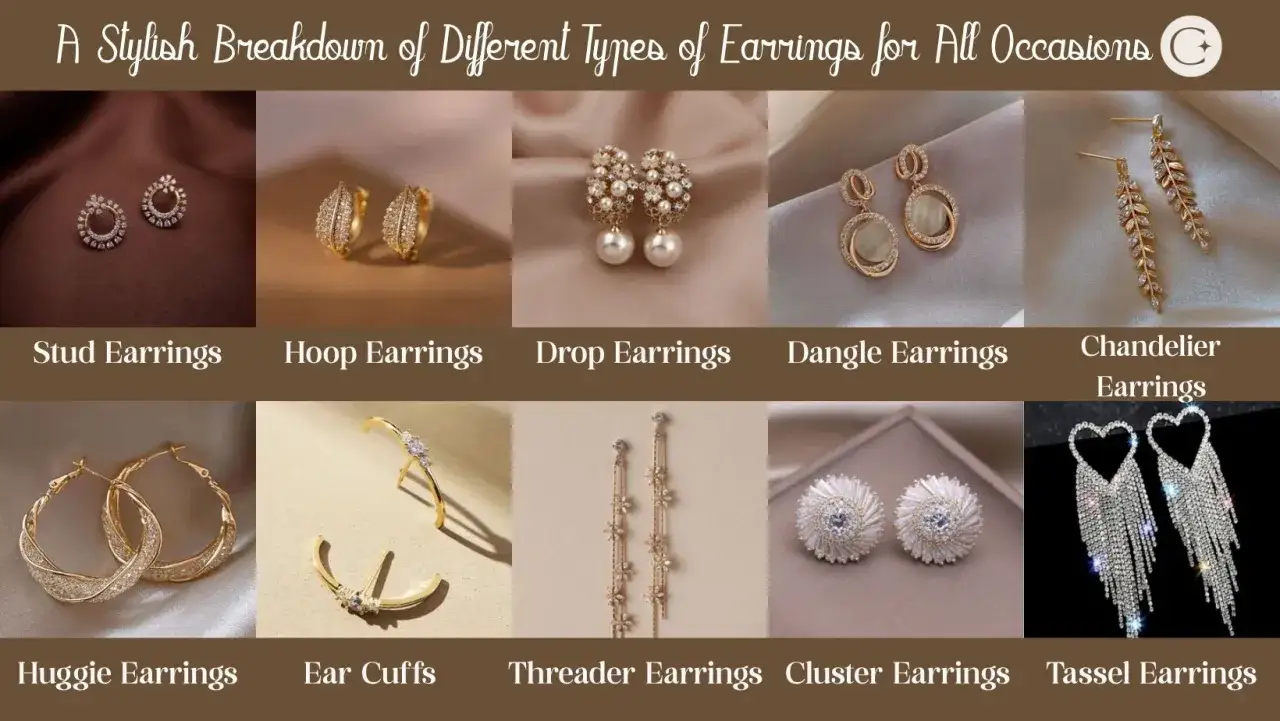
If you want a practical way to sort the category, I would group it by silhouette. That is usually more useful than the marketing names attached to a product page, and it gives you a better sense of how the earrings will look once they are on the ear.
| Style | What it looks like | Best for | What to watch for |
|---|---|---|---|
| Drop earrings | A single element hangs below the lobe, often on a hook or post. | Everyday wear, office outfits, understated evening looks. | They can feel too plain if the design is very small or very flat. |
| Chandelier earrings | Layered, branching, or tiered shapes that fan out below the ear. | Weddings, formal events, and strong statement dressing. | Scale matters; oversized chandeliers can dominate a face quickly. |
| Threader earrings | A fine chain, bar, or wire threads through the piercing and hangs on both sides. | Minimal, modern looks and lighter everyday styling. | They need careful storage because chains knot easily. |
| Tassel earrings | Strands, fringes, or chains create a fluid, swinging finish. | Boho outfits, summer dressing, parties, and creative styling. | They can fray, snag, or look messy if the fibres are low quality. |
| Hoop-dangles | A hoop carries a charm, drop, or suspended detail. | Casual to smart-casual wardrobes and easy day-to-night wear. | The charm size needs to match the hoop, or the balance looks off. |
| Linear earrings | Vertical bars, chains, or sleek geometric lines. | Tailored outfits, modern minimalism, and elongating the face. | Very thin lines can disappear against patterned clothing or dark hair. |
| Teardrop earrings | A rounded drop shaped like a teardrop or stone pendant. | Classic dressing, gifts, and a safe first statement pair. | Proportion is everything; a tiny teardrop can look timid, a huge one can overpower. |
The most important thing in that table is not the name of each style, but the way it behaves on the ear. A piece with more movement reads as livelier and often feels more dramatic, even if the materials are simple. A more rigid drop, by contrast, can look elegant without trying very hard.
Which shapes and occasions each style suits best
I rarely recommend earrings by style alone. Face shape, hairstyle, neckline, and the actual setting all change the result, and that is where the decision becomes more personal.
Face shape first
| Face shape | Usually flattering choices | Why they work |
|---|---|---|
| Oval | Almost everything, especially teardrops, threads, and chandeliers. | The proportions are balanced, so you can play with scale. |
| Round | Linear drops, longer teardrops, and narrow chandeliers. | Vertical movement adds length without adding more width. |
| Square | Curved drops, soft teardrops, and rounded hoops with movement. | Rounded outlines soften stronger jaw angles. |
| Heart-shaped | Styles that widen slightly near the jawline, such as medium chandeliers. | They balance a narrower chin and draw the eye downward gently. |
| Long or narrow | Shorter drops, clusters, and wider silhouettes. | These create horizontal interest instead of adding more length. |
Read Also: Necklace Length Guide - Find Your Perfect Fit & Style
Then match the occasion
- For work or daytime meetings, I would reach for slim drops, small teardrops, or lightweight hoop-dangles.
- For weddings or evening events, chandeliers, pearl drops, and gemstone pairs usually feel more complete.
- For weekend dressing, threaders and tassels add movement without looking overly formal.
- If your outfit already has a busy print or strong texture, simpler earrings usually look smarter than a competing statement piece.
- If your neckline is plain, earrings can carry more of the visual work without making the outfit feel crowded.
Hair matters too. An updo or slicked-back style shows off movement and length, while loose hair often hides smaller pieces. That is why I think about the whole frame around the face, not just the earring in isolation. Once you start doing that, the differences between styles become much easier to use in real life.
Why length, weight and metal choice change the experience
Two pairs can look similar on a tray and feel completely different on the ear. Length changes where the eye lands, weight changes how comfortable the pair feels after an hour, and the metal or finish changes whether the piece looks crisp or tired.
As a practical guide, I would think of these length bands:
- 20 to 35 mm below the lobe: subtle, restrained, and suitable for everyday wear.
- 35 to 60 mm: the sweet spot for many wardrobes, because it gives movement without feeling too loud.
- 60 to 90 mm: clearly statement territory, especially on smaller faces or with simple clothing.
- 90 mm and above: dramatic, fashion-forward, and best when the outfit is kept clean.
Weight deserves just as much attention. For daily wear, I try to keep earrings light enough that you forget them after a few minutes. Roughly speaking, pairs in the low-gram range per earring are often more comfortable for long days, while heavier designs can start to pull or twist. The exact comfort limit varies by person, but if an earring feels noticeable in the first ten minutes, it usually becomes more annoying later.
Material choice also affects longevity and value. Fashion earrings can look excellent for occasional wear, but if you want a piece to last, I prefer solid precious metals, hallmarked silver or gold, or at least well-made vermeil rather than thin plating. In the UK, hallmarking is worth checking for precious-metal purchases because it gives you a clearer idea of what you are actually buying. Price tends to follow construction more than style: fashion pieces often start around £10-£40, sterling silver commonly sits around £30-£120, and fine gold or gemstone versions move upward from there.
Clasp design matters more than people expect. Hooks feel airy but can swing more freely, leverbacks are usually more secure, and threaders depend on balance and friction to sit properly. If the clasp is weak, the whole silhouette starts to look careless, even when the design itself is attractive. That is the sort of detail people notice without always knowing why.
How to style movement without visual clutter
When I style earrings, I think in terms of visual weight. The goal is not to make the earrings the loudest thing in the room; it is to let them finish the outfit cleanly. That is why the best pair is often the one that complements the neckline instead of fighting it.
- With a crew neck or roll neck, choose slimmer linear drops or small chandeliers to create a vertical line.
- With a V-neck or wrap dress, teardrops and elongated drops echo the shape of the neckline nicely.
- With an off-shoulder or strapless outfit, you can go bolder because the open space around the neck gives the earrings room.
- With patterned fabric, I usually keep the earrings simple so the look stays intentional rather than busy.
- With tailored jackets or sharp blazers, geometric drops and polished metals often look cleaner than soft, highly ornate pieces.
Texture also changes the effect. Matte metals feel calmer, polished surfaces read sharper, pearls soften the whole look, and faceted stones add more sparkle than shape. If your clothes are already textured, I would avoid earrings that add another competing layer unless you want the outfit to feel deliberately maximal. The best styling decisions are often the ones that remove friction rather than adding more decoration.
There is one rule I use more than any other: match the earring’s energy to the outfit’s energy. If the clothes are quiet, the earrings can speak a little louder. If the clothes already have a voice, let the earrings finish the sentence rather than start a new one.
The three pairs I would build around first
- A refined teardrop or drop pair in sterling silver, gold, or pearl, because it works with almost everything.
- A slim linear pair, since it handles office dressing, dinners, and modern tailoring with very little effort.
- One stronger statement pair, such as a chandelier or tassel design, for events where you want the jewellery to carry more of the look.
If you only buy one pair, make it the middle ground: long enough to move, light enough to wear for hours, and simple enough to work with both knitwear and evening pieces. That is the kind of earring that earns its place quickly and keeps proving useful. Build from there, and the rest of your collection becomes much easier to choose.