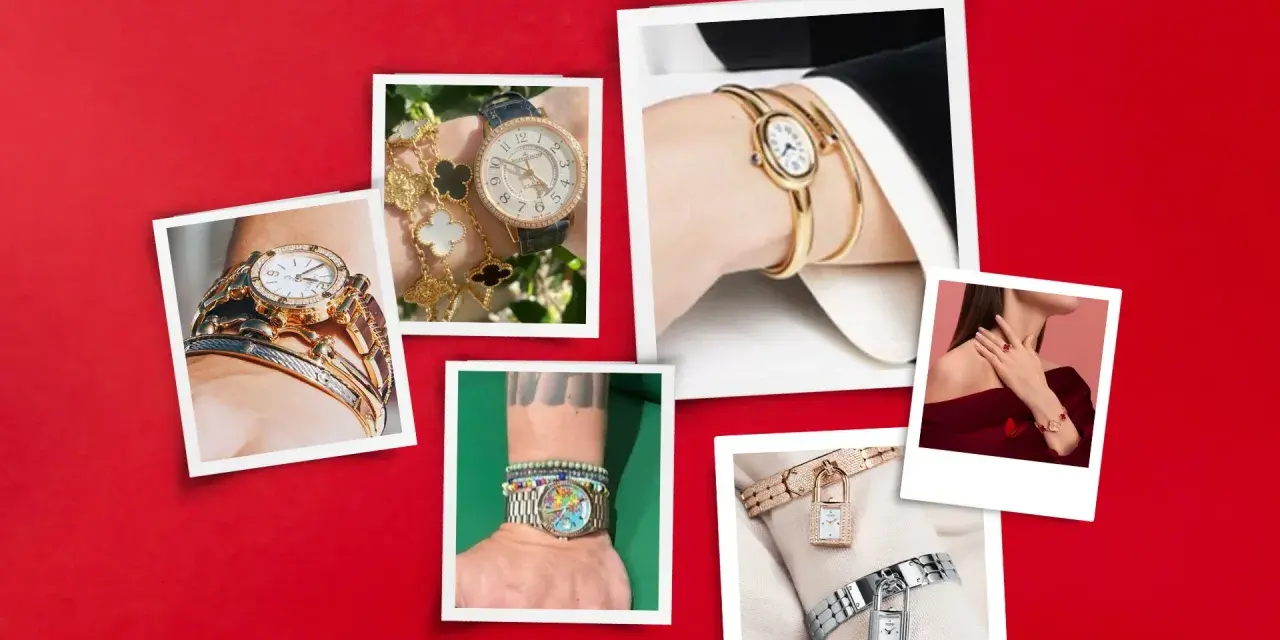
Layering jewellery around a watch works best when the wrist feels considered, not crowded. The right stack adds texture, movement, and personality, but it should still let the watch remain readable and comfortable through a full day. This guide walks through the order I use, the bracelet types that work with different watches, and the small decisions that make the whole look feel intentional.
The cleanest bracelet stack lets the watch stay readable and the wrist stays comfortable
- Start with the watch first, then add one to three bracelets that suit its size and finish.
- Keep the watch closest to the hand and place bracelets above it towards the elbow.
- Mix texture before colour; a smooth watch usually looks better beside a chain, bangle, or cord with a different surface.
- Use restraint with bulky pieces; oversized watches and heavy bracelets need more breathing room.
- For UK office wear, one slim bracelet is often enough to look polished rather than busy.
Start with the watch and decide what role it should play
The watch sets the tone for everything else. A clean dress watch with a leather strap asks for a different bracelet partner from a chunky sports watch, and a smartwatch usually looks better with something quieter and more modern. If the watch already has a lot going on, such as a large case, a textured bracelet, or a bright metal finish, I keep the rest of the stack simpler so the wrist does not become visually noisy.
My rule of thumb is simple: the more statement-making the watch is, the less decorative the bracelets should be. A minimalist watch can handle a little more jewellery around it, while an ornate watch usually needs support rather than competition. Mixing metals can work too, but I only do it when one tone clearly leads and the other acts as an accent. Once that base is clear, the physical stacking order becomes much easier to get right.
Build the stack in the right order
The most natural layout is to wear the watch closest to the hand and place the bracelets above it, towards the elbow. That keeps the watch easy to read and stops bracelets from constantly sliding over the case. It also creates a cleaner silhouette, especially when you are moving, typing, or taking off a coat.
- Put the watch on first and check the fit. It should stay in place without biting into the wrist.
- Add the thinnest bracelet next if you want a gradual transition from watch to jewellery.
- Test the stack by bending your wrist, lifting your bag, and typing for a minute. If pieces clang or dig in, the stack is too tight.
- Add a second bracelet only if the first one still leaves the wrist looking balanced.
- Stop before the stack starts to feel like a collection. The best version usually looks easy rather than engineered.
If you want a more restrained finish, split the pieces across both wrists instead of forcing everything onto one side. That still gives you a layered look, but it reads softer and is often better for conservative workplaces or formal dinners. After that, the next decision is which bracelet types actually belong beside the watch.
Choose bracelets that complement the watch instead of competing with it
Not every bracelet works with every watch, and the difference is usually about weight, finish, and movement. Fine chains add a little shine without taking over; slim bangles create structure; beaded bracelets bring a relaxed feel; and leather or cord pieces soften a metal-heavy watch. The point is not variety for its own sake. It is contrast that still feels coherent.
| Watch style | Bracelet choice that works | What it creates | What to avoid |
|---|---|---|---|
| Minimal steel or silver watch | Fine chain, slim bangle, single charm bracelet | Clean, polished, easy to wear every day | Very chunky cuffs that overpower the dial |
| Leather strap dress watch | One delicate chain or a small beaded bracelet | Soft contrast without looking crowded | Heavy metal pieces that fight the watch’s refinement |
| Chunky sports or diver-style watch | Narrow bangle or cord bracelet | Balances the scale and keeps the wrist lighter | Thick bracelets with sharp edges |
| Smartwatch | Matte bead, cord, or slim mixed-metal bracelet | Modern and casual without looking too formal | Overly ornate pieces that distract from the screen |
| Two-tone or gold watch | One bracelet that repeats one metal tone | Looks intentional rather than accidental | Too many competing finishes at once |
In practice, I usually prefer odd numbers because they feel less stiff than a perfectly matched pair. One bracelet can be enough, two is often the sweet spot, and three is usually the upper limit unless the pieces are very slim. Even then, comfort still matters more than the visual idea, which brings us to the part people skip at their own risk.
Keep the stack comfortable and protect the watch
A good wrist stack should survive a normal day without constant adjustment. If the bracelets slide into the watch case, scratch the bezel, or knock against the crown, the arrangement is wrong even if it looks good in a mirror. This is especially important with polished watches, vintage pieces, and any watch you wear regularly rather than occasionally.
- Watch the clasps. Boxy or sharp clasps catch more easily and can mark the case.
- Leave a little movement. A snug stack is better than a loose one that spins, but too tight will feel irritating fast.
- Think about noise. If the pieces clink loudly every time you move your arm, the stack probably has too much hard metal in it.
- Be careful on the crown side. I avoid bulky bracelets where they are most likely to press against the watch crown or buttons.
- Adjust for your day. A stack that works for dinner may be annoying for travel, commuting, or a day of typing.
For workouts, gardening, or anything rough on jewellery, I would remove the bracelets and often the watch too. The stack should serve the wearer, not force you to baby it all day. Once those limits are in place, it helps to see a few combinations that almost always look polished.
Simple combinations that always look polished
When people want a quick answer, I usually steer them towards combinations that are easy to repeat rather than highly experimental styling. These formulas are reliable because they respect proportion and keep the eye moving naturally down the wrist.
| Combination | Why it works | Best for |
|---|---|---|
| Steel watch + fine chain + slim bangle | Balanced, light, and polished without feeling overstyled | Everyday wear, office looks, dinners |
| Leather strap watch + one beaded bracelet | Softens the watch and adds texture without too much shine | Casual outfits, weekends, relaxed tailoring |
| Gold watch + one delicate gold bracelet | Creates a cohesive tone and keeps the wrist elegant | Formal events, date nights, minimal wardrobes |
| Smartwatch + matte cord bracelet | Feels modern and understated rather than flashy | Commuting, travel, everyday casual wear |
| Oversized watch + single narrow bracelet | Lets the watch stay dominant while the bracelet adds detail | Statement watches, chunky cases, bolder outfits |
If the result still feels slightly off, I usually remove one piece before adding another. That sounds obvious, but it is the fastest way to rescue a stack that has become too busy. The final polish is rarely about more accessories; it is about making the right one carry the look.
What I would try first if the stack still feels off
Start by changing scale, not style. If the watch is large, swap the bracelet for something thinner. If the watch is delicate, give it one slightly stronger partner so the wrist does not look top-heavy. If the metals clash, repeat one finish somewhere else in the outfit, such as in earrings, a ring, or a belt buckle, so the stack feels connected to the rest of the look.
I also check the stack in natural light, because that is where scratches, bulk, and colour mismatches show up most clearly. What looked balanced in a bathroom mirror can feel much more crowded near a window or in daylight. When the composition is right, the watch still reads as the focal point and the bracelets simply deepen the style instead of competing with it.