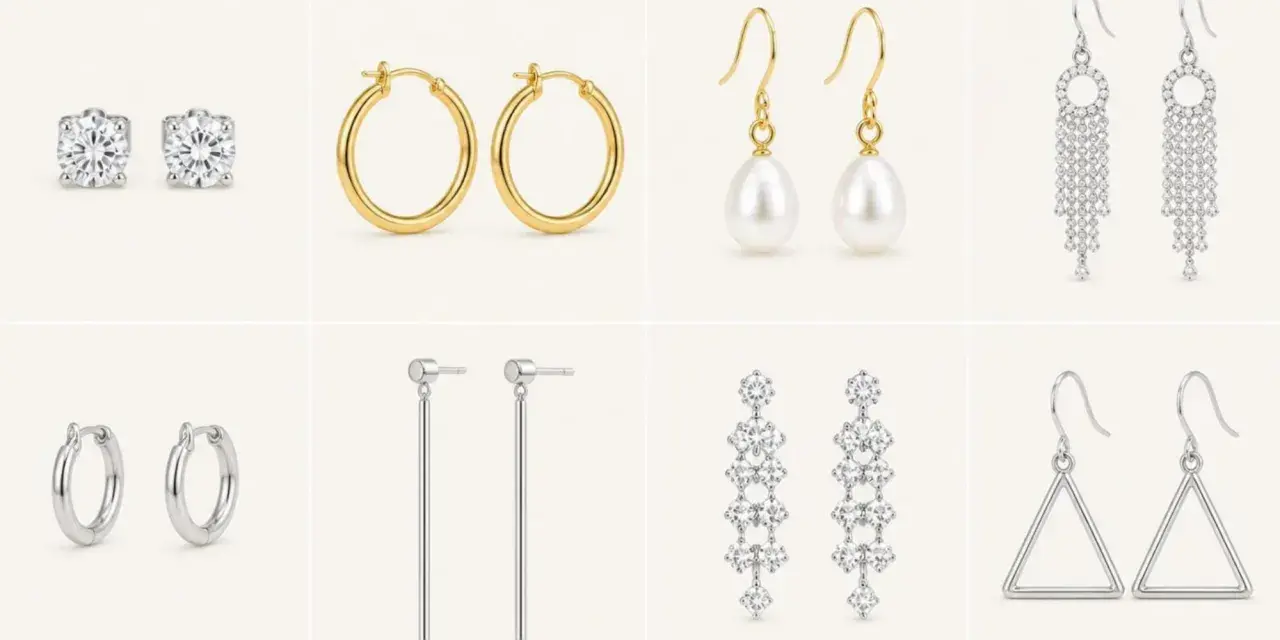
Choosing earrings is less about memorising labels and more about understanding how shape, movement and finish change the effect on the face. In this guide, I break down the main kinds of earrings, explain how they differ, and show how to choose pairs that actually suit everyday wear, special occasions and sensitive ears. I also cover backs, materials and care, because those details decide whether a pair feels effortless or irritating after an hour.
The essentials that shape a good choice
- Studs and small hoops are the easiest everyday options because they work with almost everything.
- Drop, dangle and chandelier styles add more movement and usually make the strongest style statement.
- Backs and metal quality matter as much as the design if you care about comfort and longevity.
- Face shape, hair and neckline affect how large or small an earring looks once it is worn.
- A compact rotation of four or five well-chosen pairs is usually more useful than owning many near-duplicates.
The main earring styles and what each one does best
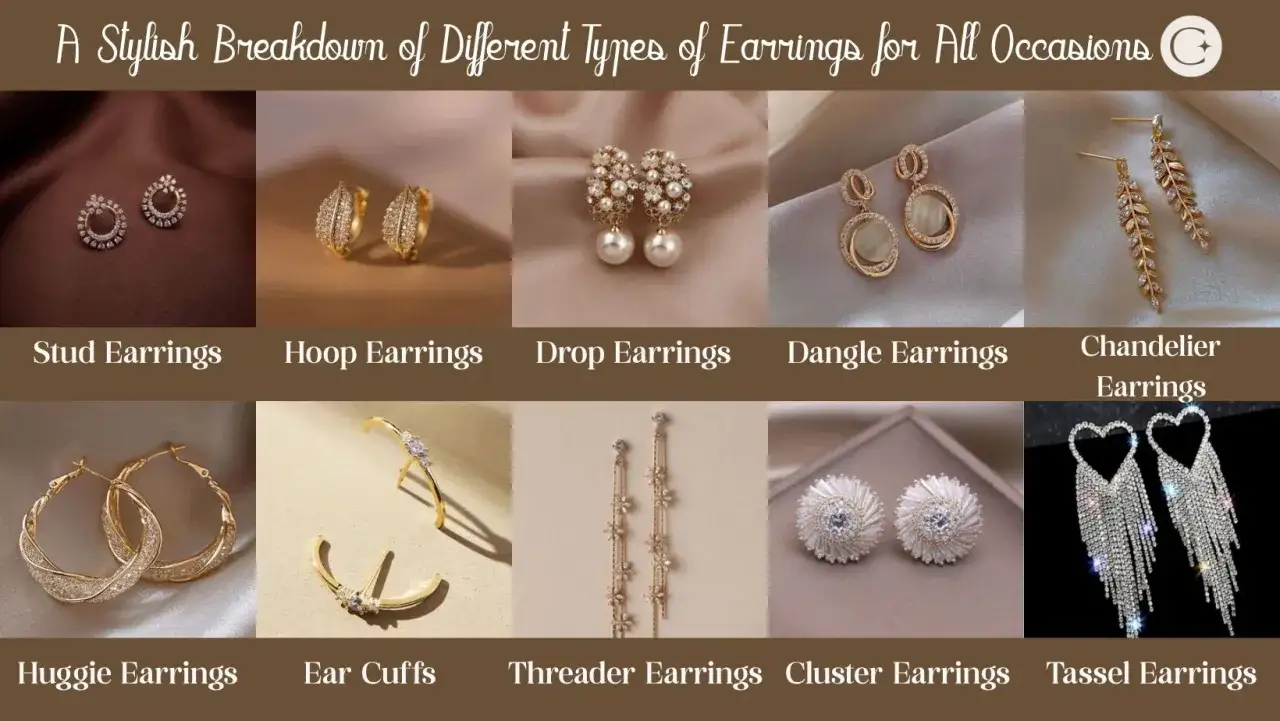
When I sort earrings into families, I start with movement. That gives you a clearer picture of what each style does on the ear, and it makes the labels much less confusing.
| Style | What it looks like | Best for | Main trade-off |
|---|---|---|---|
| Studs | Sits close to the lobe with little or no drop | Everyday wear, work, travel | Can feel too quiet if you want visible movement |
| Hoops | A circular shape in sizes from tiny to oversized | Most outfits, from casual to polished | Large hoops can be heavy or catch in hair |
| Huggies | Small hoops that sit close to the ear | Layered looks, daily wear, clean lines | Very small versions can disappear visually |
| Drop earrings | A fixed element hangs below the lobe | Lengthening the face, smart occasions | Less movement than dangles |
| Dangle earrings | Pieces that move freely as you wear them | Evenings, dressing up, visible shape | Can feel busy with patterned clothes |
| Chandeliers | Layered, branching, statement-making design | Formal events and occasion dressing | Usually the heaviest and least discreet |
| Threaders | Fine chain or bar threaded through the piercing | Light, modern, elegant styling | Need careful handling when putting them on |
| Ear cuffs and climbers | Styles that sit on or travel up the ear | Fashion-forward looks, no extra piercings | Fit depends on ear shape and comfort |
| Clip-ons and magnetic styles | Non-pierced options for the lobe or ear | Occasional wear, borrowed looks, no piercings | Comfort varies a lot by design |
The labels are not always used perfectly by retailers. In practice, I think of drop earrings as designs with a more fixed vertical line, while dangles tend to move more freely. You will also see terms like cluster, jacket and statement used alongside these families, but those usually describe a design detail or a role rather than an entirely separate category. Once you know the major shapes, it becomes much easier to read product listings without second-guessing every name.
That foundation makes the next step simpler: matching the style to your face, hair and neckline instead of choosing on looks alone.
How to match earrings to face shape, hair and neckline
I treat face shape as a starting point, not a rulebook. A round face often benefits from longer lines that create the feeling of length, while sharper features are usually softened by curves and rounded silhouettes. An oval face can wear almost anything, which is helpful but also dangerous, because it tempts you to buy whatever is popular rather than what you will actually wear.
Hair changes the effect more than most people expect. With hair up, statement pieces read more clearly and can carry more detail. With hair down, small studs may disappear, so I often move up one size rather than abandoning the style entirely. A clean bun, ponytail or tucked-back side can make threaders, cuffs and chandeliers look much more deliberate.
Neckline is the final filter. High necks and busy prints usually work best with simple studs or huggies, because the outfit is already doing plenty of visual work. Open necklines, off-the-shoulder tops and V-necks can carry drops, hoops and even larger pieces without feeling crowded. I like earrings to echo the outfit rather than compete with it; that small shift makes the whole look feel more considered.
Once the shape is right, the practical questions move to the part you do not always see: materials, backs and how comfortable the pair will be after a full day.
Why materials and backs change comfort more than style sheets admit
Comfort usually starts with the parts you do not notice in a photo. Metal choice, finish quality and the backing mechanism matter more than many style guides admit, especially if you wear earrings often or have sensitive ears.
- Push backs are the standard choice for studs and light designs, but they are not ideal for heavier pieces.
- Screw backs take longer to fasten, yet they are reassuring for valuable studs and for ears that need extra security.
- Leverbacks close neatly behind the lobe and suit drops or dangles because they help distribute weight.
- Latch or hinge backs work well for hoops and huggies because the closure is tidy and secure.
- Clip-ons and magnetic styles remain useful for non-pierced wear, but comfort can vary a lot, so I would try them on before buying if possible.
If your skin reacts easily, I would look first at titanium, niobium, platinum or high-quality surgical steel. For regular wear in the UK, sterling silver and 9ct gold are dependable, while gold vermeil gives you the look of gold with a more accessible price point, as long as you accept that it needs gentler care than solid gold. In other words, the best-looking pair is not always the one you will enjoy wearing most.
That practical side matters because it shapes how often a pair gets worn. Once comfort is sorted, you can build a smaller but far more useful collection.
A small earring wardrobe that covers almost every outfit
If I were starting from scratch, I would not buy ten similar pairs. I would build around a few roles instead: one quiet everyday pair, one polished mid-size pair, one statement pair and one flexible style that works when I want a little personality without much weight.
- Everyday quiet pair - small studs, pearls or tiny huggies for work, errands and travel.
- Polished mid-size pair - medium hoops or clean drops for dinners and smart-casual outfits.
- Statement pair - chandeliers or sculptural dangles for events and evening dressing.
- Flexible styling pair - threaders, cuffs or climbers for when you want interest without bulk.
If you wear both silver and gold, mixed metals can make a collection easier to use, not harder. I also think one or two well-made pairs in sterling silver or 9ct gold usually earn more wear than several cheap duplicates, because they survive the routine of real life more gracefully. A practical wardrobe is not about owning more; it is about having the right shape for the moment.
That only pays off if the pieces stay in good condition, which is where care becomes part of style rather than an afterthought.
The small maintenance habits that keep earrings wearable
Good care is simple, but it has to be consistent. Most damage happens from sleeping in earrings, storing pairs loose together or letting perfume and hair products sit on the metal.
- Remove earrings before bed, swimming and gym sessions.
- Wipe studs and hoops with a soft, dry cloth after wear.
- Store each pair separately so posts, chains and hooks do not tangle or scratch.
- Keep plated pieces away from moisture and fragrance.
- Check clasps, stones and settings regularly if the pair is worn often.
- Ask a jeweller to inspect valuable or loose pieces rather than forcing them back into shape yourself.
For special pieces, I keep the original pouch or box because it protects the finish better than a shared tray. The best test is simple: if an earring still feels comfortable, secure and visually balanced after several hours, it has earned its place. That is the standard I return to whenever I choose a new pair for my own collection.