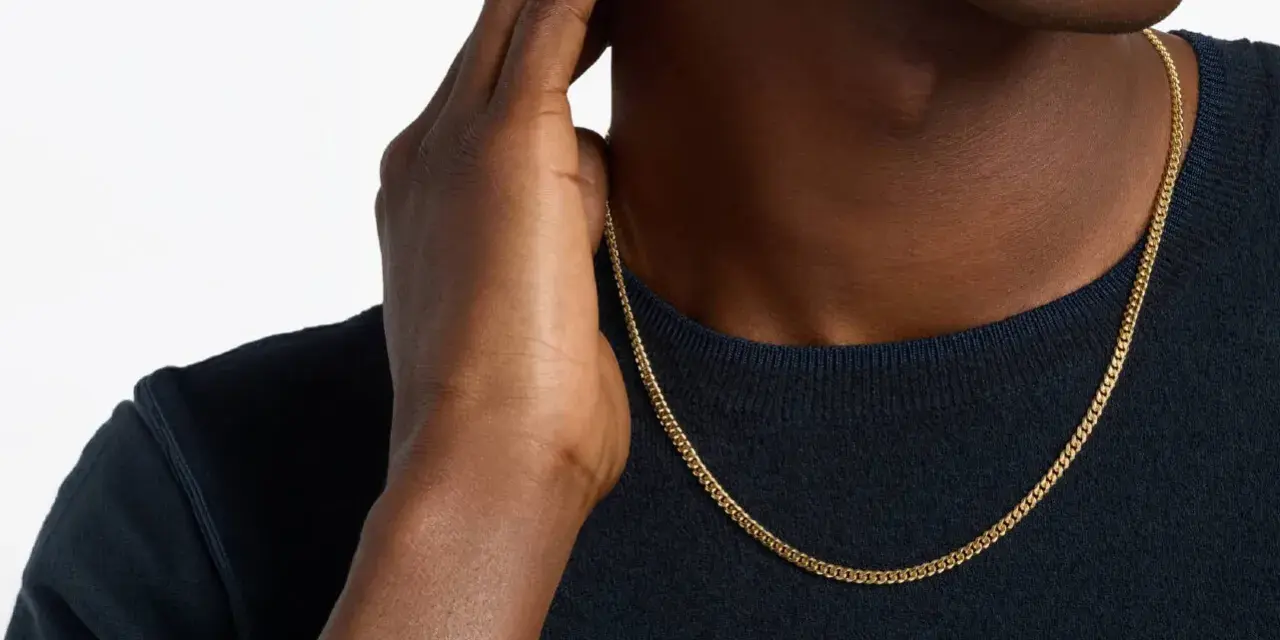
The lengths that work for most men sit in a narrower range than the market suggests
- 50 cm / 20 in is the most common starting point for men’s chains.
- 45 cm / 18 in sits close to the base of the neck and feels more fitted.
- 55 cm / 22 in is often the most versatile everyday length in the UK.
- 60 cm / 24 in gives more visual presence and suits pendants well.
- Chain width, pendant weight, and neckline can change how the same length actually wears.
- If you are unsure, measure on your body rather than trusting an abstract chart.
What standard lengths actually mean for men's chains
When I talk about a standard men’s chain length, I am usually talking about a practical range rather than one fixed number. In the UK, the most useful baseline is 50 cm / 20 in, with 55 cm / 22 in and 60 cm / 24 in covering the next most common wearing positions. That range covers the collarbone, the upper chest, and the slightly lower hang that works better with pendants or a looser look.
| Length | Approximate placement | What it feels like | Best for |
|---|---|---|---|
| 45 cm / 18 in | Base of the neck | Close, clean, and clearly visible | Slimmer necks, sharper styling, open collars |
| 50 cm / 20 in | Collarbone | The classic everyday default | Most builds, simple chains, gift buying |
| 55 cm / 22 in | Just below the collarbone | Relaxed without feeling long | Pendants, layering, slightly broader frames |
| 60 cm / 24 in | Upper chest | More visible and deliberate | Statement chains, heavier pendants, over-shirt wear |
| 70 cm / 28 in | Mid-chest | Bold and fashion-led | Medallions, long layering, streetwear looks |
I would not call 70 cm “standard” in the everyday sense. It is useful, but it is a styling choice first and a default second. For most men, the real decision happens between 45 cm and 60 cm, and that is where the rest of the fit questions start to matter.
How your build and neckline change the fit
Height alone is a poor way to choose a chain. Neck size, chest width, and the way you dress matter more, because the same length can look precise on one person and awkwardly short on another. I usually think in terms of how the chain meets the collarbone and whether it stays visible above clothing or disappears underneath it.
Slim or narrow build
If the neck is slim and the upper chest is relatively narrow, 45 cm to 50 cm often gives the cleanest result. A shorter chain can look intentional here rather than tight, especially with a fine curb or trace chain. I would only move up if the wearer wants a softer drop or plans to wear a pendant.
Average build
For most average builds, 50 cm / 20 in is the best starting point. It usually lands near the collarbone, which makes it easy to wear with T-shirts, knitwear, and open-collar shirts. If there is any doubt, this is the size I would test first because it gives the widest styling range.
Broad or athletic build
Broader necks and fuller chests often need 55 cm / 22 in or 60 cm / 24 in before the chain starts to feel balanced. A length that looks “average” on paper can sit too high once the chain meets a stronger frame. In these cases, the extra few centimetres are not a luxury; they are what keeps the necklace from looking cramped.
Read Also: Bangle vs. Bracelet - What's the Real Difference?
What the neckline changes
A crew neck usually works better with a chain that sits either just at or slightly below the collarbone, while an open collar can handle a shorter, closer fit. If you want the chain to remain visible under a shirt, I would stay around 45 cm to 50 cm. If you want it to sit over clothing with more presence, 55 cm to 60 cm is usually the safer choice.
Once the build and neckline make sense, the next variable is the chain itself, because length and style do not always produce the same visual result.
Why chain style changes the number on the tag
Two chains with the same stated length can wear very differently. That is because drape matters, and drape is simply the way a chain settles and moves on the body. A flat curb chain lies differently from a round rope chain, and a heavy Cuban link can seem shorter than a lighter, slimmer design even when both are marked 50 cm.
| Chain style | How it wears | Why it matters for length | Best use |
|---|---|---|---|
| Curb or Figaro | Lies flatter against the skin | Often reads as slightly shorter and neater | Everyday wear, understated looks |
| Rope | Has more texture and visual volume | Can feel denser and a little more prominent | Smart-casual outfits, subtle statement pieces |
| Franco or box | Falls cleanly and evenly | Usually looks close to its actual length | Minimal chains, pendants, layering bases |
| Cuban or heavy link | Sits with a strong visual footprint | May appear shorter because the links occupy more space | Bolder styling, fashion-led looks |
Chain thickness changes the result as well. A 2 mm chain and an 8 mm chain with the same length do not create the same effect on the chest, and the heavier piece often needs more visual room to breathe. Add a pendant on top of that, and the drop can become noticeably lower than the chain alone would suggest.
That is why I treat length as the starting point, not the whole answer. Once the chain style is right, the choice becomes much easier for specific outfits and occasions.
The lengths I would choose for everyday wear, pendants, and layering
When people ask me what length they should buy, I usually answer with the intended use first. A chain that looks good on its own may not be the chain you want under a pendant, and a necklace that works beautifully with a T-shirt may feel slightly wrong with tailoring. The cleanest way to choose is to match the length to the job it needs to do.
| Use case | Best length | Why I like it |
|---|---|---|
| Everyday discreet wear | 45 cm to 50 cm | Sits close, stays tidy, and works under most collars |
| Everyday visible wear | 50 cm to 55 cm | Shows above a tee without looking oversized |
| Pendant necklace | 55 cm to 60 cm | Gives the pendant room and keeps the drop balanced |
| Layered styling | 50 cm base with 55 cm or 60 cm second chain | The spacing helps prevent tangling and keeps the layers readable |
| Statement piece | 60 cm to 70 cm | Creates a stronger vertical line and more presence over clothing |
For layering, I normally keep the chains separated by about 5 cm / 2 in. That spacing is usually enough to show both pieces properly without making them fight for the same space. If both chains are heavy, thick, and nearly the same length, they are far more likely to tangle or sit awkwardly.
If you wear pendants, I would also think about pendant size before buying the chain. A small cross or tag can sit comfortably on 50 cm, but a larger medallion usually looks better a step longer. The pendant should look like part of the design, not like it has been squeezed into a chain that is too short for it.
How I measure at home before buying
Measuring at home is the simplest way to avoid guessing. I usually advise people to test the fit on the body rather than relying only on neck circumference, because the final look depends on where the chain lands in relation to the collarbone and chest.
- Use a soft tape measure around the base of the neck and note the relaxed measurement.
- Add the drop you want: close fit for a fitted look, a few extra centimetres for collarbone wear, and more if you want the chain lower on the chest.
- Test with a piece of string or an existing chain, then check where it falls in a mirror.
- Factor in any pendant, because the extra weight can pull the chain lower than expected.
- If you are between sizes, go longer for pendants and broader frames, or shorter for a cleaner, tighter line.
I also check what the chain will do inside real clothes. A chain can feel perfect on bare skin and then sit too high under a stiff shirt collar. If that is how it will be worn most of the time, I would always test with the same neckline, not just in isolation.
For a gift, this is where I lean conservative. A 50 cm or 55 cm chain is usually a safer buy than 45 cm because the wearer has more room to style it. If the chain comes with an extender, that flexibility can save the purchase, but I still prefer to get the base length right first.
Common mistakes that make a chain feel wrong
Most bad chain purchases are not caused by bad taste. They come from choosing on one factor alone and ignoring the rest. I see the same mistakes repeated often, and nearly all of them are easy to avoid once you know what to look for.
- Choosing by height alone instead of by neck size and chest shape.
- Ignoring chain width, which can change how long the piece appears on the body.
- Buying too short for a pendant, then wondering why the pendant sits awkwardly high.
- Forgetting that heavier chains and heavier pendants drape differently from fine chains.
- Picking one size for every outfit, even though crew necks, open collars, and shirts with structure all behave differently.
- Overlooking extenders, which can make a borderline length much more usable.
The biggest mistake, in my view, is treating the size chart as a final answer instead of a starting point. A chain that is technically “standard” can still look wrong if it clashes with the wearer’s proportions or the way they dress. Once you stop thinking in rigid rules, the choice becomes much more forgiving.
If you only buy one chain, start here
If I had to choose one length for most men, I would start at 50 cm / 20 in. It is the most balanced everyday option, and it usually sits neatly at the collarbone without feeling too tight or too long. If the wearer has a broader build, likes a slightly lower hang, or plans to wear a pendant, I would move up to 55 cm / 22 in before I looked at anything else.
- 45 cm / 18 in for a close, fitted look.
- 50 cm / 20 in for the safest all-round choice.
- 55 cm / 22 in for pendants, layering, and a more relaxed feel.
- 60 cm / 24 in for visible styling and stronger presence.
That is the simplest way I think about men’s chain lengths: start with where you want the necklace to sit, then adjust for build, chain style, and how you plan to wear it. Once those three pieces line up, the size chart stops being guesswork and becomes a useful tool.