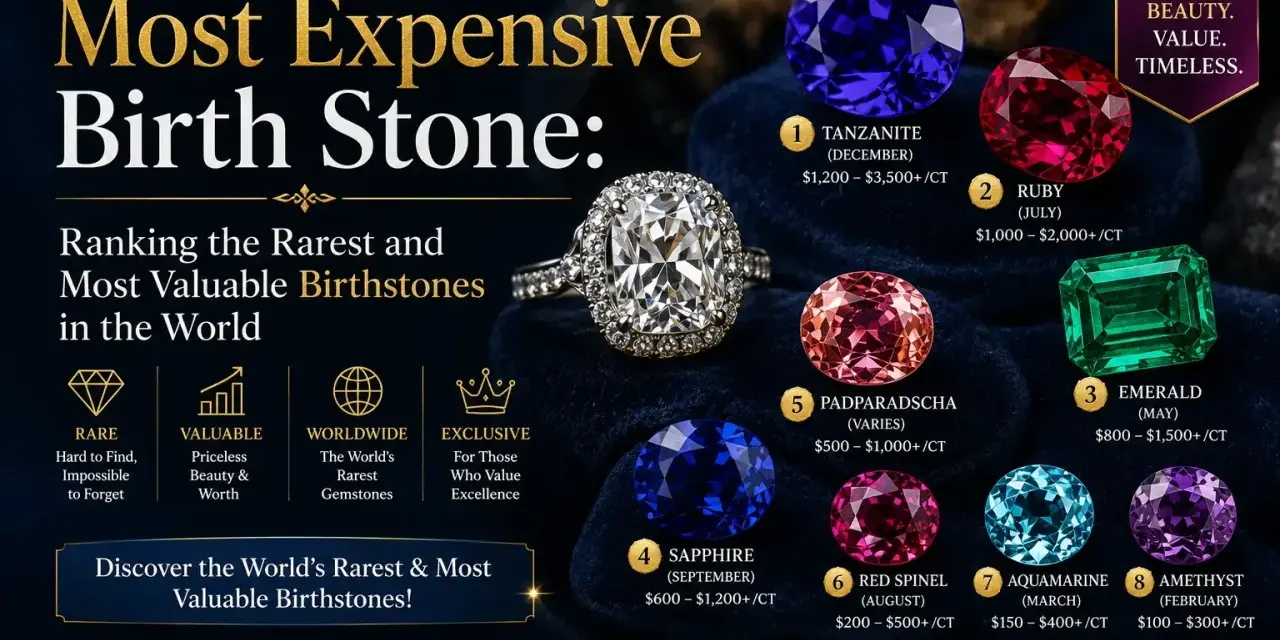
The most expensive birthstone is usually diamond, but the real story is less tidy than a single label. Price is shaped by rarity, colour, clarity, size, treatment and whether the stone is natural or lab-grown. I am going to break that down in plain English so you can see when a high price is justified, when it is mostly marketing, and how that looks in the UK market.
Key points to know before you buy
- Diamond is usually the priciest birthstone in everyday retail terms.
- Alexandrite, ruby and some exceptional sapphires can outrank many diamonds per carat.
- Price is driven by rarity, colour quality, clarity, size, treatments and origin.
- In the UK, a lab report and full disclosure matter more than the month on the birthstone chart.
- If symbolism matters more than scarcity, lab-grown stones change the budget completely.
Why diamond usually leads the price list
GIA recognises diamond as the April birthstone on almost all modern lists, and it is still the default answer when people ask which birthstone sits at the top of the market. The reason is not mysterious. Fine natural diamonds combine strong demand with a grading system that rewards rarity at every step: colour, clarity, cut and carat weight.
That matters because diamond pricing is not linear. A stone that is only slightly better on paper can cost noticeably more, especially once you move into larger sizes or into very high colour and clarity grades. In practical terms, that is why a well-cut, high-grade diamond can move from “expensive” to “seriously expensive” faster than most shoppers expect.
There is also a cultural reason diamond stays ahead. It is the stone most associated with engagement jewellery, which keeps demand high in the UK and beyond. So if you want the shortest possible answer, diamond is usually the priciest birthstone in ordinary retail life. The caveat is that price ceilings are not fixed, which is why I check the exceptions next.
When alexandrite and ruby can outrank a diamond
Natural alexandrite is the first exception I would look at. GIA describes it as rare and valuable, and the best stones show that unmistakable colour change from green or bluish green in daylight to red or purplish red in incandescent light. That “chameleon” effect is not just a neat feature; it is a major part of the gem’s value.
Because fine alexandrite is genuinely scarce, small stones with strong colour change can cost more per carat than many diamonds. The same basic logic applies to ruby. Very good rubies, especially untreated stones with vivid colour, can command some of the highest prices in the coloured stone market. In other words, a top ruby may sit above a normal diamond simply because the supply of truly fine material is so thin.
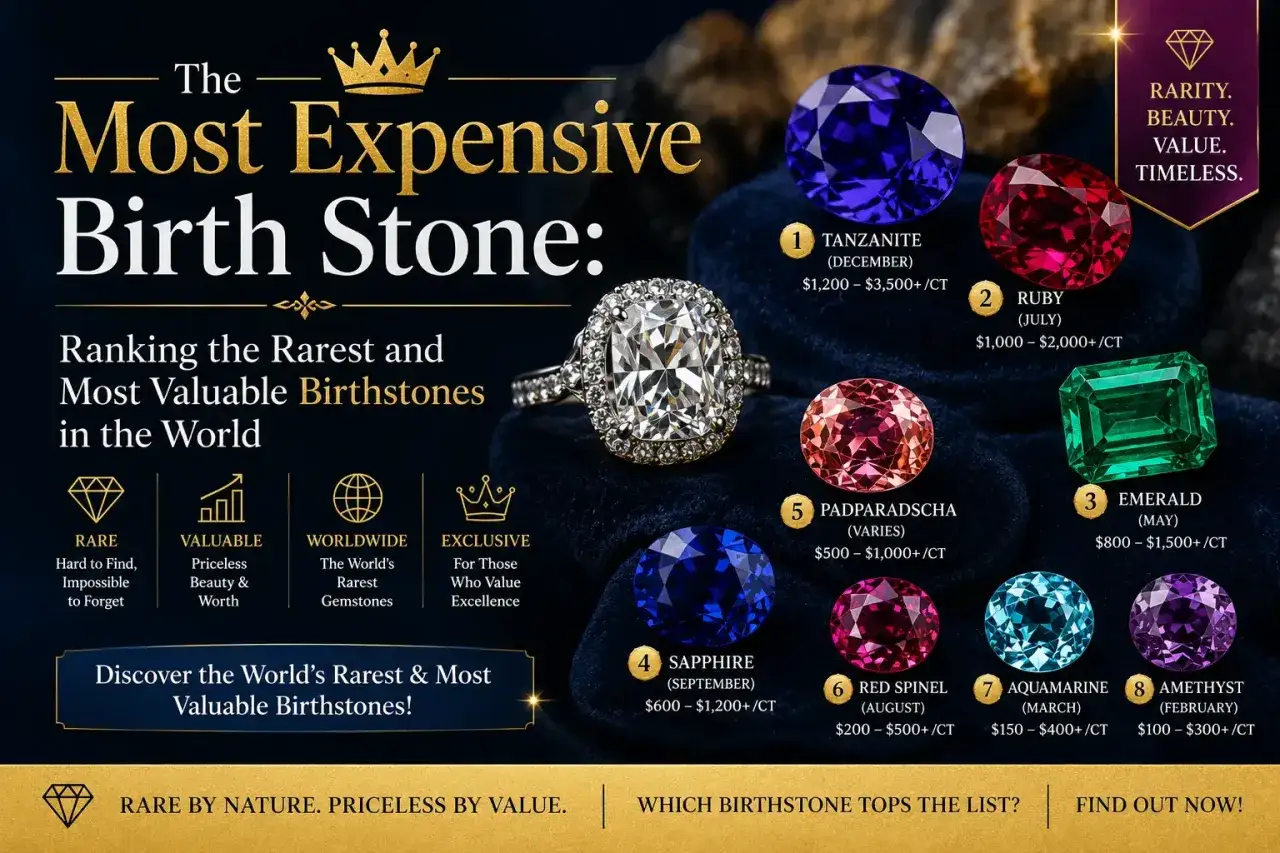
Sapphire can join that conversation too. Exceptional blue sapphires, especially stones with prized origin and saturated colour, can become extremely costly. So can unusual fancy varieties such as padparadscha, where the market is paying for colour quality as much as for the name of the birthstone itself. The honest answer is that diamond usually wins on average, but rare coloured stones can win at the top end.
A practical price comparison across the main birthstones
Price bands in jewellery are broad, so I prefer to think in tiers rather than fixed numbers. The table below shows where the main birthstones usually sit when you compare fine natural stones in the UK market.
| Birthstone | Usual place in the market | Why it gets pricey | What to watch |
|---|---|---|---|
| Diamond | Usually the benchmark at the top | Rare high colour, high clarity and strong demand | Look for a report, not just a carat weight |
| Alexandrite | Often among the most expensive coloured birthstones | Very low supply and strong colour change | Weak colour change can cut value sharply |
| Ruby | Can equal or beat many diamonds | Vivid red colour, fine clarity and rarity over one carat | Treatments and synthetics are common in the market |
| Sapphire | Wide range, with elite stones at the top | Colour strength, origin and size | Heat treatment is common and should be disclosed |
| Emerald | Often expensive in fine quality, especially as size rises | Strong green colour and large clean crystals are rare | Inclusions are normal; ask about oiling or other clarity enhancement |
| Pearl | Usually below the gems above unless natural and exceptional | Lustre, size, matching and natural rarity | Most pearls on the market are cultured, not natural |
The important part of that comparison is not the label on the stone but the quality tier underneath it. A modest diamond can cost less than a superb ruby, and a fine alexandrite can outrun both. That is why the next thing I look at is not the month, but the actual price drivers.
What actually pushes a birthstone into a higher price bracket
When I assess value, I separate the gem from the sales pitch. Five factors usually do the heavy lifting.
- Rarity - the less fine material there is in the market, the faster the price rises. This is why alexandrite and top ruby are so hard to ignore.
- Colour quality - for coloured stones, the best saturation and tone usually command the biggest premium. A weak or muddy colour can drag a gem down fast.
- Size - price often rises sharply once a stone gets beyond commercial sizes. With emerald, sapphire and ruby, the jump between “nice” and “serious” can be dramatic.
- Treatments - heat, oiling, filling and other enhancements are not automatically bad, but they change value. The market prices a disclosed treated stone very differently from an untreated one.
- Origin and traceability - for some stones, a verified source can materially change the price, especially when the origin is historically prized.
Cut quality matters too, although it behaves differently across gem types. Diamonds are judged through the 4Cs, while coloured stones are often judged first by colour and then by clarity, cut and size. That is why two stones with the same carat weight can sit in completely different price brackets. Once you understand that, the market becomes much less confusing.
How I would buy an expensive birthstone in the UK
If I were buying a valuable birthstone piece in the UK, I would not start with the budget alone. I would start with the job the stone needs to do. Is it a daily-wear ring, a gift with symbolic weight, or a piece meant to hold value and be discussed for years? That question changes everything.
For any meaningful spend, I would ask for a lab report and full disclosure of treatments. If a seller says a stone is natural, heated, unheated, treated or lab-grown, that needs to be written down clearly. In my experience, vague language is often where overpaying begins. A transparent invoice is more useful than a polished sales script.
- Compare stones like for like, not just by carat weight.
- Check whether the colour is natural, enhanced or the result of a treatment.
- Ask whether origin is verified or simply assumed.
- Use the setting to protect the stone, especially for softer gems such as emerald and pearl.
- Consider lab-grown diamond if you want the April symbolism without the natural rarity premium.
I would also think about wearability. A diamond or sapphire can be a sensible daily piece, while an emerald ring may need more care and a more protective setting. If the stone is expensive enough to insure, I would want a current valuation and a clear paper trail from the start. That is the difference between a beautiful purchase and a costly mistake.
The price tag is only half of the decision
If I boil the subject down to one practical answer, it is this: diamond is usually the highest-priced birthstone, but it is not the only one that can become very expensive. Exceptional alexandrite, ruby and fine sapphires can rise above many diamonds, especially once rarity and origin enter the picture.
For a buyer, the smarter question is not simply “which birthstone costs the most?” It is “which stone gives me the right balance of rarity, beauty, durability and value for the way I will actually wear it?” That is where the best jewellery decisions usually happen.
My own rule is simple: buy the gem you love, but make sure the price is backed by quality you can prove. When those two things line up, the piece feels expensive for the right reasons.