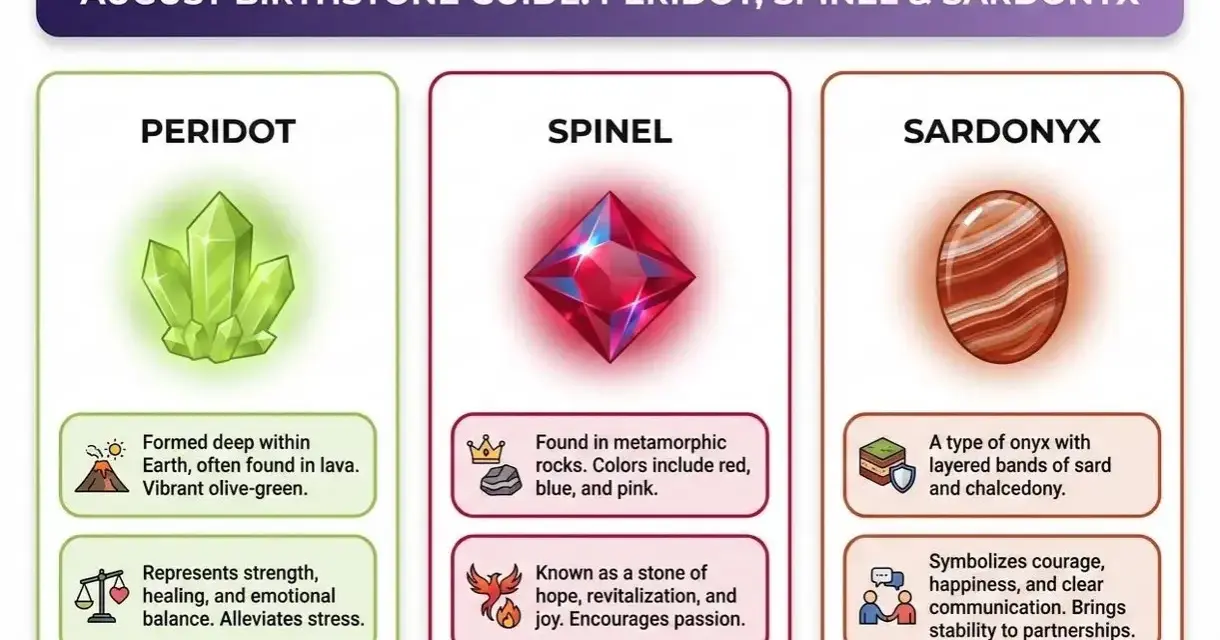
The clearest answer to the August 24 birthstone is peridot, but the full picture is a little richer than one green gem. August actually has three accepted birthstones, so the right choice depends on whether you want the classic August look, a tougher everyday stone, or something with a more antique feel. In this guide, I break down the three options, explain which one fits 24 August best, and show how to choose a piece that will still feel right years from now.
The short answer for 24 August
- 24 August is usually linked first to peridot, the best-known August birthstone.
- Spinel and sardonyx are also accepted August stones, so the date is not limited to one gem.
- Peridot is the most recognisable choice, especially for the bright green August look.
- Spinel is the practical option if you want more durability for rings or frequent wear.
- Sardonyx suits people who like banded, heritage-inspired jewellery and carved details.
- The best choice depends on style, wear pattern, and how much care you want to give the piece.
Why 24 August does not have a single exclusive gemstone
Birthstones are usually organised by month rather than by exact day, so 24 August does not point to a unique gem the way a zodiac sign or an anniversary stone might. That is why the real answer is broader: August has a small family of gemstones, and each one reflects the month in a different way. The American Gem Society notes that sardonyx was the original August stone, peridot later became the primary one, and spinel was added in 2016.
That history matters because it explains why the question is less about finding a single correct stone and more about choosing the right August stone for the person. In the UK, I usually see peridot presented as the familiar first choice, with spinel and sardonyx widening the options rather than replacing it. Once you understand that structure, the decision becomes much easier.
With that out of the way, the next question is obvious: why does peridot still lead the conversation?
Why peridot is usually the stone people mean
Peridot is the yellowish green to greenish yellow gem variety of olivine, a mineral family that gives it that bright, fresh colour people immediately associate with August. It has a long history, but it does not feel old-fashioned in the wrong way. I like that balance: it is traditional enough to feel meaningful, yet modern enough to wear cleanly in simple settings.
According to GIA, peridot sits at 6.5 to 7 on the Mohs scale, which measures how well a mineral resists scratching. That makes it attractive for jewellery, but not especially tough compared with harder stones. In practical terms, I would reach for peridot in pendants and earrings first, and only choose it for a ring if the setting offers decent protection.
Peridot also has an easy symbolism. It is often linked with renewal, warmth and light, which suits late summer well. If someone wants the most recognisable, most classic answer to a birthday in late August, peridot is still the stone I would start with. If you want something more durable or less obviously green, though, the other August stones quickly become more interesting.
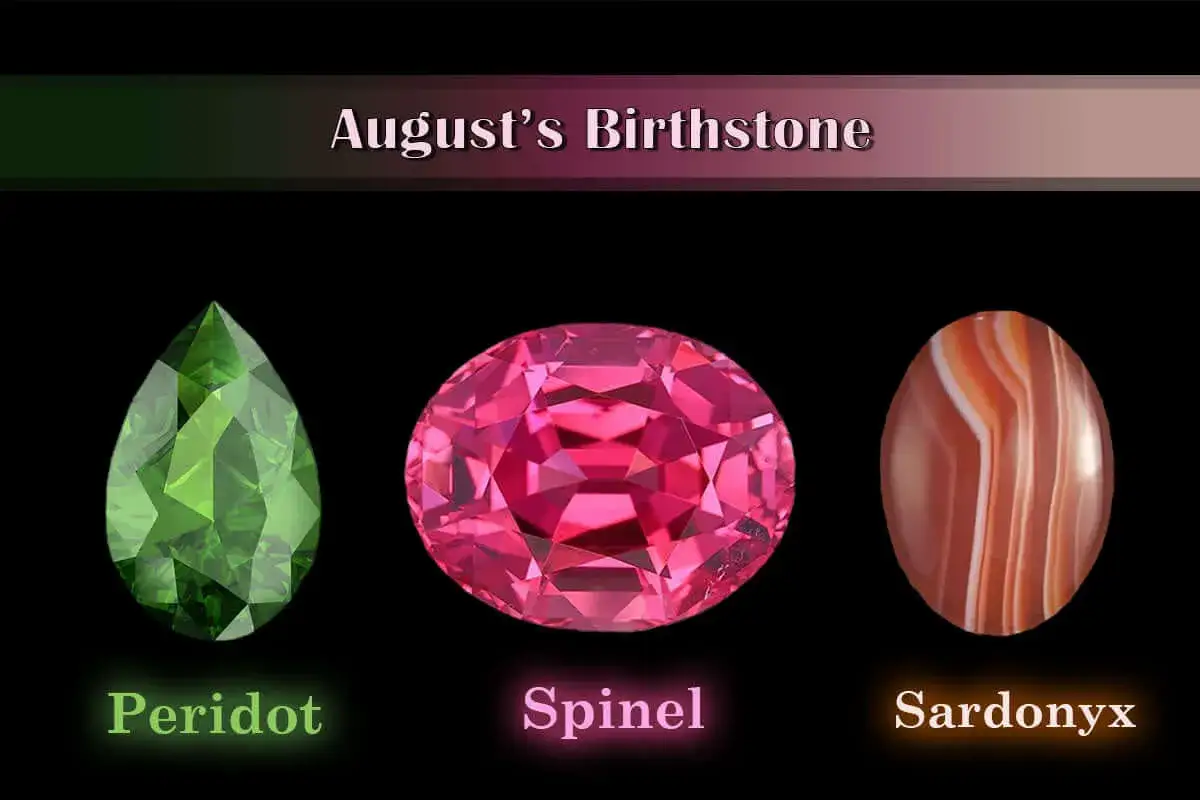
How peridot, spinel and sardonyx compare at a glance
The quickest way to narrow the choice is to compare the three stones by colour, durability and the kind of jewellery they suit best. I find this more useful than treating them as equals on paper, because they solve different problems in real life.
| Stone | Typical look | Mohs hardness | Best use | What makes it stand out |
|---|---|---|---|---|
| Peridot | Yellow-green to green | 6.5-7 | Pendants, earrings, occasional rings | The classic August stone and the most recognisable choice |
| Spinel | Red, pink, violet, blue, green and more | 8 | Rings and everyday jewellery | More durable and far more colour-varied than most people expect |
| Sardonyx | Layered brown, orange, white and reddish banding | 6.5-7 | Cameos, signet rings, vintage-style pieces | The most historical and decorative of the three |
Spinel is the one I reach for when a buyer wants a birthstone that can survive real wear. It is harder than peridot, and that makes a noticeable difference if the piece is going to be worn often. One of the best-known examples has British relevance too: a famous red spinel is set in the Imperial State Crown, which gives the stone real cultural weight in a UK context.
Sardonyx is different again. It is a banded form of chalcedony, which is a microcrystalline form of quartz with very fine crystal structure. That layered look gives it a carved, heritage feel that peridot and spinel do not try to imitate. If peridot is the clean modern answer and spinel is the versatile one, sardonyx is the stone for people who like jewellery with texture and history.
So the choice is not really about which stone is “better”; it is about which one solves the wearer’s style problem most elegantly.
Which stone I would choose for different pieces
When I narrow this down for an actual gift, I think in terms of how the jewellery will be worn, not just what month it belongs to. That approach usually leads to a better result than chasing the most traditional answer every time.
- For a birthday pendant, I would choose peridot. It gives the clearest August signal and shows its colour beautifully away from hard wear.
- For a ring that will be worn often, I would choose spinel. Its higher hardness gives it a much better chance of handling daily life.
- For a vintage-inspired gift, I would choose sardonyx. It suits engraved mounts, cameos and signet-style settings better than the others.
- For someone who loves bright colour but not green, spinel is the obvious answer because it comes in red, pink, blue and violet tones.
- For someone who wants the most recognisable August birthstone, peridot is still the safest and most intuitive pick.
The one case where I hesitate is a peridot ring that will be worn every day with very little care. It can work, but only if the setting is protective and the wearer is sensible about removing it for rough tasks. That leads directly to the practical part most people skip: how to look after the stone you choose.
How to care for August birthstone jewellery
Care matters more than people think, especially when a birthday gift is meant to last. A beautiful stone can still be the wrong choice if the wearer does not want to baby it, and that is where the durability differences really matter.
- Peridot: clean it with warm water, a little mild dish soap and a soft brush. Avoid steam cleaners and ultrasonic cleaners, and keep it away from acids and harsh chemicals. I would also store it separately so harder gems do not scratch it.
- Spinel: this is the easiest of the three to live with. Warm soapy water is the safest option, though ultrasonic and steam cleaning can be suitable if the stone has no fractures. I still prefer gentle cleaning for set jewellery.
- Sardonyx: treat it gently, especially if the stone has been dyed. High heat can affect colour treatment, so I would avoid aggressive repair or cleaning methods. Soft cleaning is enough for most pieces.
- All three stones: take them off before gym sessions, gardening, swimming and heavy cleaning. That simple habit prevents most chips, scratches and avoidable wear.
In other words, spinel is the least demanding choice, peridot needs the most caution, and sardonyx sits somewhere in the middle but asks for careful handling if colour treatment is involved. Once you know that, the final choice becomes much more straightforward.
The simplest buying rule for a 24 August gift
If I had to reduce the whole decision to one rule, it would be this: choose peridot for the classic August story, spinel for the most wearable jewellery, and sardonyx for a piece with history and texture. For a ring you expect to live in, spinel is the safest all-rounder. For a pendant or pair of earrings, peridot gives you the cleanest birthstone signal. For a gift that feels more distinctive and antique, sardonyx is the stone that usually surprises people in the best way.
That is the part I find most useful about August birthdays: you are not trapped in one look. The month gives you a tidy classic, a tougher modern option and a historical alternative, which means you can match the gem to the wearer instead of forcing a generic answer. For 24 August, peridot is still the default choice, but the best choice is the one that fits the jewellery, the lifestyle and the person who will actually wear it.