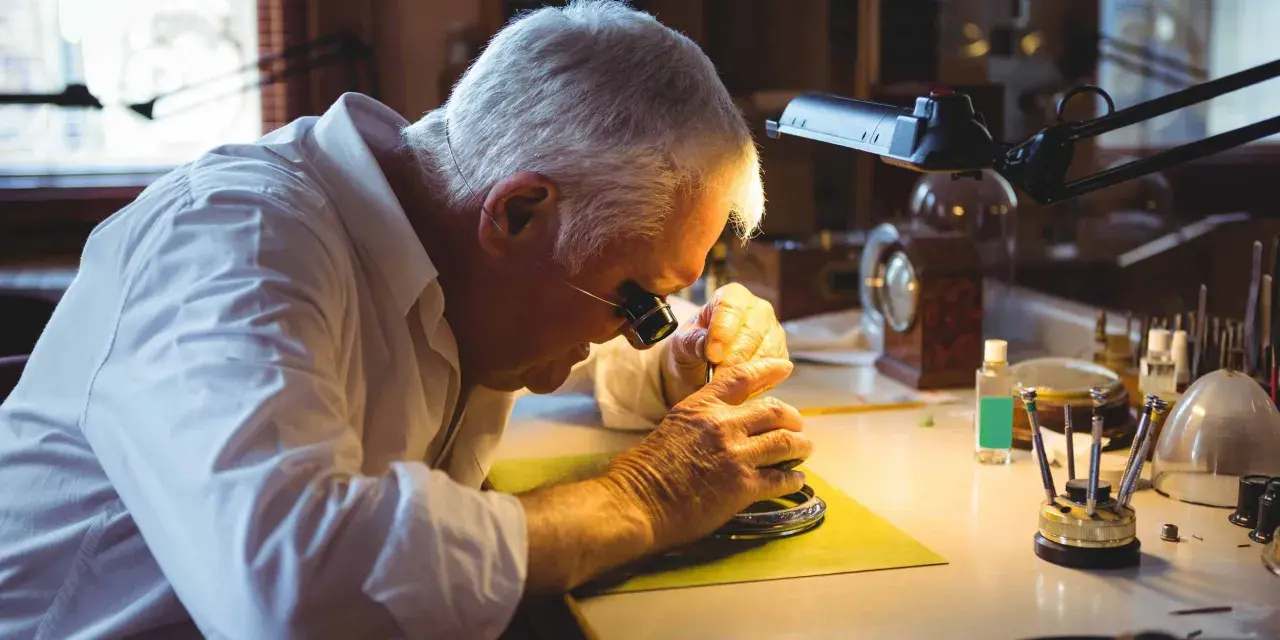
Fixing a timepiece is usually less about forcing it back to life and more about reading the symptom correctly. In this guide, I walk through how to fix a watch safely, when a simple adjustment is enough, and when a proper service in the UK is the smarter move. I will cover the most common faults, the tools that actually help, and the mistakes that can turn a small problem into a bigger bill.
Start with the symptom and you will avoid most bad repairs
- A stopped quartz watch often needs a new battery, a crown reset, or a clean battery contact.
- A mechanical or automatic watch usually needs winding, regulation, or a full service rather than a quick tweak.
- Fog, droplets, or rust inside the crystal are signs to stop DIY work and book a repair.
- Loose straps, clasps, and spring bars are the easiest problems to solve safely at home.
- In the UK, straightforward repairs are often measured in days, while full services can take several weeks.
Identify the fault before you try to fix it
The first thing I do is separate a timekeeping problem from a wear-and-tear problem. A watch that has stopped, runs badly, or lets in moisture is asking for a different fix every time, and the wrong repair is usually the expensive one. A watch sits somewhere between tool and jewellery, so the repair has to protect both the movement and the finish.
| Symptom | What it usually points to | First move | DIY? |
|---|---|---|---|
| No movement at all | Dead battery, crown left out, or empty mainspring | Push the crown fully in, then test again | Sometimes |
| Seconds hand jumps in larger steps | Low battery on many quartz models | Replace the battery or take it to a repairer | Maybe |
| Runs fast or slow | Magnetism, shock, or dried lubrication | Keep it away from magnets and book a service if it continues | No |
| Fog or droplets under the crystal | Moisture ingress or failed gasket | Stop wearing it immediately | No |
| Crown will not sit right | Worn stem, stripped thread, or seal issue | Do not force it | No |
| Bracelet is loose | Worn spring bar or clasp tension | Replace the hardware or resize the bracelet | Yes, if it is external |
Quartz watches
If the watch runs on a battery, I check the simplest failure first. Make sure the crown is fully pushed in, because a pulled crown can stop the movement on many watches or leave the hands inactive. If the second hand is jumping in larger steps, that often points to a low battery on quartz models; if the watch is solar-powered, the answer may simply be more light rather than a new cell.
Mechanical and automatic watches
For a hand-wound watch, a full stop after sitting for days is not a failure by itself. I would give it roughly 20 to 40 gentle turns and stop when the resistance becomes firm and even. Automatic watches often need the same nudge after they have been left in a drawer; the mainspring, which is the coiled power source inside the movement, may simply need help getting started again. If it is still erratic, or if the winding feels gritty, the issue is deeper than a user reset.
Straps, bracelets, and clasps
A lot of "broken watch" calls are really just fastening problems. A spring bar is the tiny spring-loaded pin that holds a strap or bracelet to the case, and a missing or bent one can make the whole watch feel broken. A jeweller can replace it quickly, and a bracelet can often be resized without touching the movement at all.
Once the fault is clear, the next question is which fixes are safe to attempt at home.
The safe repairs you can try at home
Once the fault is clear, I limit DIY work to the parts that do not threaten the movement. If the symptom points inside the case, the decision becomes one of risk, not effort. The crown is the small knob used to set the time and wind the watch, and the gasket is the seal that helps keep moisture out; both deserve careful handling.
Reset the crown and clean the exterior
- Check that the crown is fully seated before anything else.
- On screw-down models, thread it in slowly and stop as soon as it seats.
- Wipe sweat, dust, and fingerprints off the case with a soft microfiber cloth.
- Avoid solvents such as bleach or thinner, which can damage finishes and straps.
- If the watch is wet, do not turn the crown until it is dry.
Wind or charge the movement properly
For a hand-wound watch, I give it about 20 to 40 gentle turns and stop when the resistance becomes firm. For an automatic, the same few dozen turns can wake it up after it has been left on a shelf; after that, normal wrist movement takes over. Solar models are different again: they need light, not a battery swap, so bright daylight or a suitable lamp may be enough to bring them back.
- Do not force the crown when it feels stiff.
- Do not assume every dead-looking watch needs a new battery.
- If the watch still stops after a fresh wind or charge, move to professional help.
Read Also: Men's Chain Length Guide - Find Your Perfect Fit
Fix the strap or bracelet hardware
If the problem is outside the case, the repair is usually straightforward. A bracelet with a missing link screw, a cracked leather strap, or a loose clasp is annoying, but it is not the same as movement failure. I replace damaged leather rather than trying to save it with glue, and I use the correct spring bar width so the strap sits securely between the lugs.
- Replace cracked leather instead of trying to rescue it with glue.
- Use the correct spring bar width for the lugs.
- Check the clasp before you assume the whole watch has failed.
If the symptom points inside the case, the decision becomes one of risk, not effort.
When a professional repair is the only sensible move
Once the fault points inside the case, I stop the DIY instinct. Water inside the case, a cracked crystal, rust, a loose crown stem, or a chronograph pusher that has jammed usually needs trained hands and the right seals, not improvisation. Seiko recommends authorised service centres for repairs because a watch is a sensitive precision instrument, and that is a useful standard to keep in mind.
| Red flag | Why I would not DIY it | Likely repair path |
|---|---|---|
| Moisture under the crystal | Corrosion can begin quickly inside the movement | Open, dry, clean, replace seals, and pressure-test |
| Damaged crown or stem | Delicate parts can be bent or stripped | Part replacement and resealing |
| Cracked or shattered crystal | Glass fragments and dust can enter the case | Crystal replacement and case cleaning |
| Battery leakage | Contacts and circuits can be eaten away by corrosion | Contact cleaning or movement repair |
| Watch lost time after a knock | The movement may need regulation or part replacement | Inspection, timing adjustment, or full service |
In the UK, Timpson lists a basic quartz service from £40 and a mechanical service from around £115; battery and pressure tests are typically within 7 days, quartz service in 21 days, and mechanical service in 35 days. I treat those figures as a useful benchmark rather than a promise, because brand, parts, and the condition of the watch can change the final bill. Timpson also works on a no fix, no fee basis, which is a sensible model when the fault is not obvious.
That difference matters because a service is what keeps the watch healthy after the immediate fault is gone.
What a proper watch service should include
A repair fixes the immediate fault; a service resets the watch for the next few years. The difference matters because many watches appear to be fixed after a battery or crown adjustment, yet the real problem is worn lubrication or ageing seals that will fail again if nobody opens the watch properly. A proper service is not just a battery change with a receipt attached to it.
| Service task | What it does | Why it matters |
|---|---|---|
| Disassembly and cleaning | Removes old oil, dust, and wear debris | Reduces friction and long-term damage |
| Lubrication and inspection | Re-oils moving parts and checks worn components | Keeps accuracy and power delivery stable |
| Gasket replacement or check | Refreshes the seals around the case | Helps preserve water resistance |
| Regulation | Fine-tunes the movement's rate | Improves timekeeping accuracy |
| Pressure test | Checks whether the case can still resist water ingress | Protects the movement after the case has been opened |
For mechanical watches, I treat 3 years as the right starting point; Seiko recommends about every 3 years, and Timpson gives 3 to 5 years depending on use and care. If the watch is water-resistant and you actually wear it in rain, sinks, or the sea, regular gasket checks matter just as much as timing. A quick repair can buy time, but a proper service is what keeps the movement alive.
From there, the choice between repair and replacement becomes much easier.
How I decide between repair, service, and replacement
My rule is simple: I repair for value, service for health, and replace only when the numbers no longer make sense. If a repair quote gets much past half the cost of a comparable replacement, I ask whether the watch is sentimental, mechanically interesting, or genuinely better built than the model I would buy instead. That is especially true for a watch that has jewellery value as well as practical value.
| Situation | Best call | Why |
|---|---|---|
| Dead battery, otherwise sound quartz watch | Repair | Cheap, fast, and usually worth it |
| Mechanical watch loses minutes or stops | Service | The movement likely needs cleaning and lubrication |
| Water ingress or heavy rust in a low-cost watch | Replace | Internal damage can exceed the watch's value |
| Vintage or gifted piece | Repair | Sentimental value often outweighs the quote |
| Broken crystal on a mid-range watch | Compare quote and replacement cost | The right answer depends on parts availability and finish |
I use a rough 50 percent rule, but I bend it for watches that carry family history, a quality movement, or a case that is hard to replace. Once the economics are clear, maintenance is what protects your decision.
The habits that keep the next repair away
- Push the crown fully in after setting the time or date.
- For screw-down crowns, thread them back down gently and stop once seated.
- Remove the watch before a bath or sauna, and do not treat water resistance as permanent.
- After sea water exposure, rinse with fresh water and dry with a soft cloth.
- Wipe sweat, dust, and dirt off the case and bracelet after wear.
- Avoid strong shocks, solvents, bleach, and prolonged contact with magnets.
- Keep mechanical pieces serviced at sensible intervals rather than waiting for failure.
If the watch is solar-powered, give it light now and then instead of leaving it in a drawer for months. That small habit can prevent a lot of false alarms.
The details I check before I hand a watch over
Before I approve a repair, I want three things in writing: the likely fault, the turnaround time, and whether the case will be resealed and pressure-tested afterwards. A good workshop will also tell you if the crown, crystal, gaskets, or seals need replacing rather than just guessing at the obvious symptom.
- Ask for a written estimate before internal work begins.
- Ask whether water resistance will be tested after the repair.
- Ask which parts will be returned if they are replaced.
- Ask whether the work is done in-house or sent to a specialist centre.
- Keep the receipt and service note with the watch box or papers.
That approach keeps the repair focused on accuracy, protection, and long-term value, which is exactly what a good timepiece deserves.