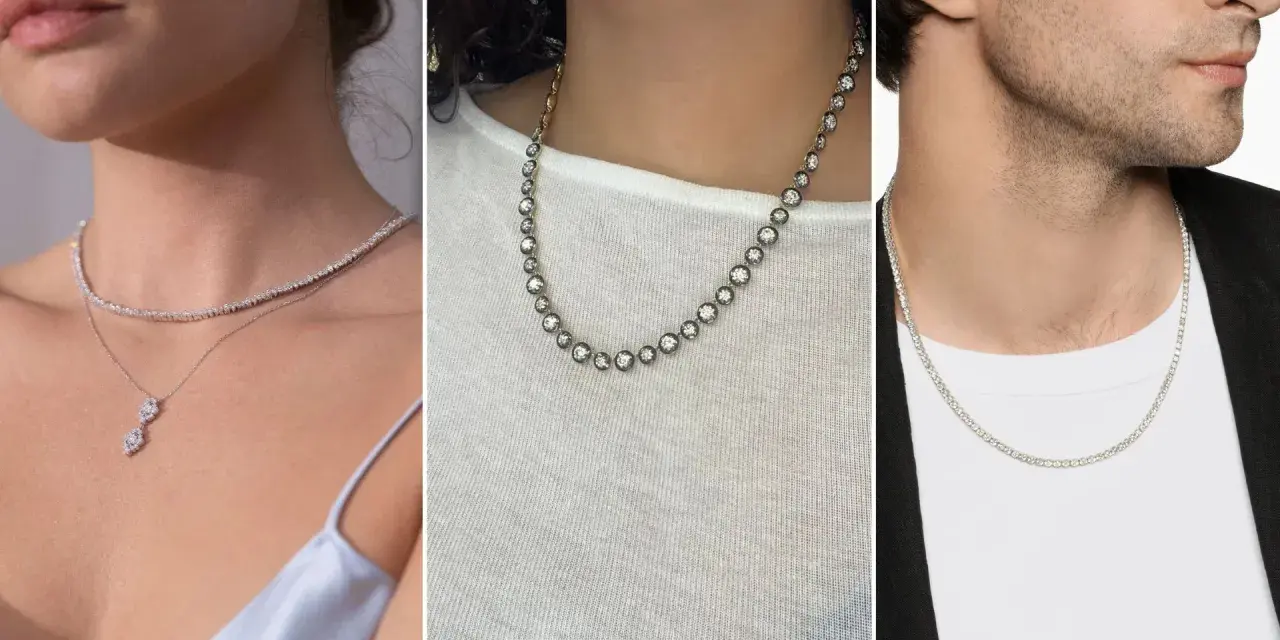
A tennis necklace is one of those jewellery pieces that looks restrained at first glance and then reveals its precision. It is a continuous line of matched stones, usually diamonds, set so the sparkle reads as one fluid ribbon around the neck. In this guide, I break down the design, the fit, the styling logic, and the details that separate a beautiful piece from an underwhelming one.
The essentials at a glance
- It is a flexible necklace made from individually set stones in a continuous line.
- Diamonds are the classic choice, but coloured gemstones and lab-grown stones are also used.
- 16 inches is the most versatile length for a classic collarbone fit.
- The setting, clasp and metal matter almost as much as the stones themselves.
- It is more versatile than it first appears, but proportion decides whether it looks refined or heavy.
What a tennis necklace actually is
At its core, this is a necklace built from individually set stones linked in a flexible line. The classic version uses diamonds, but the style can also be made with sapphires, emeralds, rubies or lab-grown stones; what defines it is the uninterrupted visual rhythm, not one specific gem. I think of it as a calibrated line of light rather than a single focal charm. The roots are older than the name, with clear overlap with riviere jewellery and other diamond line pieces. The modern tennis necklace keeps that same elegant structure, but it usually feels a little cleaner and more uniform, which is why it works so well with tailoring, knitwear and evening dresses alike. That is also why the setting and fit matter so much, which is where the real design choices start.Why the setting changes the whole mood
The same row of stones can look airy, delicate, architectural or heavy depending on the setting and metal. Prong settings let in the most light and tend to look the most traditional; bezel settings wrap each stone more fully and create a smoother, more protective finish. I usually tell people that the setting does at least as much style work as the stones themselves.
| Design choice | What it changes | Best for |
|---|---|---|
| Prong setting | Maximum sparkle, visible metal, classic luxury feel | A bright, traditional look |
| Bezel setting | Sleeker, smoother, slightly more modern | Everyday wear and a lower-profile finish |
| Uniform stones | Even rhythm from end to end | A crisp, contemporary line |
| Graduated stones | Larger centre stones, softer taper | A more vintage or formal effect |
Metal colour changes the tone too. White gold and platinum sharpen the look, yellow gold warms it, and rose gold softens it. The best choice is less about rules and more about whether you want the necklace to disappear into the outfit or become the outfit's brightest line. Once that structure is clear, the next question is length.
How to choose the right length and fit
Length is where many people get the mood wrong. A 14-inch necklace feels close and deliberate, almost choker-like; 16 inches usually sits at or just above the collarbone and is the safest classic choice; 18 inches gives a little more movement; and 20 inches starts to feel more relaxed and less traditional. For most people, 16 inches is the one that looks instantly balanced.
- Choose 14 inches if you want a sharp, close fit and have a smaller neck.
- Choose 16 inches if you want the most versatile length for shirts, dresses and layering.
- Choose 18 inches if you want a softer drape or plan to wear it over knits and higher necklines.
- Choose 20 inches if you want a longer statement line that feels less formal.
- Check the centre point so the necklace sits flat and does not twist when you move.
If I were choosing one piece to do the most work in a wardrobe, I would usually start with 16 inches. It is the length that tends to look deliberate without feeling too precious, which matters more than people expect once the necklace moves from a display case to real life. After length, the style conversation shifts to its closest relatives.
How it differs from a riviere necklace and other diamond styles
These styles are related, which is exactly why they are so easy to confuse. The simplest way to separate them is to look at stone arrangement, formality and how old-school the silhouette feels. I prefer to compare the actual construction rather than the label alone, because retailers often use the terms loosely.
| Style | Typical look | Best known for | Overall mood |
|---|---|---|---|
| Tennis necklace | Even line of matched stones | Clean symmetry and everyday-to-evening versatility | Modern and polished |
| Riviere necklace | Often graduated stones that flow like a river | A more historical French-inspired profile | Elegant and slightly more formal |
| Pendant necklace | One central focal point | Spotlighting a single stone or charm | Simple and directional |
| Stone-set choker | Closer fit around the neck | High-impact styling near the throat | Bold and fashion-led |
The practical difference matters because it changes how the jewellery behaves on the body. A tennis necklace is about continuous sparkle, while a pendant creates a single focal point and a riviere often leans a little richer and more formal. Once you see that distinction, choosing the right piece becomes much easier.
How to wear it without overpowering the outfit
This is where the style earns its reputation. Because the necklace already frames the face, it works best when the rest of the look gives it room, such as a simple knit, a crisp shirt with an open collar, a black dress or a clean neckline that does not compete for attention. I find that the necklace usually looks most expensive when everything around it is quietly restrained.
- Let it be the brightest line near the face and keep earrings small if the necklace is large.
- For layering, leave 2 to 4 inches between chains so the pieces do not tangle or visually collapse.
- Pair white metals with cool tones and yellow gold with warmer fabrics if you want the whole outfit to feel coherent.
- For daytime, wear it with a shirt, blazer or fine knit rather than another heavy statement piece.
- For evening, give it space over bare skin or a simple neckline so the stones can actually read as a continuous line.
A small warning: a tennis necklace can look surprisingly formal if the stones are large or the fit is too tight, so proportion matters more than glamour glosses. When the balance is right, it looks effortless rather than try-hard, which is the real goal. Before buying, the build details are what protect that effect.
What to check before you buy one in the UK
The best buying decisions are less about chasing size and more about checking the build. Look at the consistency of the stones, the security of the clasp, the flexibility of the links and whether the necklace sits flat without flipping. If the piece is meant to be worn often, I would rather have excellent construction and slightly smaller stones than the other way around.
In the UK, precious metal jewellery is also governed by hallmarking rules, so it is sensible to look for the correct marks when a piece is sold as gold, silver, platinum or palladium and falls into the relevant weight category. For reference, the common thresholds are 1 gram for gold, 7.78 grams for silver, 0.5 grams for platinum and 1 gram for palladium. That detail matters because it tells you the metal has been independently tested, which is still one of the most practical protections a buyer can ask for.
- Check the clasp for a secure box clasp or equivalent lock with a safety catch.
- Ask about the setting so you know whether the stones are more exposed or more protected.
- Confirm the metal and look for the right hallmark on precious-metal pieces.
- Inspect stone matching because uneven colour or size breaks the continuous effect.
- Clarify the stone type so you know whether you are buying natural diamonds, lab-grown diamonds or coloured gemstones.
- Think about aftercare as these necklaces benefit from periodic cleaning and clasp checks.
For day-to-day care, I keep the advice simple: store it separately, wipe it after wear, and keep it away from chlorine, perfume and heavy abrasion. A piece like this is built to look effortless, but that effect only stays effortless if the engineering behind it is taken seriously. Once those basics are in place, the design can hold its shape and its appeal for years.
Why proportion matters more than carat weight
The best tennis necklaces are not necessarily the biggest or the flashiest. They are the ones where the stones, length, metal and clasp all feel proportionate, so the necklace reads as a single clean gesture rather than a row of expensive parts. That is what makes the style feel calm, precise and genuinely elegant.
If you remember only one thing, make it this: the style works when it looks precise. That precision is why it has lasted, why it adapts so easily to different wardrobes, and why it still feels current in 2026 without needing reinvention. For me, that is the real appeal of the piece, it gives you brilliance without clutter, and it does so with far more discipline than people expect.