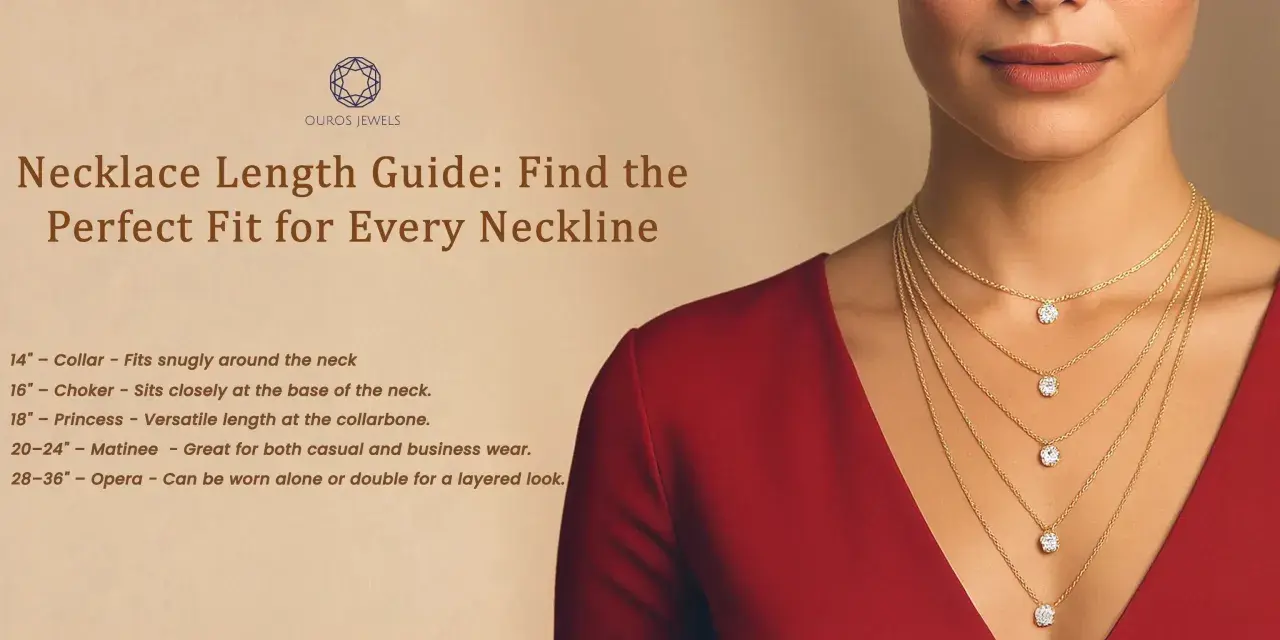
The right necklace length changes the whole line of an outfit. A chain that lands on the collarbone can make a shirt look sharper; a longer strand can soften a high neckline and give a pendant room to breathe. When people ask me for the best necklace length for women, I usually start with 18 inches, then adjust for body shape, neckline, and whether the piece is meant to be worn alone or layered.
The collarbone is the most useful starting point
- 18 inches is the most versatile default for most women because it usually sits at the collarbone.
- 16 inches works well for a neater fit, smaller necks, and open necklines.
- 20 inches is better when you want the necklace to sit lower or work over higher necklines.
- For layering, start with a base chain around 16 to 18 inches and separate layers by 2 to 4 inches.
- If you are buying blind, an adjustable chain with an extender is safer than a fixed length.
The safest place to start is the collarbone
If I had to choose one length without seeing the person, I would usually choose 18 inches, or about 45 cm. It is the most forgiving length because it sits close to the collarbone, which tends to flatter most necklines and most frames without feeling too tight or too long. In UK terms, that makes it the easiest all-round option for everyday wear, gifts, and pendants.
That said, the “right” length depends on the job you want the necklace to do. A delicate chain worn under a blouse often needs a different drop from a statement piece you want to show off with knitwear. Once you know that, the next step is seeing exactly where each standard length lands.
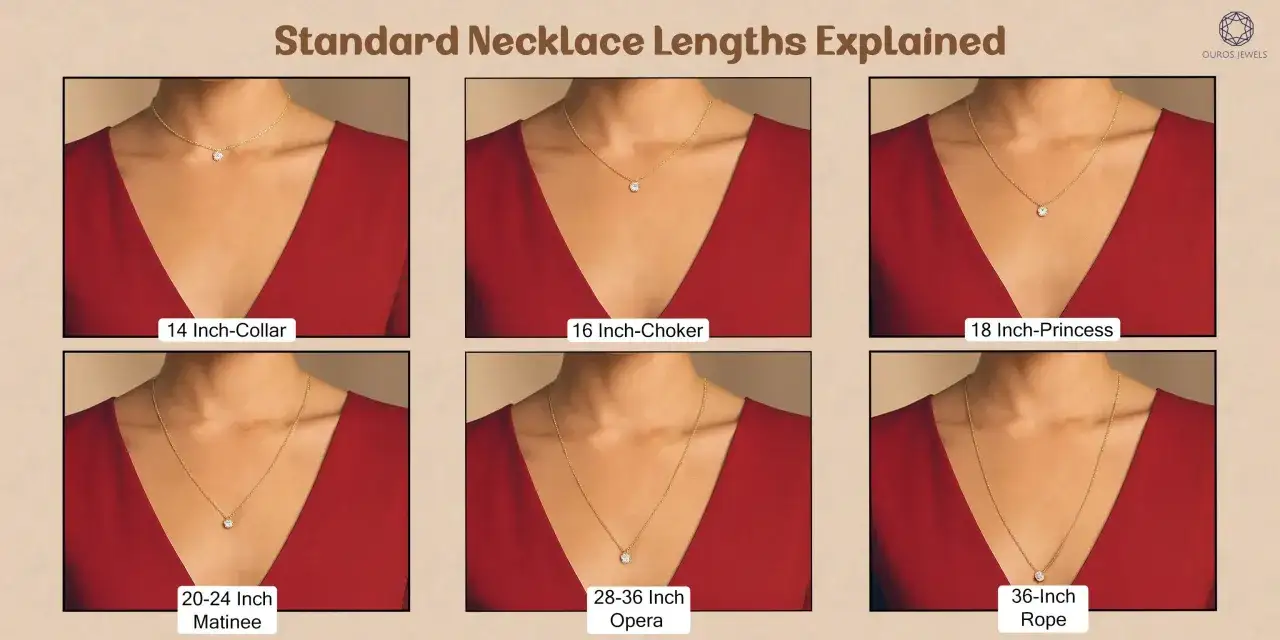
How common necklace lengths sit on the body
Necklace sizing is more useful when you think in positions, not just numbers. The same chain can look different on two people, but the standard length bands still give a solid reference point.
| Length | Approx. cm | Where it usually sits | Best use |
|---|---|---|---|
| 14 inches | 35 cm | Tight at the base of the neck | Fashion-led chokers, off-shoulder looks, strong focal points |
| 16 inches | 40 to 41 cm | At the base of the throat or just above the collarbone | Clean everyday wear, smaller necks, open necklines |
| 18 inches | 45 to 46 cm | At the collarbone | The most versatile choice for pendants and everyday styling |
| 20 inches | 50 to 51 cm | Just below the collarbone | Layering, higher necklines, slightly more relaxed drop |
| 22 inches | 55 to 56 cm | Between the collarbone and bust | Statement pendants and outfits that need more vertical line |
| 24 inches | 60 to 61 cm | At the top of the bust | Bolder pendants, knitwear, more dramatic styling |
| 30 to 36 inches | 76 to 91 cm | Mid-chest or lower | Eveningwear, long layers, doubled-up chains |
The useful detail here is not just the number. It is the visual effect: the shorter the chain, the more it frames the face and neck; the longer it gets, the more it creates vertical length and movement. That matters even more when you start matching the chain to a neckline.
Which lengths work best with different necklines
The neckline is usually the strongest clue. If the necklace and the opening of the garment are fighting each other, the whole look feels off even when the piece itself is beautiful. I prefer to let the clothing set the shape and let the necklace either echo it or sit just outside it.
| Neckline | Best starting length | Why it works |
|---|---|---|
| V-neck | 16 to 18 inches, or 18 to 20 with a pendant | Echoes the angle of the neckline and draws the eye down cleanly |
| Crew neck or round neck | 16 to 18 inches | Sits above or at the neckline without disappearing into the fabric |
| Boat neck | 16 to 18 inches | Respects the wide horizontal line and keeps the look balanced |
| Strapless or off-the-shoulder | 14 to 16 inches | Shows the collarbone and keeps the necklace close to the skin |
| Turtleneck or roll neck | 20 to 24 inches, or longer | Creates separation from the fabric and prevents the necklace from getting lost |
| Shirt collar | 18 to 20 inches | Works under an open collar or over a closed shirt without looking cramped |
| Scoop neck | 18 to 20 inches | Follows the softer curve of the neckline without crowding it |
For layering, I usually treat the necklace lengths like a visual staircase. A short base chain, then another piece 2 to 4 inches longer, gives enough space to stop tangling and enough contrast to make each layer readable. That approach is especially useful when you wear pendants, because it keeps the pendant from sitting awkwardly on the neckline seam. From here, the last piece of the puzzle is your frame, because proportions change how every chain lands.
How body proportions change the fit
I would not choose a necklace length from height alone. Two women can be the same height and still need different chains because of neck length, torso length, bust shape, and how they like their jewellery to sit. Face shape gets discussed a lot, but in practice the body line and neckline usually matter more.
| If you are... | Start here | What to watch |
|---|---|---|
| Petite or short-torsoed | 16 to 18 inches | Very long chains can overpower the frame or sit lower than expected |
| Tall or long-torsoed | 18 to 22 inches | Short chains may look tighter than you expect and lose presence on the chest |
| Broad-chested or fuller-busted | 18 to 22 inches | Too-short chains can ride up and sit awkwardly against the neck |
| Short-necked | 16 to 18 inches | Tight chokers can shorten the line visually, so leave a little breathing room |
| Long-necked | 16 to 20 inches | You can wear shorter lengths comfortably without crowding the neckline |
Pendant size matters here too. A small charm can sit happily on 16 or 18 inches, but a larger pendant often needs 20 inches or more so it hangs at a clean point instead of drifting into the collarbone. If you are building a jewellery box rather than buying a single piece, this is where an extender becomes genuinely useful rather than just a nice extra. That leads straight to the most reliable way to check fit before you spend.
How I measure before buying a chain
When I want a necklace to land in a specific place, I never trust the label alone. I check the actual drop, because a chain that is listed as 18 inches may still feel different once a clasp, pendant, or heavier link is added. A little measuring saves a lot of returns.
- Lay a necklace you already love flat and measure it from end to end, including the clasp.
- If you do not have a reference piece, use a string or ribbon around your neck and mark where you want the chain to sit.
- Measure that string against a ruler, then compare it with the product length in inches or centimetres.
- If you are buying a pendant, allow extra room for the charm drop so it does not sit higher than expected.
- Choose an extender if you are between sizes; a 2-inch extender gives useful flexibility for different necklines and knitwear.
I also pay attention to how the chain behaves over clothes. A neat 16-inch chain can vanish under a high neckline, while a 20-inch chain can sit perfectly over a fine-knit jumper. If your wardrobe moves between tailoring, shirts, and knitwear, an adjustable chain is usually smarter than a fixed one. That brings me to the simplest buying rule of all.
What I would buy if I needed one necklace to do most jobs
If I had to choose one chain for a woman with no further information, I would buy an adjustable 16 to 18 inch necklace or a clean 18-inch chain with a simple extender. That covers the collarbone length most people wear best, gives room for layering, and still works with pendants. It is not the most dramatic choice, but it is the one most likely to be worn often.
- Choose 16 inches if you want a neat, close fit or you wear a lot of open necklines.
- Choose 18 inches if you want the most versatile everyday length.
- Choose 20 inches if you wear higher necklines, shirts, or heavier pendants.
- Choose 22 to 24 inches if you want a statement look or more vertical length.
For most wardrobes, the best result is not a single universal number but a chain that lands where the outfit needs it to land. If you remember only one rule, make it this: start at the collarbone, then move shorter or longer based on neckline, pendant weight, and how much contrast you want from the clothing.