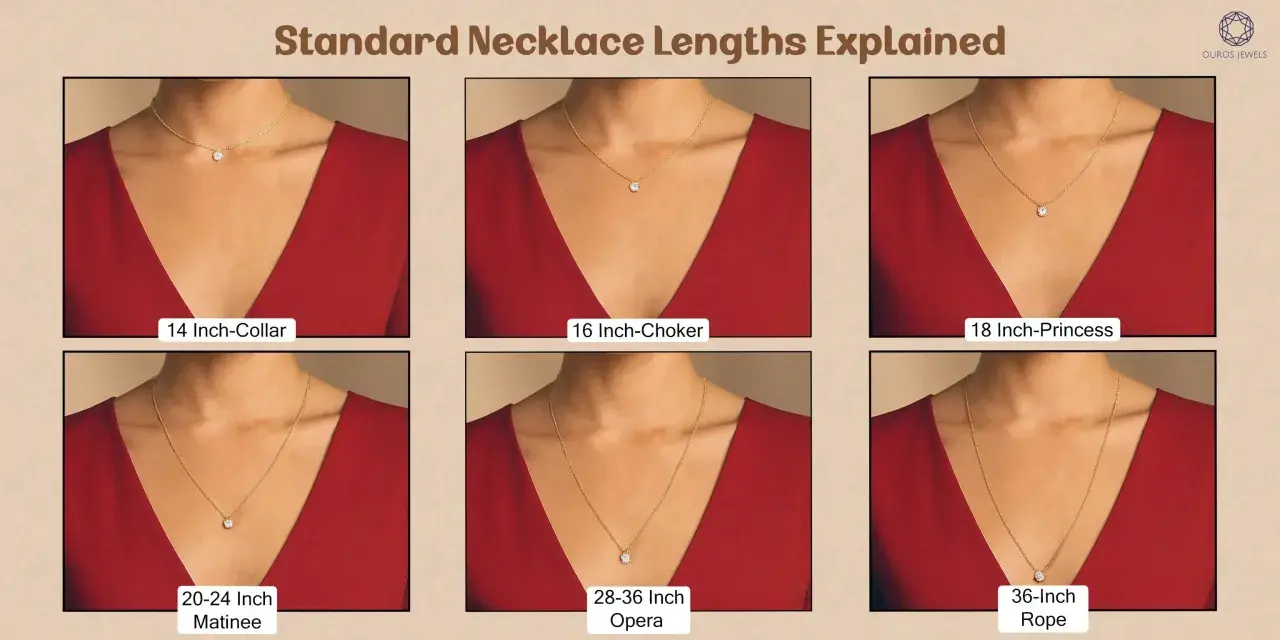
Understanding necklace lengths matters more than most buyers expect. The same chain can look crisp, romantic, or awkward depending on where it sits on the body, and the right choice changes how a neckline, pendant, or layered set reads at a glance. In this guide, I break down the standard sizes, how they translate into centimetres, and how I would choose one for everyday wear, statement styling, or a gift.
The main lengths to keep in mind before you choose
- 18 in / 45 cm is the most versatile starting point for everyday wear.
- 14-16 in gives a closer fit and a sharper, more fashion-led look.
- 20-24 in works well for pendants, higher necklines, and a little more movement.
- 30 in and longer create drama and are easier to style as a statement or layered piece.
- Check whether the pendant drop is included in the chain measurement, because it changes where the piece actually lands.
- UK retailers often list both inches and centimetres, so it is worth reading both numbers instead of guessing from one alone.
The standard lengths and where they sit
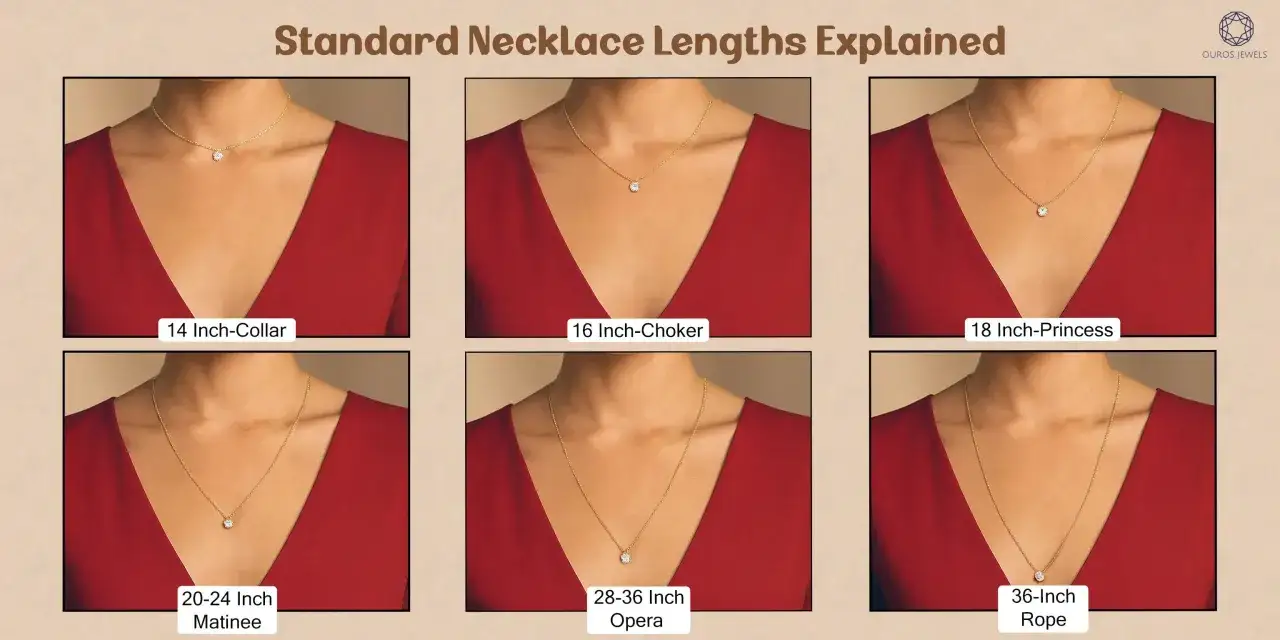
Most brands sell chains in 2-inch steps, so the numbers you see most often are 14, 16, 18, 20, 22, 24, 30, and 36. I usually treat them as a starting map rather than a fixed rule, because neck size, height, torso length, and pendant drop all change where the same chain lands.
| Name | Length | Centimetres | Where it usually sits | Best used for |
|---|---|---|---|---|
| Collar | 12-14 in | 30-35.5 cm | High on the neck or very close to the base | Fashion-led looks, open necklines, dramatic pearls |
| Choker | 14-16 in | 35.5-40.5 cm | At the base of the neck or just above the collarbone | Bold styling, short chains, layering foundations |
| Princess | 17-19 in | 43-48 cm | At or just below the collarbone | The classic everyday pendant length |
| Matinee | 20-24 in | 50.8-61 cm | Upper chest | Statement pendants, workwear, higher necklines |
| Opera | 28-36 in | 71-91.5 cm | Below the bust in a long drape | Evening looks, longer pearls, doubled styling |
| Rope | 36+ in | 91.5+ cm | Long, fluid drape | Knotting, wrapping, creative layering |
For most people, the sweet spot is still around 18 in / 45 cm. In UK shops, that is often the number to remember if you want one chain that can work with a plain top, a pendant, or a light layered set. Once you understand where the main sizes fall, the next step is matching them to the neckline you actually wear.
Choose by neckline, not just by number
A chain can be the right size and still feel wrong if it fights the neckline of the outfit. I look at the opening of the garment first, then decide whether I want the necklace to echo that shape, sit inside it, or deliberately contrast with it.
| Neckline | Good chain lengths | Why they work |
|---|---|---|
| Crew neck | 16-18 in / 40.5-45.7 cm | Keeps the look clean and prevents the chain from disappearing under the fabric |
| V-neck | 18-22 in / 45.7-55.9 cm | Echoes the opening and draws the eye downward in a balanced line |
| Scoop neck | 16-20 in / 40.5-50.8 cm | Follows the curve without crowding the throat |
| Boat neck | 18-24 in / 45.7-61 cm | Creates length against a wide horizontal line |
| Turtleneck or roll neck | 20-30 in / 50.8-76.2 cm | Sits over the fabric instead of disappearing into it |
| Strapless or off-the-shoulder | 14-18 in / 35.5-45.7 cm | Frames the collarbone and keeps the focus on the shoulders |
Body proportions matter too, but not in a rigid way. A 45 cm chain can feel perfectly relaxed on one person and slightly shorter on another, so I never rely on a chart alone. As a rough starting range, many women find 40-45 cm comfortable for everyday wear, while many men start closer to 55-63 cm, but the real test is where the chain lands on the body rather than the label on the box. From there, the real styling question is whether the piece should stand alone, sit in a stack, or become the base for a pendant.
Layering works best when the spacing is deliberate
Layering looks expensive when the chains are separated enough to read as individual lines. When they sit too close together, they twist, tangle, and lose the visual rhythm that makes layered jewellery feel intentional.
- Start with a base chain around 16-18 in / 40.5-45.7 cm.
- Add the next chain 2-4 in / 5-10 cm longer so each layer has room.
- Mix textures, such as a fine chain with a heavier link or a plain chain with a pendant, so the layers do not compete.
- Use one focal piece only. Two strong pendants usually feel crowded; one pendant and one clean chain usually feels sharper.
- Keep an extender on hand if a favourite chain sits almost right but not quite.
I see the same mistake often: three chains with almost no difference in length. They look neat on a hanger, then collapse into one line the moment they move. The small detail people miss is weight. Two chains of similar thickness and finish are much more likely to tangle than two chains with a clear difference in scale.
Once the spacing is right, measuring the piece against your own body is the easiest way to make the choice real.
Measure at home before you buy
If you are shopping online, a minute with a tape measure saves a lot of returns. The goal is not perfect maths; it is to get close enough that you know how a chain will behave before it arrives.
Measure a length you already like
- Wrap a flexible tape measure or a piece of string around the point where you want the chain to sit.
- Mark the spot where the ends meet.
- Lay the string flat and measure it in inches or centimetres.
- Compare it with a necklace you already wear well, or repeat the test with a pendant style if that is what you plan to buy.
Read Also: How to Layer Necklaces - Stop the Tangles & Look Polished
Account for the pendant drop
If the necklace has a pendant, do not stop at the chain length. The pendant adds extra drop, so a 45 cm chain with a 3 cm charm can behave more like a 48 cm piece once it is on. This is one of the most common reasons a necklace feels longer than expected. The same applies to an extender chain, which usually adds 1-2 in / 2.5-5 cm of extra room for fine-tuning. If the chain has an adjustable clasp, note both settings, because a piece that spans two sizes can give you two very different fits.
If you are between two sizes, I usually lean shorter for a close, polished fit and longer for a relaxed fit or layered set. That small decision changes how the piece moves, how it sits with clothing, and how often you will reach for it. Once the fit is clear, the last question is what mood the length creates.
The same length can read very differently in style
Chain length does more than solve fit. It changes the mood of the entire piece. A short necklace reads sharper and more graphic, while a longer one feels more relaxed, more fluid, and often more luxurious.
- Short lengths feel modern, precise, and slightly more fashion-driven.
- Classic collarbone lengths feel balanced and easy, which is why they work so well for everyday wear.
- Longer lengths feel softer and more dramatic, especially when worn over knitwear or evening fabrics.
- Pearls change character noticeably with length: a short strand can feel traditional, while a long strand feels more contemporary or theatrical.
A shorter chain can sharpen a plain T-shirt or shirt collar, while a longer strand softens tailoring and knitwear. I do not think of length as an afterthought; I treat it as part of the design language. The pendant, the metal, and the length all speak together, and when one of them is off, the whole piece feels less convincing. Once you see length as part of style rather than just measurement, choosing becomes much easier.
The rule I use when I want the fit to work every time
If I had to buy one chain without overthinking it, I would start at 18 in / 45 cm. It is the cleanest all-rounder for most adults, it sits in a flattering place on the body, and it gives enough room to wear alone or with a pendant. From there, I would move shorter only if I wanted a deliberately close, editorial look, and longer only if I knew I wanted a pendant, a higher neckline, or a layered effect.
That is the practical way I approach chain sizing: start with the collarbone, check the pendant drop, and think about the clothes you actually wear. Do that, and the measurement stops being guesswork and starts becoming a styling tool.