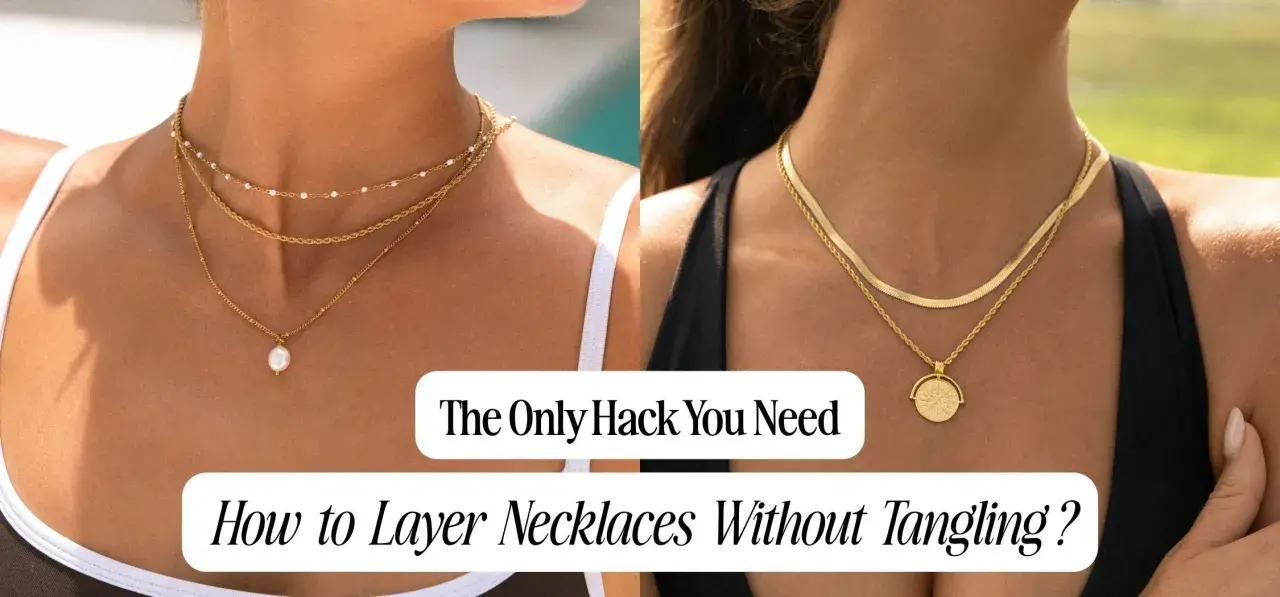
The fastest route to a clean, balanced stack
- Start with one anchor necklace and build around it, rather than adding pieces at random.
- Leave roughly 1 to 2 inches, or about 2.5 to 5 cm, between layers so each one is visible.
- Mix chain weights and textures, but keep one clear focal piece so the look does not feel crowded.
- Match the stack to the neckline and outfit, especially if you wear high collars or open shirts.
- Use extenders or a layering clasp if the lengths are too close together or the chains keep twisting.
The quickest way to make a layered stack look intentional
I always start with a base necklace that does one job clearly. That might be a fine chain sitting near the collarbone, a small pendant, or a short choker if I want the whole look to feel tighter and more modern. The point is to give the eye a starting place; once that anchor is in place, the other necklaces can support it instead of competing with it.
For everyday wear, I usually keep the stack to two or three pieces. More than that can work, but only if the spacing is disciplined and the chains are quite light. If every necklace is trying to be the star, the result looks busy instead of styled, and that is the difference most people notice first.Once the base is chosen, the next step is to set the lengths properly so the stack has room to breathe.
Choose lengths that create real separation
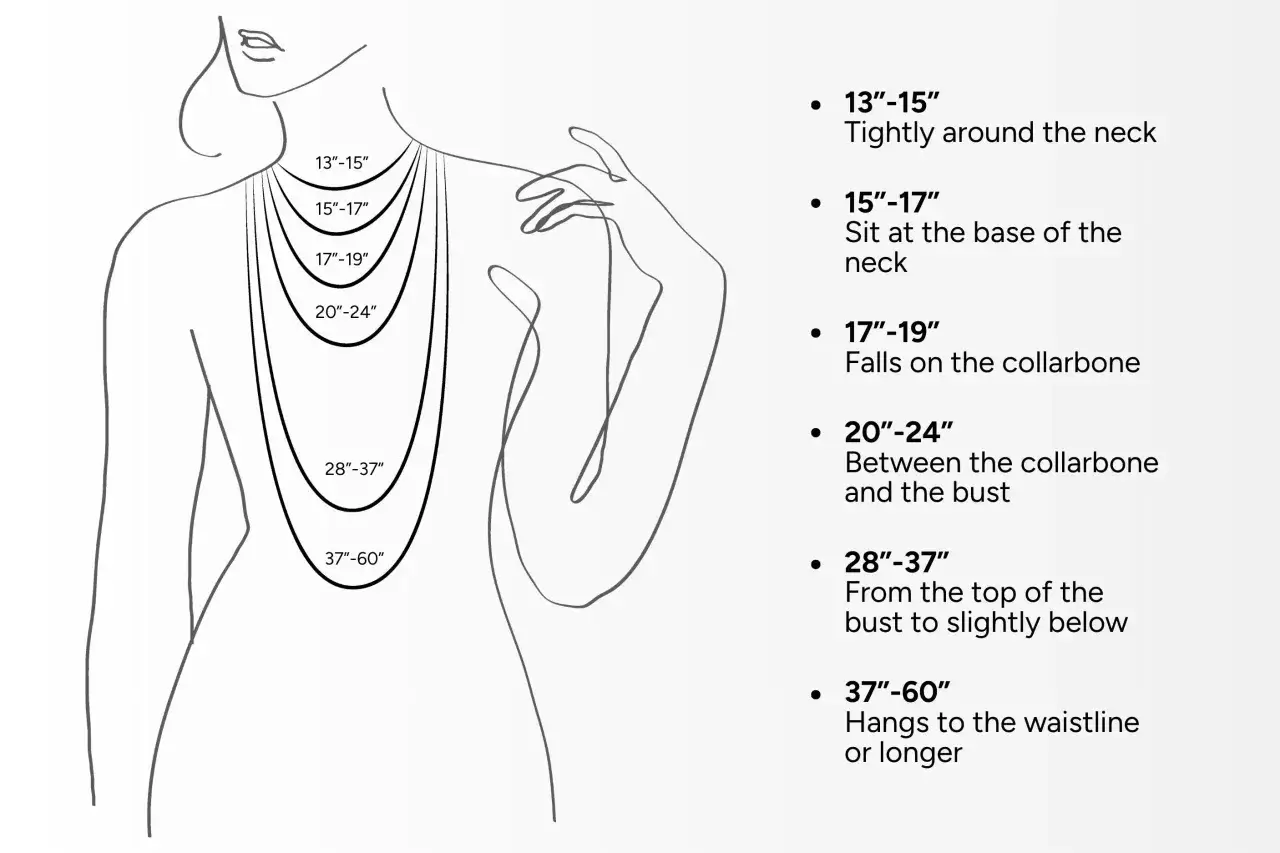
The simplest rule is to leave enough space between each necklace for the shapes to read separately. In practice, that usually means around 1 to 2 inches between layers. I find that a smaller gap can work for very delicate chains, but once pendants enter the picture, the spacing needs to be generous enough that the pieces do not sit on top of each other.
| Length | Approx. cm | Where it sits | Best use in a stack |
|---|---|---|---|
| 14 inches | 35.6 cm | High on the neck | Choker-style base or a very close, modern top layer |
| 16 inches | 40.6 cm | At the collarbone | Most versatile starting point for a neat everyday stack |
| 18 inches | 45.7 cm | Just below the collarbone | Works well as the middle necklace, especially with a pendant |
| 20 inches | 50.8 cm | Upper chest | Gives the stack a longer line and helps separate focal pieces |
| 22 to 24 inches | 55.9 to 61 cm | Lower chest | Good for a final drop layer or a statement pendant |
A simple 16-18-20 inch ladder is often enough for a polished look, but I adjust it depending on body shape and neckline. Petite frames may look best with slightly shorter spacing, while a longer torso can carry a wider spread without the necklaces overlapping visually. If one pendant is noticeably larger than the others, I give it more room than the chain alone would suggest.
Once the lengths are working, the stack becomes much easier to style because texture and shape can do their job without fighting for space.
Mix texture and shape without making the stack noisy
This is where a necklace stack starts to feel edited rather than random. I like to combine at least one smooth chain with one piece that has character, such as a pendant, a fine curb chain, a paperclip chain, a strand of pearls, or a small charm. The contrast keeps the eye moving, but I still want one necklace to lead the composition.
Mixed metals can work very well, especially when the finishes are deliberate rather than accidental. Gold with silver no longer looks like a mistake when the proportions are calm and the pieces have a shared mood. What usually goes wrong is not the metal mix itself, but the lack of hierarchy: every chain is equal, so nothing feels designed.
My rule is simple: one statement, one supporting piece, and one quiet piece. That gives you variety without visual clutter, and it works just as well for office wear as it does for evening outfits. With the material mix under control, the next decision is where the stack should sit on the body.
Match the stack to the neckline and outfit
The neckline shapes the whole composition more than most people expect. A necklace stack that looks perfect with a scoop neck can feel awkward under a high collar, and a dramatic pendant can disappear if the top already has strong detail. I always check the clothes before I finish the jewellery, because the stack should respond to the outfit rather than fight it.
| Neckline | What works best | What to avoid |
|---|---|---|
| Crew neck or T-shirt | A short base plus one or two layers that drop below the neckline | Too many short pieces that all sit in the same zone |
| V-neck | A pendant or central drop that echoes the V shape | Flat, boxy layers that ignore the line of the neckline |
| Button-down shirt | One short chain and one longer layer inside the open collar | Very delicate chains that disappear into busy fabric |
| High neck or turtleneck | Longer chains that start lower on the chest | Chokers that fight the neckline or get visually lost |
| Strapless or off-shoulder top | Shorter layers with a clear centre point | Overly long stacks that pull the eye too far down |
For formal events, I usually keep the stack cleaner and let the outfit do more of the talking. For casual clothes, I can be looser with mixed textures and small charms. Either way, the outfit should decide whether the stack is sharp and minimal or slightly more expressive. Once that relationship is right, the common mistakes become easier to spot and correct.
Fix the problems that make layers look messy
Most awkward necklace stacks fail for the same few reasons, and they are fixable.
- The lengths are too similar. If two chains sit almost exactly together, they tangle and visually merge. Increase the gap or move one necklace further down.
- Too many pieces have the same weight. Three heavy chains can feel blunt, while three very fine chains can disappear. Mix one heavier line with lighter support pieces.
- Every necklace has a pendant. Pendants compete when they all sit in the same zone. Let one piece be the clear focal point and keep the others quieter.
- The stack has no centre of gravity. If the pieces all pull in different directions, the eye has nowhere to rest. Align the longest piece so it grounds the group.
- The clasp sits badly at the back. If the chains start twisting from the clasp area, the front will never settle neatly. Re-clasp them at different starting points or use a layering clasp.
There is also a simple judgment call I make often: if the stack only looks good for the first five minutes, it is usually overworked. Taking one necklace off is often the better fix than trying to force a complicated combination to behave. Once you have cleaned up the problem areas, you can work with a few reliable formulas instead of guessing every morning.
A few stack formulas I actually use
These combinations are not rules, but they are dependable starting points. They work because each one creates a clear top, middle, and lower line without making the neckline feel crowded.
- Minimal everyday stack. A 16-inch fine chain, an 18-inch tiny pendant, and a 20-inch plain chain. This is the easiest option when you want polish without much effort.
- Modern mixed-texture stack. A short chain, a mid-length paperclip or curb chain, and a longer pendant. The different textures keep the look from feeling flat.
- Soft feminine stack. A delicate choker, a small gemstone necklace, and a longer fine chain. This works especially well when the outfit is simple and you want the jewellery to do more of the styling.
- Evening stack. One short statement chain, one very simple middle layer, and one longer piece with a small drop. That balance gives sparkle without letting the stack dominate the whole outfit.
If you are unsure where to begin, copy one of these formulas exactly and then change only one variable at a time. Swap the pendant, adjust the lengths, or change one metal finish, but do not alter everything at once. That approach makes it much easier to see what is actually improving the look.
The small habits that keep a stack looking polished all day
Once the necklace stack is in place, the details matter more than people expect. I fasten the shortest necklace first, then build downward, because that usually keeps the arrangement tidier at the back and cleaner at the front. If one chain keeps sitting too close to another, I add a small extender rather than forcing the whole stack to work at the wrong length.
I also avoid sleeping, exercising, or spraying perfume directly onto layered jewellery, because those habits turn a neat stack into a tangled one very quickly. Storing each necklace separately helps too, especially if the chains are fine or easily kinked. In the end, the best layered look is usually the one that feels calm, controlled, and easy to wear; if you keep one focal point, sensible spacing, and a neckline-aware shape, the whole arrangement will look considered rather than overdone.