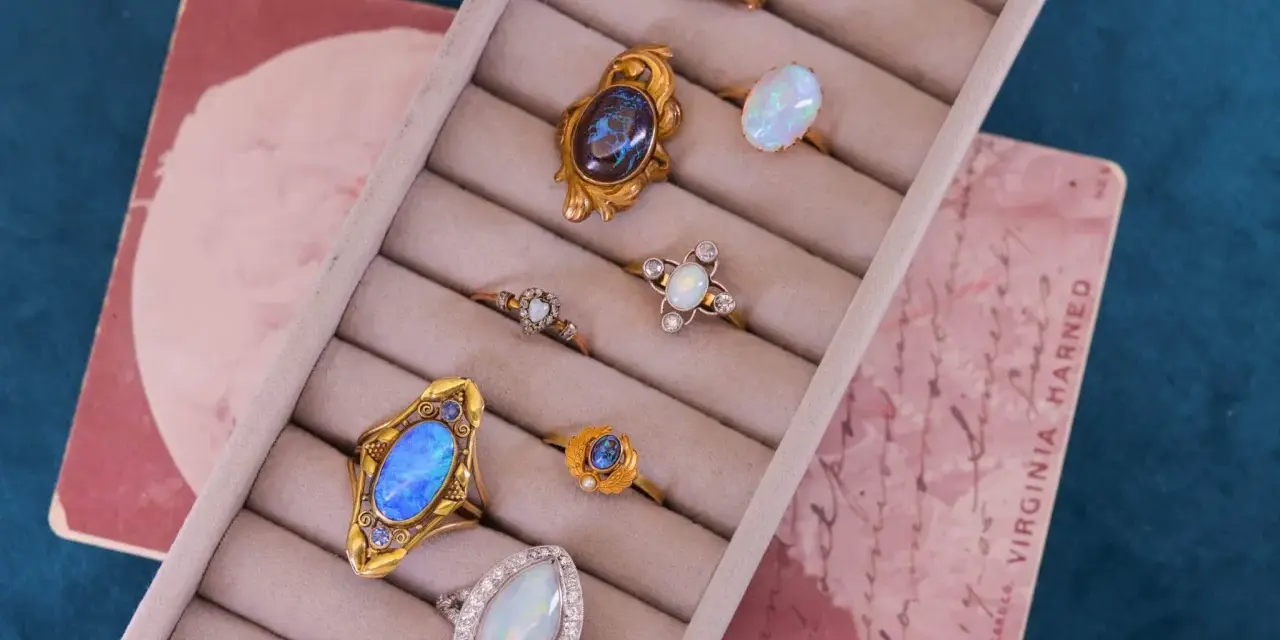
Jewelry with opal stones has a softness that still feels distinctive: the colour shifts as you move, so the piece never looks quite the same twice. In this guide, I focus on the styles that flatter opal best, how to choose the right metal and setting, and the practical checks that matter before you buy. I also cover the care rules I trust most, because opal rewards gentle wear and punishes careless habits.
The main things to know before you choose opal jewellery
- Opal is defined by play-of-colour, so simple designs usually let it look stronger.
- Pendants and earrings are easier to live with than exposed rings or bracelets.
- Bezel, halo, and low-profile settings tend to protect the stone better than open claws.
- In the UK, precious-metal jewellery above legal weight thresholds should carry hallmarks.
- Warm soapy water is safe for cleaning, but steam and ultrasonic cleaners are not.
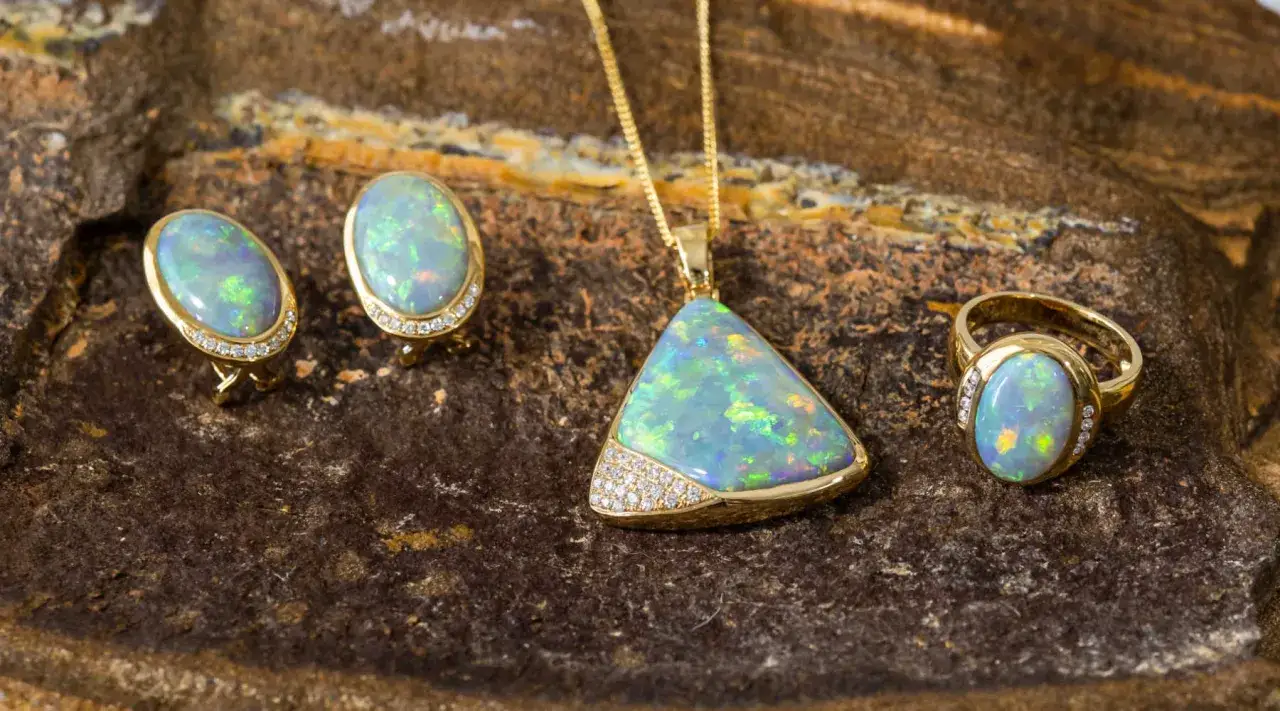
What makes opal jewellery stand out
Opal behaves differently from the usual “sparkle” stones. What draws the eye is not just brightness, but play-of-colour, the flashes of spectral tones that move when the stone turns. Precious opal shows that effect; common opal does not. Within the precious category, dark-background stones usually feel bolder, white opal reads softer and more romantic, and fire opal brings a warmer orange-to-red note that feels more contemporary.
I also look at the cut before I look at the size. Opal is often shaped as a cabochon, a smooth domed cut that lets the colour roll across the surface instead of breaking it into facets. In practice, that means the best opal pieces are usually the ones that give the stone room to breathe, rather than crowding it with too much metal or too many companion gems. That idea drives the style choices in the next section.
The styles that let opal do the talking
When I think about opal styles, I start with how much movement the piece will get. The stone looks best when it can catch light without being knocked around all day, which is why some formats work better than others.
| Style | Why it works | Best use |
|---|---|---|
| Pendant | Keeps the stone visible, away from impact, and easy to layer. | Everyday colour, gifts, neckline focus. |
| Stud earrings | Low fuss, close to the face, and less exposed to knocks. | Small opals, office wear, quiet elegance. |
| Drop earrings | Add movement, so even a modest stone can feel lively. | Evenings, dressier looks, soft statement pieces. |
| Ring | The strongest statement, but also the most exposed. | Best when set low and worn with care. |
| Brooch | Feels sculptural and vintage, especially with larger stones. | Tailored jackets, coats, occasion dressing. |
| Bracelet | Eye-catching, but least forgiving because it hits surfaces often. | Better for occasional wear than for daily use. |
If I had to start with one versatile format, I would still choose a pendant or a pair of studs. They show the stone well, stay comfortable, and do not ask as much of the wearer as a ring does. Once the style is clear, the next question is how the metal and setting should support it.
Choosing the right metal and setting
Yellow gold gives opal warmth. It softens white or milky stones and suits vintage-inspired pieces, especially when you want the opal to feel rich rather than icy.
White gold or platinum creates a cleaner, sharper contrast, which is useful with black opal or a stone that already has a lot of blue and green fire. Rose gold sits between the two and works beautifully when you want a slightly romantic finish, especially on blush, peach, or pale crystal opal.
For settings, I lean toward a bezel first, particularly for rings and any piece that will see regular wear. The metal rim protects the stone better than open claws and gives opal a sleek outline. A halo can work when you want a smaller centre stone to look fuller, but I think it is best when the surround stays restrained. If the design becomes too busy, the opal turns into decorative noise instead of the focal point.
A low-profile basket or partly enclosed setting also helps, because opal does not enjoy needless knocks. That matters even more when the piece has to pass the practical checks that come with buying in the UK.
What to check before buying in the UK
In the UK, I always check the hallmark before I get distracted by the stone. Pieces made from gold, silver, platinum or palladium above the legal weight thresholds should be hallmarked, and the marks should tell you the sponsor, fineness, and assay office. Gold is thresholded at 1 gram, platinum and palladium at 0.5 gram, and silver at 7.78 grams, so very small items can fall below the legal limit. That means a missing hallmark on tiny studs or a light pendant is not automatically a problem, but a larger piece without one deserves an explanation.
Then I ask what kind of opal I am actually looking at. Solid opal is one continuous stone and is the most straightforward option. Doublets use a thin opal slice backed with another material, while triplets add a protective cap. Both can look brilliant for the money, but they are layered constructions and need gentler treatment than a solid stone.
| Construction | What it is | Why people buy it | What to watch for |
|---|---|---|---|
| Solid opal | One continuous stone. | Best all-round choice for value, longevity, and simplicity. | Usually costs more and still needs careful wear. |
| Doublet | A thin opal layer bonded to a backing. | More affordable, often vivid face-up. | Keep it away from rough wear and prolonged moisture. |
| Triplet | Opal slice with a protective top cap and backing. | Bright look at a lower entry price. | The layered structure is least forgiving if damaged. |
For value, I do not focus on carat weight alone. Colour intensity, the spread of the colour pattern, body tone, clarity, and cut all matter. Black opal is often the most prized because the dark background makes the colour flash harder; white opal is more common in jewellery; fire opal is judged a little differently because the colour body is the point. If a seller cannot clearly tell you whether a stone is natural, treated, synthetic, or assembled, I would treat that as a warning sign. Once you know what you are buying, the real question becomes how to keep it looking that way.
How to wear opal pieces without making them feel fragile
Opal can look surprisingly modern if the rest of the outfit stays disciplined. I like it against navy, charcoal, black, cream, denim, and textured knitwear, because those fabrics let the stone supply the colour without competition. A single opal pendant over a plain shirt often reads more elegant than a heavily layered neckline, and a small pair of studs can soften tailoring without making it feel ornate.
When I want opal to feel current rather than costume-like, I keep the rest of the jewellery simple. That might mean a plain gold chain, a slim bracelet, or no other coloured stones at all. If the opal is already flashing blue, green, pink, and orange, it usually does not need help. It needs space.
- For work, keep the scale modest with studs or a narrow pendant.
- For evenings, drop earrings or a ring with a clean profile can look polished without overpowering the outfit.
- For gifting, opal makes sense for October birthdays and is traditionally linked with the 14th wedding anniversary.
- For a vintage feel, brooches and cluster designs create character without looking fussy when the stone is the main event.
That styling rule also helps when you are narrowing down which pieces are worth buying first, because the most wearable opals are usually the ones that stay protected while still being seen.
How to keep opal bright without overhandling it
Opal care is simple, but it is not casual. GIA notes that warm soapy water is safe, and that is still the method I trust most: lukewarm water, mild soap, a soft brush if needed, and a lint-free cloth. I avoid ultrasonic and steam cleaning completely, because they add the kind of stress opal does not need.
- Remove opal rings before the gym, DIY work, gardening, or washing up.
- Keep them away from perfume, hairspray, bleach, and household cleaners.
- Store each piece separately in a soft pouch or lined box.
- Avoid sharp knocks and sudden temperature changes.
- Dry the stone gently after cleaning and never leave it soaking as a routine.
There is an old habit of storing opals in water, but I would not rely on that as a cure. In very dry rooms it may help the air around the stone, but good storage, stable temperature, and a light touch matter more. With that in place, choosing the first opal pieces becomes much easier.
The opal pieces I would choose first for the best mix of beauty and wearability
If I were building a small opal collection from scratch, I would start with three formats. A bezel-set pendant is the safest all-round choice because it shows the colour well and does not get hit constantly. Small studs are the quietest option and probably the easiest to wear often. A low-set ring is the most expressive, but I would only choose it if the wearer is willing to treat it as a special piece rather than a hard-working daily ring.
That is the balance I keep coming back to with opal: let the stone stay visible, protect it from rough use, and keep the design honest. When those three things line up, the result feels considered rather than precious, which is exactly why opal still works so well in modern jewellery wardrobes. It is colour with restraint, and that is a combination worth choosing carefully.