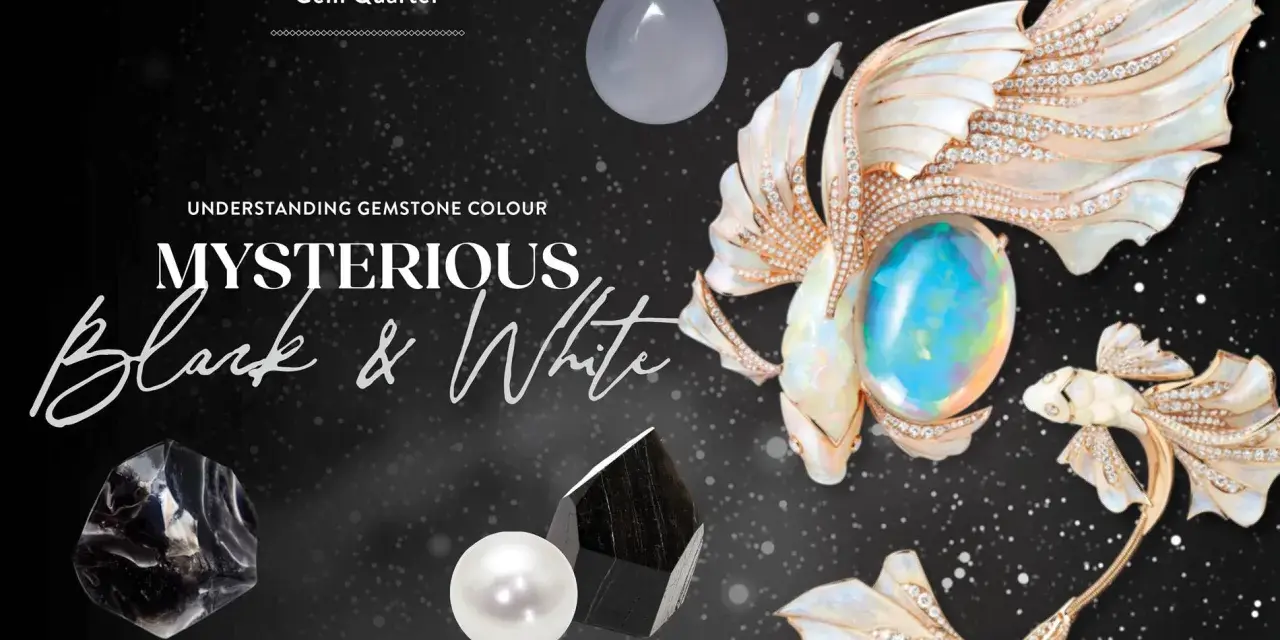
Monochrome gemstones have a direct, graphic look that can feel modern one minute and archival the next. A black and white gemstone can work for a statement ring, a quiet pendant, or a more tailored everyday piece, as long as you understand what creates the contrast and how much wear the stone can actually handle. In the sections below, I focus on the examples worth knowing, the differences that matter when you buy, and the styling and care choices that keep the look sharp.
What matters most before you choose one
- Black-and-white colour usually comes from banding, inclusions, opacity, or strong surface contrast rather than a single simple hue.
- Onyx, banded agate, zebra jasper, snowflake obsidian, pearls, and black or white diamonds are the names I would check first.
- Durability matters as much as colour, because pearls and obsidian need far more care than agate or diamond.
- In the UK market, I would always ask whether a stone sold as onyx is dyed chalcedony or naturally banded material.
- The best setting is usually the one that lets the pattern or lustre stay visible, not the one that buries the stone under metal.
What creates the contrast in these stones
Black-and-white gemstones are not a single mineral family. The look can come from alternating bands, microscopic inclusions that scatter light, or a naturally dark body colour interrupted by lighter patches. In GIA’s research on fancy black and fancy white diamonds, for example, the colour is linked to inclusions and transparency effects rather than to a simple tint shift, which is why those stones sit in a very different category from standard colourless diamonds.
That difference matters because it affects both value and wear. A stone that looks dramatic because of banding can be beautiful in a pendant even if it is not ideal for a ring, while a translucent gem with a milky appearance may be rare and desirable but still more fragile than its polished surface suggests. I always start by asking what actually creates the look before I think about style. Once that is clear, the examples become much easier to compare.
The stones I would put at the top of the list
When I think about monochrome jewellery, I separate the stones into two camps: the ones that create a clean pattern and the ones that create a stronger visual surface contrast. Both can be excellent, but they do different jobs.
| Stone | What it looks like | Why it is useful | Practical note |
|---|---|---|---|
| Onyx | Clean black material with banding in classic forms; often cut into cabochons, beads, cameos, or intaglios. | It gives a very crisp, formal look and suits vintage-inspired jewellery especially well. | Gem-A notes that the name is often used for black-and-white-banded stones, but it is also applied to uniformly black material, so the label alone is not enough. |
| Banded agate | Alternating black, grey, and white layers that may be straight, curved, or concentric. | One of the best stones for visible pattern, especially in pendants and statement rings. | Usually durable enough for regular wear, but quality varies with the clarity of the bands and the polish. |
| Zebra jasper | Striped or veined black-and-white pattern with a more graphic, earthy feel. | Good for bold jewellery when you want contrast without a glossy, over-refined finish. | Best when the pattern is centred properly in the cut; otherwise the effect can look busy rather than intentional. |
| Snowflake obsidian | Black volcanic glass with pale, snowflake-like cristobalite spots. | It has one of the clearest black-and-white effects in nature and reads well even from a distance. | More brittle than agate or jasper, so I prefer it in pendants, earrings, and other lower-impact pieces. |
| Pearl | White, cream, grey, silver, or black body colour with strong lustre. | It is the softest, most elegant option if you want monochrome jewellery with a refined finish. | Pearls are far more delicate than most gemstones, so they need separate storage and gentle cleaning. |
| Fancy black or white diamond | Opaque black, milky white, or highly included stones with a distinctive light-scattering appearance. | The hardest and most durable choice in this group, and the one most suited to heirloom-level wear. | Do not confuse fancy white diamond with a standard colourless diamond; they are not the same thing. |
For me, the strongest pieces are the ones where the pattern does the work without needing a heavy design around it. If the stone already has visual tension, the setting should be calm.
How I would choose one for a ring, pendant, or pair of earrings
Jewellery type matters more than many buyers expect. A stone that looks excellent in a pendant can be awkward in a ring, simply because rings take more knocks, more skin contact, and more abrasion from daily life. I think in terms of hardness, toughness, and stability, not hardness alone.
| Jewellery type | Best choices | Why they work |
|---|---|---|
| Ring | Diamond, agate, jasper | These are the better options for daily friction, especially if the stone is set low or protected by a bezel. |
| Pendant | Agate, onyx, pearl, obsidian | There is less impact, so even softer stones can look excellent without being overworked. |
| Earrings | Pearl, diamond, agate | Comfort and movement matter more than direct abrasion, which makes earrings a good place for delicate stones. |
| Brooch or statement piece | Large banded agate, zebra jasper, snowflake obsidian | The pattern is visible from a distance, and wear is usually lighter than on a ring or bracelet. |
If I were choosing for an everyday ring, I would avoid pearl and be cautious with obsidian. If I were choosing for a pendant, I would be far more flexible and let the design lead.
How to style monochrome stones without making them look harsh
Many people assume black-and-white jewellery only suits stark tailoring. In practice, it works just as well with cream knitwear, denim, silk shirts, and mixed-metal stacks if the rest of the look stays quiet. The point is contrast, not competition.
- Use round or oval cabochons when you want the stone to feel softer and more wearable.
- Use sharp step cuts or geometric settings when you want a more architectural effect.
- Let one strong monochrome piece lead; too many patterned stones in one look can feel busy.
- Pair high-contrast gems with solid colours such as black, white, charcoal, camel, or navy.
- For evening wear, pearl and diamond give the cleanest finish; for daytime, agate and jasper feel more relaxed.
That last point matters more than people admit. A dramatic stone can look very different depending on whether you want polish, softness, or a more editorial feel, and the same piece can move between those moods with a change of setting or outfit.
How to check quality and care for it properly
This is where buyers save themselves the most regret. A good monochrome gem should look good now and still look good after years of wear, so I pay attention to origin, treatments, polish, and the realities of cleaning. The word on the label is only the start.
- Ask whether an onyx piece is naturally banded chalcedony or dyed material.
- Check whether the black-and-white pattern is centred and intentional, especially in cabochons and cameos.
- Look at the polish under light; dull areas can flatten the contrast quickly.
- Use lukewarm water, mild soap, and a soft cloth for agate, jasper, and most diamond pieces.
- Store pearls separately and keep perfume, hair spray, and cosmetics away from them until the last step.
- Avoid ultrasonic and steam cleaning for pearls, and avoid rough knocks for obsidian.
For pearls, I am especially cautious: GIA describes them as relatively soft, and in practice that means they should be treated as fine organic jewellery rather than as everyday hard-stone pieces. That single distinction saves a lot of unnecessary damage.
The shortlist I would start with for lasting contrast
If I wanted the most practical value, I would begin with banded agate or a well-described onyx piece. They deliver strong contrast, wear comfortably, and fit both modern and vintage styling. If I wanted something softer and more romantic, I would choose pearl, but only for pieces that will not take constant abrasion.
- Best value and strong everyday character: banded agate or onyx.
- Best quiet elegance: pearl in earrings or a pendant.
- Best bold statement on a lower budget: zebra jasper or snowflake obsidian.
- Best long-term heirloom option: fancy black or white diamond, if the budget justifies it.
If you want one black and white gemstone that stays relevant across seasons, choose the stone that matches the way you actually wear jewellery, not just the way it looks in a tray. The strongest pieces are the ones where colour, cut, and durability all line up.