Bridal earrings should do three things at once: flatter the dress, frame the face and stay comfortable long enough for a full day of photos, hugs and dancing. The best answer to the question of what earrings to wear on wedding day is to work backwards from the dress, hair and comfort level, not forwards from whatever looks brightest in the jewellery box. In this guide, I break down the choices that actually matter so the final pair feels intentional rather than improvised.
The quickest way to narrow the choice is to match the earrings to the whole look
- Detailed dresses usually need quieter earrings. If the gown already has lace, beading or embroidery, small studs or short drops often look more polished than a large statement pair.
- Simple dresses can carry more jewellery. Satin, crepe and minimal silhouettes leave room for longer drops, pearls or a little more sparkle.
- Hair changes the balance. Updos show more earring, while loose waves often need a shape that still reads in motion and in photographs.
- Comfort matters more than most brides expect. A wedding day can run 10 hours or more, so weight, backs and metal choice are not small details.
- Pick one focal point. If the veil, headpiece or necklace is already strong, the earrings should support the look rather than compete with it.
Start with the dress, not the jewellery box
The dress sets the rules more than the earrings do. A gown with a high neckline, heavy lace or strong embellishment usually wants something quieter near the face, because too much detail in one place can make the whole look feel crowded. By contrast, a clean strapless or sweetheart silhouette can take a longer drop, a refined chandelier or a more sculptural design without losing balance.
| Dress type | Earring direction | Why it works |
|---|---|---|
| High neck or halter | Studs, tiny drops or a very delicate cluster | Lets the neckline stay the focus and keeps the upper half visually clean |
| Strapless or sweetheart | Drop earrings, pearls, statement studs or light chandeliers | Creates balance and gives the face more presence |
| Off-the-shoulder | Medium drops or elegant studs | Echoes the open frame without overpowering it |
| One-shoulder | Slim drops, asymmetric styles or restrained studs | Keeps the look directional instead of visually busy |
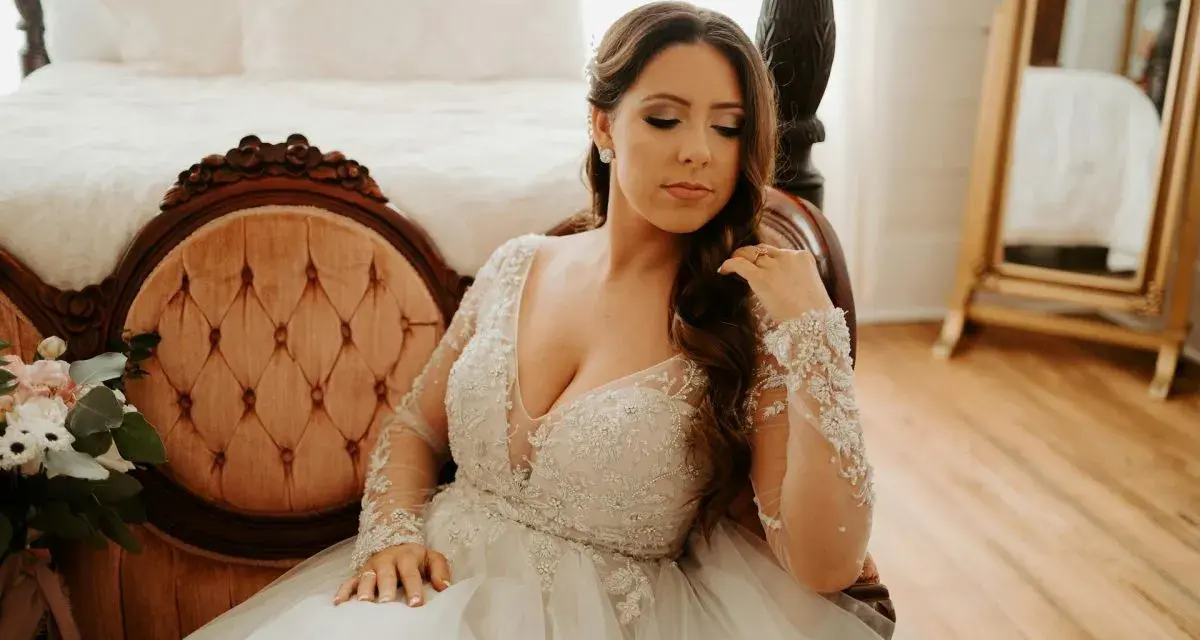
| Heavily beaded or lace-covered | Pearl studs, short drops or small diamond earrings | Prevents the jewellery from competing with the dress texture |
| Minimal satin or crepe | Longer drops, sculptural shapes or refined chandeliers | Gives the simplicity of the dress a focal point near the face |
A useful rule of thumb is this: if the dress already has visual weight, keep the earrings closer to the ear; if the dress is pared back, the earrings can carry more of the styling story. Once the silhouette is clear, the hairstyle usually tells you how much movement the earrings need.
Let your hairstyle and veil shape the final choice
Hair can change an earring more than the earring itself changes the outfit. An updo opens up the ears and neckline, so even a modest pair can read clearly. Hair worn down, especially in soft waves, often needs a little more length or brightness because the earrings have to stay visible through movement and shadows. I also pay close attention to the veil or hair accessory, because the prettiest pair in isolation can disappear once everything is worn together.
- Sleek bun or low chignon - good for drops, ear climbers and statement studs. The clean hairline gives the earrings room to breathe.
- Loose waves - better with medium-length drops, bright stones or slightly larger studs that still show through the hair.
- Hair fully down - usually needs sparkle, shape or length. Tiny pieces can vanish unless the hair is tucked back.
- Half-up, half-down - the most flexible option; it can support pearls, small drops or a more decorative pair.
- Veil or hair vine - if these are detailed, I usually keep the earrings cleaner so the look does not start competing with itself.
If you are doing a hair trial, bring the earrings with you. That is the easiest way to see whether the scale is right, especially if the style sits close to the cheek or moves around the face. Once hair and veil are sorted, the metal and stone finish becomes much easier to judge.
Choose metal and stone with the rest of your jewellery in mind
Bridal earrings do not need to match everything perfectly, but they should belong to the same visual family as the ring, necklace and headpiece. If your engagement ring already has a strong diamond, for example, the earrings can either echo that brightness or soften it with pearls. If your whole look is warm and romantic, yellow gold and ivory-toned pearls often feel more cohesive than a cool, high-shine finish.| Material | Best for | What it gives the look |
|---|---|---|
| Yellow gold | Warm skin tones, vintage-inspired dresses and softer ivory fabrics | A rich, classic finish that feels romantic rather than stark |
| White gold or platinum | Cool-toned gowns, modern silhouettes and diamond-heavy looks | A crisp, bright finish that photographs cleanly |
| Rose gold | Soft romantic styling and brides who want something a little less expected | A gentle blush tone that feels contemporary but still elegant |
| Pearls | Classic, civil or church ceremonies, and dresses that need softness | Quiet luminosity rather than hard sparkle |
| Diamonds or clear stones | Formal weddings, evening receptions and minimalist gowns | Sharper light return and more visible sparkle in photos |
| Coloured stones | Brides who want a personal accent or a subtle something blue | Character, symbolism and a little individuality |
Read Also: Bracelet Styles Guide - Find Your Perfect Fit & Look
A rough budget map I would use in the UK
Price matters because bridal earrings are often worn for a single long day, then ideally again after the wedding. I usually think in three broad bands: under £100 for good fashion jewellery or sterling silver pieces, £100 to £300 for gold vermeil, freshwater pearls or small lab-grown stone designs, and £300 to £1,000+ for solid gold, platinum or diamond pieces that can become long-term keepsakes. If you want the earrings to live beyond the wedding album, spending a little more on material quality is often smarter than spending more on size.
The current bridal mood leans toward pieces that still feel wearable after the big day. That is one reason pearls, refined drops and small diamonds remain such reliable choices: they do the wedding job without looking trapped inside it. With the palette set, the actual style becomes the next decision.
Which earring styles actually work on a wedding day
Style is where brides often overthink the choice. The best wedding earrings are not automatically the biggest or the most expensive; they are the ones that sit naturally against the rest of the look. I tend to divide them by how much visual weight they carry, because that is easier to use than chasing trend labels.
| Style | Best for | My read on it |
|---|---|---|
| Studs | Heavily detailed dresses, long ceremonies and brides who want the safest option | Timeless, understated and almost impossible to get wrong, especially if the stone or pearl quality is good |
| Pearl drops | Romantic looks, soft lighting and updos | Elegant without feeling severe, and they move beautifully in photographs |
| Diamond or crystal drops | Minimal dresses, evening receptions and sleek hair | Best when you want clear sparkle rather than softness |
| Chandeliers | Simple gowns, formal venues and brides who want a proper statement | Strong, glamorous and not ideal if the dress or veil already has a lot going on |
| Hoops and huggies | Modern brides, registry office weddings and second-look receptions | Can feel fresh and current, but they need to look refined rather than casual |
| Ear climbers or sculptural pieces | Fashion-led brides and very simple outfits | Interesting and directional, but they only work when the rest of the styling is calm |
If I had to narrow it down fast, I would say this: studs are the safe classic, pearl drops are the soft romantic choice, and longer drops suit brides who want the earrings to be noticed. Chandeliers are the most dramatic, but they also ask for the most restraint elsewhere. Once the style is chosen, face shape becomes a useful tiebreaker rather than the starting point.
Face shape is useful, but it should not overrule the dress
Face shape can help when two pairs already suit the dress equally well. I would not let it dominate the decision, but I do think it is useful for fine-tuning the final pick. The aim is simple: add balance where the face needs it, without making the styling feel formulaic.
| Face shape | Usually flattering direction | Why |
|---|---|---|
| Round | Long drops, teardrops or vertical lines | Creates length and stops the jewellery from widening the face visually |
| Square | Curved drops, pearls or rounded clusters | Softens strong angles around the jawline |
| Heart-shaped | Drops with a little more width at the bottom | Balances a narrower chin and draws the eye downward gently |
| Oval | Most styles will work | Let the dress, hair and overall mood decide |
| Long | Studs, clusters or shorter drops | Keeps the face from looking even longer |
I treat this as a final check, not a hard rule. A bride with a long face may still look better in a longer earring if the dress is extremely simple and needs that vertical line. A round face can absolutely wear a larger design if the rest of the styling is balanced. That is why comfort and wear time matter so much next.
Comfort, security and wear time are the part people forget
A wedding day is not a two-minute photo shoot. You may be wearing the earrings for 10 to 14 hours, and the difference between a pair that looks lovely and a pair that truly works is often weight. If you can feel them tugging in the first few minutes, they will usually become annoying by the end of the ceremony, never mind the dance floor.
- Check the weight before the wedding. Put them on and wear them for at least 30 minutes at home. If they feel heavy at your desk, they will feel heavier after a long morning.
- Pay attention to the backs. Screw backs, secure butterflies or locking hoops are worth prioritising for pieces with any real weight.
- Choose skin-friendly metals if needed. If your ears are sensitive, 18ct gold, platinum or properly tested nickel-free options are safer than mystery plating.
- Think about snagging. Fine lace, veils and hairpins can catch on loose chains, fringes and delicate openwork.
- Test them with movement. Turn your head, hug someone and dance a little. If they shift too much, they are probably too lively for the day.
- Pack a backup. Spare backs, a soft cloth and even a second, simpler pair can save the afternoon if something feels wrong.
If you are choosing between two pairs and one is slightly lighter, I would usually take the lighter one unless the heavier pair is clearly better matched to the dress. The best bridal jewellery disappears into the day in the right way: present, but never distracting. That is exactly what the final fit check is for.
The final fit check I would do before leaving for the ceremony
The last decision should happen with the full look on, not with the earrings in isolation. I would put on the dress, the veil, the earrings and any necklace or headpiece together, then look at the face from a few angles and in both natural and indoor light. This is the moment when a pair that seemed perfect on the dressing table can reveal itself as too plain, too shiny or simply too much.
- Stand back and look in the mirror from at least two metres away.
- Take a quick photo on your phone; what looks balanced in a mirror can read differently on camera.
- Check whether the earrings compete with the neckline, or whether they are getting lost.
- Remove one accessory if the top half of the look feels crowded.
- If you are still torn, choose the pair you would genuinely wear again after the wedding.
If I were choosing for a bride today, I would start with a classic shape in a quality metal, then let the dress and hairstyle decide how much presence the earrings need. For most weddings, that means pearls, diamonds or a refined drop in a size that feels elegant rather than obvious. The right pair does not steal the scene; it makes the whole bridal look feel finished.