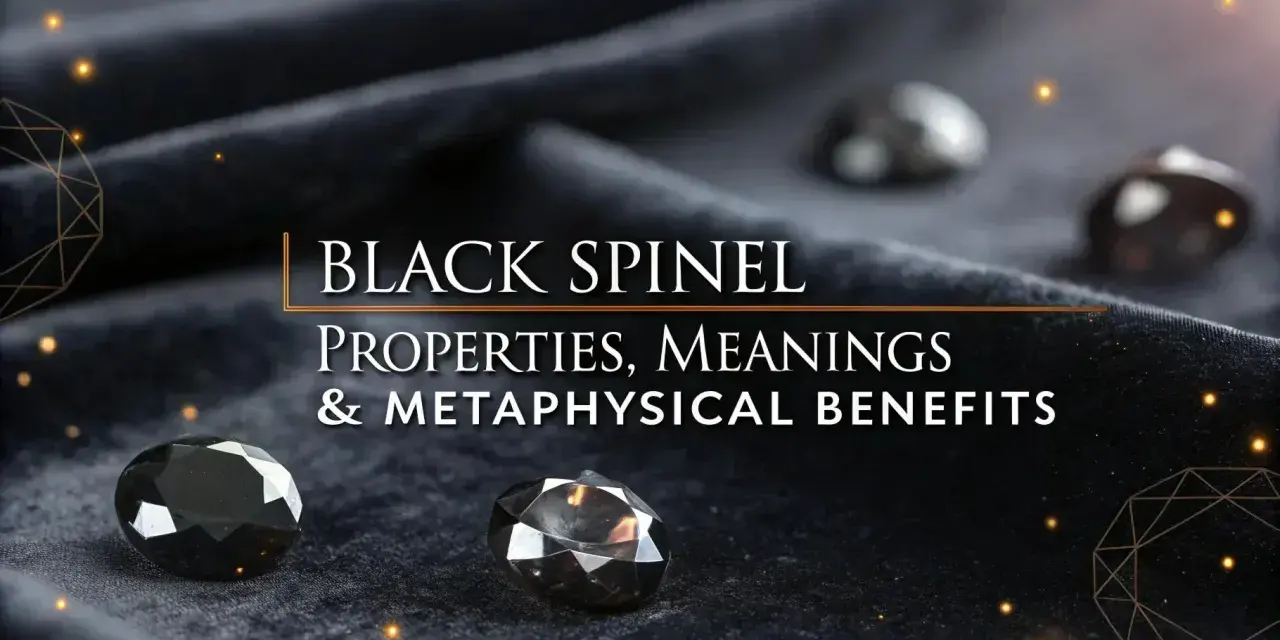
Black spinel has a very specific appeal: it looks restrained, elegant, and quietly powerful. The black spinel meaning usually centres on protection, grounded confidence, and resilience, but the stone is just as interesting for what it can do in jewellery; it is durable, versatile, and easier to live with than many people expect. In this article I look at the symbolism, the gemological properties, how it compares with other black stones, and how to choose and care for a piece that actually suits your style.
What to know before choosing black spinel jewellery
- Symbolically, it is usually linked with protection, grounded energy, and steady self-belief.
- Physically, spinel is durable enough for daily wear and ranks 8 on the Mohs scale.
- Its vitreous luster gives it a crisp, polished look that reads more refined than matte black stones.
- It is often chosen as a more accessible alternative to black diamond, especially in rings and pendants.
- Warm soapy water is the safest default for cleaning; ultrasonic or steam can be fine if the stone is not fractured or filled.
What black spinel symbolises in jewellery
There is no single historic script for the stone, so I read its symbolism as a cluster of related ideas rather than one fixed rule. Across modern jewellery and crystal traditions, it tends to stand for protection, grounded energy, self-trust, and resilience under pressure.
When I talk about black spinel meaning, I usually describe it as a stone of protection without aggression. That matters, because some black gemstones feel severe or overtly dramatic, while spinel feels more composed: it suggests boundaries, but not hardness for its own sake. In crystal traditions it is sometimes linked with the root chakra, which fits the broader idea of stability and security, but I treat that as symbolic language rather than science.
What I like about it is the mood it creates. It is not a loud luck charm and it is not a sentimental stone; it reads more like a quiet talisman for someone who wants calm, focus, and a sense of inner control. That is a useful distinction, because the emotional value of a black gemstone depends as much on its tone as on its colour, and this one is especially good at staying understated. Once that symbolism is clear, the practical question becomes whether the stone is actually well suited to everyday wear.
The properties that make it practical to wear
From a jewellery point of view, black spinel earns its reputation. GIA notes that spinel ranks 8 on the Mohs scale, has good toughness, and is stable in light and chemicals, which makes it a sensible choice for rings, earrings, and pendants that are worn often.
| Property | What it means in jewellery | Why it matters |
|---|---|---|
| Mohs hardness 8 | Resists scratching better than many dark stones | Good for everyday wear, including rings |
| Good toughness | Handles knocks better than brittle gems | Reduces the risk of chipping in normal use |
| Vitreous luster | Looks glass-like and polished when well cut | Gives the stone its sharp, refined finish |
| Stable in light and chemicals | Does not usually fade in ordinary conditions | Comfortable for routine wear and display |
| Usually easy to clean | Warm soapy water is safe; ultrasonic or steam can be suitable | Makes maintenance straightforward if the stone is not fractured or filled |
I also like that the stone behaves predictably. A well-cut black spinel should look glossy, even, and polished rather than flat. If it looks lifeless, the issue is usually the cut or polish, not the material itself. That is why the same stone can feel very different from one setting to another, which makes the comparison with other black gems worth looking at next.
How it compares with other black stones
GIA describes black spinel as a natural gemstone that more closely mimics the appearance of black diamond, with a vitreous luster and a strong balance of appearance, longevity, and affordability. That is the practical reason it keeps showing up in modern jewellery: it gives you a polished black look without the cost or formality of a diamond.
| Stone | Look | Durability | Best use | My read |
|---|---|---|---|---|
| Black spinel | Deep black, glossy, with crisp reflections | High for daily wear | Rings, pendants, earrings | The best all-rounder if you want refinement and practicality |
| Black diamond | Often darker and more metallic in feel | Exceptionally high | Luxury statement pieces | More prestigious, but usually a very different budget |
| Black onyx | Smoother and more matte to semi-gloss | Moderate | Vintage and graphic designs | Great for bold silhouettes, but less forgiving in everyday rings |
| Black tourmaline | More textured and sometimes striated | Moderate to good | Chunkier, more earthy jewellery | Good for a natural look, less ideal if you want a mirror-like finish |
| Jet | Very dark, light, and often satin-like | Soft | Antique or mourning-inspired pieces | Historically rich, but not a first choice for hard-wearing jewellery |
For most buyers, the real decision is usually between spinel and onyx. Spinel wins if you want shine, sharper definition, and better durability; onyx wins if you prefer a flatter, more graphic surface. That difference becomes more obvious once the stone is set into a ring or pendant, because the design can either sharpen the look or soften it.
Where it works best in real outfits
In the UK, I most often see black spinel work in clean, pared-back pieces that let the stone do the talking. It feels especially strong in sterling silver and white gold, where the cool metal keeps the look crisp, but it can also look excellent in yellow gold when you want a deeper, more editorial contrast.
- Rings work best when the cut is neat and the setting protects the edges. I would lean towards a bezel or a low-profile setting for everyday wear.
- Earrings are where black spinel can look surprisingly sharp. Small faceted studs or drops give you that black-glass effect without feeling heavy.
- Pendants suit the stone beautifully because they show off its depth without exposing it to as much impact as a ring.
- Bracelets can look excellent in a line of smaller stones, especially if you want a sleek alternative to diamonds or black onyx.
I find faceted stones more convincing than cabochons for most modern looks, because the faceting gives spinel life and stops it from disappearing into the outfit. A cabochon can still work, especially in a more sculptural or vintage piece, but the stone is at its best when it catches light cleanly. If you pair it with pearls, diamonds, or a sharp white shirt, it reads as confident rather than severe, which is exactly why it has become such a useful black gemstone in contemporary jewellery.
What I check before buying a piece
When I buy or recommend black spinel, I look at three things first: colour, cut, and disclosure. The colour should be a deep black with some life in the surface, the cut should be symmetrical and well polished, and the seller should be clear about whether the stone is natural, synthetic, treated, or fracture-filled.
- Ask for treatment disclosure if the stone is unusually cheap or unusually flawless.
- Choose a cut with clean symmetry; black stones show poor polishing quickly.
- Prefer a secure setting for rings, especially if you wear them daily.
- Store it separately from softer stones so it does not scratch other pieces in your box.
- Clean it with warm water, mild soap, and a soft cloth; that is the safest default.
- Use ultrasonic or steam cleaning only if you know the stone has no problematic fractures or filling.
If a piece looks too glossy but strangely flat, I would be cautious; sometimes the issue is not the stone but the cut, and sometimes it is not spinel at all. The good news is that a well-chosen black spinel piece is one of the easiest black gemstones to live with: it gives you depth, durability, and a quieter kind of luxury without asking for complicated care. For me, that balance is the real appeal, because it makes the stone feel both meaningful and genuinely wearable.