Key things to know before you buy or wear tiger's eye
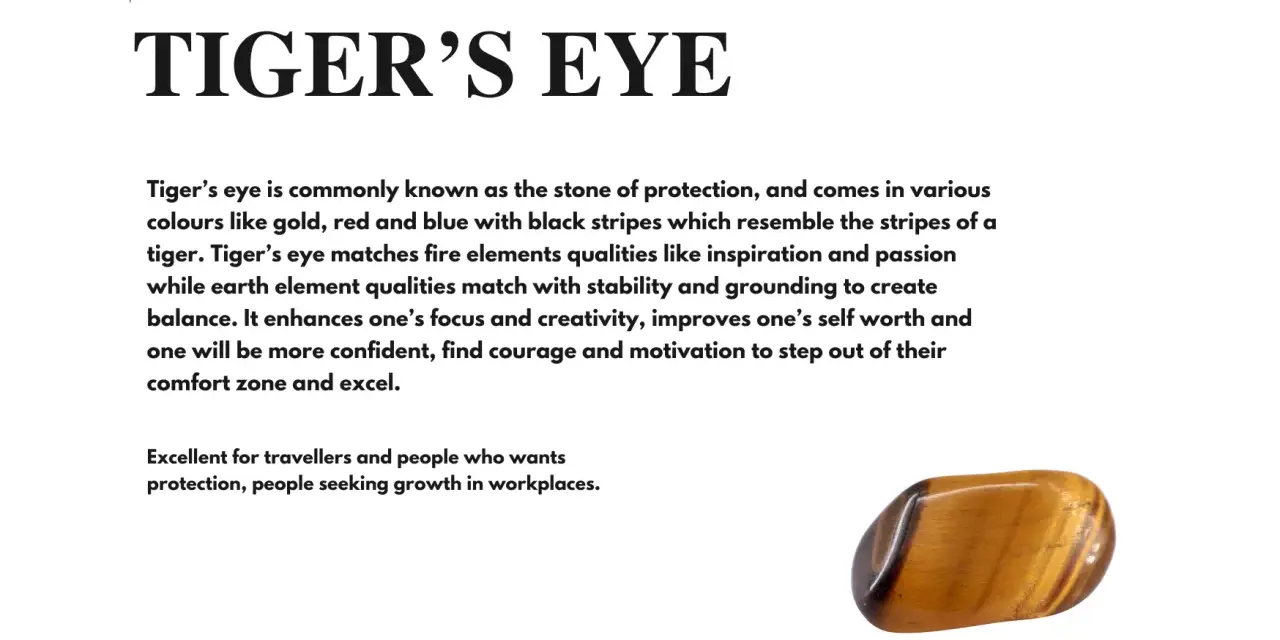
- Tiger's eye is a chatoyant quartz gemstone, which means it shows a moving band of light across a smooth, polished surface.
- Its most common symbolic themes are courage, protection, grounding, and clear thinking, especially in talisman-style jewellery.
- Golden-brown stones feel warm and assertive, while blue hawk's eye reads cooler and more restrained.
- Cabochon cuts, beads, and smooth domed settings usually show the stone best.
- Good tiger's eye should have a crisp, moving sheen and an even polish, not a dull or muddy face.
- Simple care goes a long way: mild soap, soft cloths, and sensible storage keep the finish looking sharp.
What tiger's eye actually is
GIA describes tiger's eye as a chatoyant variety of quartz, and that optical effect is the whole reason the stone is so recognisable. Chatoyancy is the silky, moving band of light that appears when the stone is cut and polished correctly, usually as a cabochon rather than a faceted gem. In practical terms, that means tiger's eye is less about sparkle and more about motion: tilt it, and the light seems to slide across the surface.
I always think of that movement as the stone's signature. A good piece feels alive in the hand, and even a small pendant can look far richer than its size suggests when the band is clean and the polish is even. That is why tiger's eye works so well in jewellery, and why the stone's symbolism tends to focus on alertness, focus, and self-possession rather than flamboyance. Once you understand the material itself, the meaning starts to make a lot more sense.
What the stone symbolises in jewellery
In jewellery, tiger's eye is usually read as a stone of courage, protection, grounding, and practical confidence. Those meanings are traditional and cultural rather than scientific, so I treat them as symbolic language: useful because they help people choose a piece that feels right, not because the stone can be proven to change your life. Still, the symbolism has staying power because it matches the visual character of the gem so well. It looks watchful, steady, and composed.
| Symbolic theme | What it suggests in jewellery | Where it fits best |
|---|---|---|
| Courage | A sense of inner strength and forward motion | Gifts for new jobs, big decisions, or personal milestones |
| Protection | Amulet-like energy, often worn as a daily talisman | Bracelets, pendants, and signet-style rings |
| Grounding | Calm, stable, no-nonsense energy | Workwear, everyday pieces, and understated looks |
| Focus | Clear judgement and disciplined attention | Desk jewellery, minimalist rings, and simple chains |
| Prosperity | Good fortune and momentum, especially in gifting | Celebration gifts and "good luck" pieces |
The reason this stone feels so wearable is that the symbolism is not abstract or airy. It is practical, almost moral in tone: keep your nerve, stay alert, move with purpose. That makes the different colour forms especially interesting, because they shift the mood without changing the basic identity of the gem.
The colour variants change the mood
Tiger's eye is not just one look. The classic golden-brown stone is the version most people know, but the family also includes cooler blue material and darker mixed forms. Those variations do not create completely different meanings, but they do change the emotional register of the jewellery. If the golden stone feels confident and direct, the darker or cooler forms feel quieter and more reflective.
Classic golden-brown tiger's eye
This is the version most closely associated with strength, steadiness, and self-belief. The brown-gold banding has an earthy warmth that makes it easy to wear with gold metal, leather, camel tones, navy, and black. In my view, this is the most versatile choice if you want the stone to read as both symbolic and stylish rather than overtly spiritual.
Blue hawk's eye
Blue hawk's eye has a more restrained, slightly cooler personality. It still carries the same chatoyant movement, but the mood is less fiery and more observant. If the golden stone says "I am ready", the blue stone says "I am composed". That makes it a strong option for people who like the idea of tiger's eye but want something a bit less warm or obvious.
Darker mixed stones such as tiger iron
Tiger iron combines tiger's eye with other mineral layers, usually creating a deeper, more contrast-heavy look. The result is more grounded and more statement-like, which is useful if you want a piece that feels substantial rather than delicate. It can be excellent in bracelets and larger pendants, but it is not the version I would choose for someone who wants a subtle everyday talisman.
Once you start thinking in those terms, the stone becomes easier to style well, because the visual tone tells you how formal, bold, or relaxed the jewellery will feel.
How to wear tiger's eye without making it feel heavy
Tiger's eye can look refined, but only if the design respects the stone's weight and pattern. I tend to think of it as a stone that likes structure. It works best when the setting is clean, the proportions are balanced, and the rest of the outfit gives it space.
| Jewellery type | What it communicates | Best styling approach |
|---|---|---|
| Pendant | Balanced, centred, easy to read | Wear with shirts, knitwear, or a plain crew neck |
| Bracelet | More talismanic and casual | Pair with leather, beads, or a single metal bangle |
| Ring | Confident and directional | Choose a cabochon or signet shape with clean metal lines |
| Earrings | Lighter and more polished | Keep them small enough that the stone does not dominate the face |
Metal choice matters more than people expect. Yellow gold enhances the warm, almost vintage feel of the stone, while silver or white metal makes it look cooler and more modern. In a UK wardrobe, tiger's eye is especially strong with navy tailoring, cream jumpers, charcoal wool, and simple leather accessories. It can absolutely work in evening jewellery too, but I would keep it to one focal piece so the look stays intentional rather than busy.
If you want the stone to feel elegant rather than theme-driven, keep the rest of the outfit relatively quiet. Tiger's eye is already carrying texture and movement for you, so it does not need competing prints or too many other statement stones. That brings us to the more practical question of quality, because the right piece looks composed while the wrong one just looks flat.
How to choose a good piece and avoid weak examples
When I judge tiger's eye, I look for three things first: movement, polish, and balance. The band of light should shift clearly as the stone moves, the surface should be smooth and well-finished, and the colour should feel rich rather than muddy. A stone that looks impressive only in one exact angle is usually less satisfying in real life than the photos suggest.
GIA notes that some tiger's eye quartz may be bleached to lighten the colour, so it is worth asking whether a piece has been treated if you want something as natural as possible. Treatments are not automatically a problem, but they should be disclosed, especially in higher-value jewellery. I would also be cautious with imitations such as fibre-optic glass, which can mimic the effect but usually feel too uniform and too perfect.
- Look for a crisp moving band that travels across the face when you tilt the stone.
- Check the dome: a good cabochon should look smooth and evenly shaped, not lumpy or shallow.
- Watch the colour depth: rich golden-brown usually feels more convincing than dull beige-brown.
- Inspect the finish: scratches, pits, or a cloudy polish can kill the visual effect.
- Ask about treatments if the price seems unusually low for the size and appearance.
- Examine bead strands carefully, because matched tone and consistent drilling say a lot about overall quality.
For gift-buying, I usually prefer pieces that are visually straightforward. A clean cabochon pendant or a well-made bracelet is easier to wear than an oversized carved design, and it usually ages better stylistically. A good tiger's eye piece should look honest and calm at first glance, then reveal its character when the light moves across it. Once you have that in mind, care becomes much simpler.
How to care for tiger's eye jewellery so it keeps its flash
Tiger's eye is sturdy enough for regular wear, but it still benefits from sensible handling. Clean it with lukewarm water, a drop of mild soap, and a soft cloth or brush, then dry it properly before storing it away. I would avoid abrasive cleaners, strong detergents, chlorine, bleach, perfume, and hairspray directly on the stone, because all of those can dull the finish or mark the setting over time.
Store tiger's eye separately from harder gems such as diamond or sapphire, ideally in a pouch or a lined box compartment. That matters more than many buyers realise, because scratches on the polished dome are far more noticeable than they would be on a faceted stone. For rings and bracelets, check the setting occasionally: a loose cabochon or a stretched elastic bracelet will make even a beautiful stone feel careless.I also tend to be conservative with ultrasonic or steam cleaning unless the seller specifically confirms that the piece is suitable. For a sentimental or symbolic item, a soft manual clean is usually the better choice anyway. Good care is not complicated, but it is what keeps the stone's banding crisp rather than tired, and that leads neatly to the reason tiger's eye still keeps turning up in modern collections.
Why tiger's eye still earns a place in a modern jewellery box
The stone lasts because it does three jobs at once. It gives you a strong visual line, it carries a meaning that is easy to understand without feeling sugary, and it works in both casual and more polished settings. That combination is harder to find than it looks, which is why tiger's eye still feels relevant rather than nostalgic.
If I were choosing one piece for someone who likes jewellery with personality but not excess, I would usually start with a medium cabochon pendant or a simple bead bracelet. If I wanted the piece to feel more personal, I would lean into the symbolism and choose a ring or pendant that sits close to the body, where it feels almost like a private signal. That is the real strength of tiger's eye: it can be a style choice first and a symbolic object second, or the other way around, without losing either role.
For a jewellery box, that balance is rare, and it is why tiger's eye keeps working year after year. If you choose a stone with a clear moving band, a well-made setting, and a tone that suits your wardrobe, it will look considered rather than trendy, which is usually exactly what makes it worth wearing.