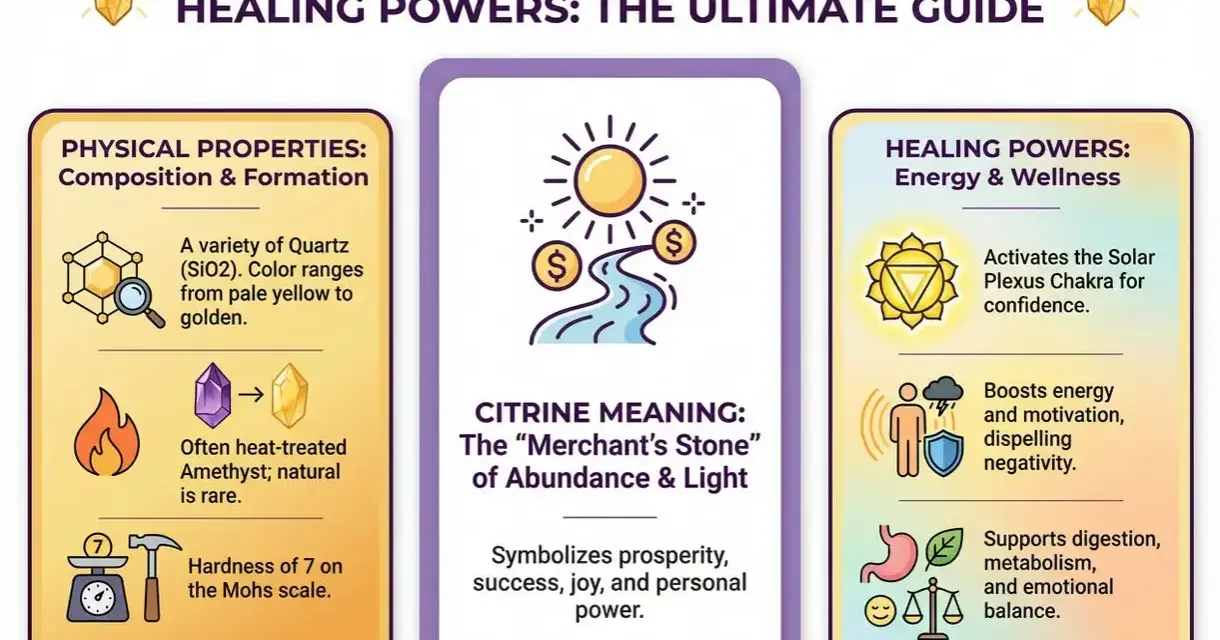
Key points to keep in mind when reading citrine as a spiritual stone
- Citrine’s spiritual symbolism centres on joy, confidence, and a sense of renewed energy.
- It is often linked with abundance and personal power, especially in modern crystal traditions.
- Different jewellery forms carry different meanings: a ring feels more personal, while a pendant feels more intimate.
- Natural citrine is rare, and much of what is sold today is heat-treated amethyst, so provenance matters if authenticity matters to you.
- Citrine is durable enough for regular wear, but it still needs gentle cleaning and heat awareness.
What citrine symbolises spiritually
At a spiritual level, citrine is usually read as a bright, clearing stone: warmth after heaviness, hope after stagnation, and confidence after self-doubt. I see that as the heart of its appeal. It does not feel like a stone of stillness; it feels like a stone of movement.
The stone’s golden colour does a lot of the symbolic work. Citrine is quartz coloured by trace iron, and that naturally sunlit tone has made it feel associated with vitality, clarity, and emotional lift for a long time. In modern spiritual practice, people often use it as a reminder to keep their outlook open rather than defensive.
In practical terms, that symbolism usually clusters around four ideas:
- Joy, because its colour reads as bright and uplifting.
- Optimism, because it is often chosen during periods of change.
- Confidence, because it is linked with self-trust and visibility.
- Momentum, because it is used as a symbol of moving forward rather than waiting passively.
I treat those meanings as part of jewellery culture and spiritual tradition, not as proof of a measurable effect. That distinction matters, because citrine becomes more interesting when you understand what it symbolises rather than expecting it to do the work for you. That leads naturally to the idea of abundance, which is where citrine is most often discussed.
Why citrine is tied to abundance and personal power
Citrine’s reputation as a stone of abundance comes from a combination of colour, folklore, and modern crystal language. The old nickname “merchant’s stone” captures the idea neatly: citrine is associated with prosperity, but also with the mindset that supports it. In other words, it is less about money falling from the sky and more about confidence, initiative, and a willingness to act.
That is why citrine is often connected with the solar plexus chakra in spiritual traditions. A chakra is a traditional energy centre used in several belief systems, and the solar plexus is commonly linked with willpower, self-worth, and personal agency. If a stone is meant to support that centre symbolically, citrine makes sense because its colour and tone feel active rather than passive.
This is also where people sometimes misunderstand the stone. Citrine is not usually framed as a “fix everything” crystal. It is more believable as a reminder stone: a piece you wear when you want to stay clear-minded, make decisions, or keep your nerve during a transition. I find that framing more useful, because it connects symbolism to behaviour.
In real life, that makes citrine especially fitting for moments like a new job, a creative launch, a business reset, or a personal change that requires steadiness. If the stone is going to mean something, it helps when the wearer is doing something meaningful too. Once that is clear, the setting of the stone becomes part of the message.
How citrine changes when it becomes jewellery
Citrine is not symbolic in a vacuum. Once it is turned into jewellery, the meaning shifts with the piece. A ring, a pendant, and a bracelet do not send the same message, even if they use the same stone. That is one reason citrine works so well in jewellery symbolism: the format lets you shape the intention.| Jewellery piece | Symbolic feel | Best use |
|---|---|---|
| Ring | Visible commitment, confidence, daily reminder | Everyday wear, personal milestone, self-purchase |
| Pendant | Closer to the heart, warmer and more intimate | Gifting, emotional symbolism, layered looks |
| Bracelet | Repeated visibility through the day | Stacking, subtle ritual, office-to-evening wear |
| Earrings | Lightness, polish, less overtly talismanic | Refined styling, event wear, understated symbolism |
For me, citrine works best when the setting does not fight the stone. If the design is too busy, the symbolism gets diluted. If the design is too plain, the piece can feel generic. The sweet spot is a setting that lets the colour carry the story. That also makes it worth asking what kind of citrine you are actually buying.
Natural citrine versus heat-treated stones
This is the part many buyers overlook. According to GIA, natural citrine is rare, and much of the citrine on the market comes from heat treatment of amethyst. That does not automatically make the stone unattractive or unsuitable for jewellery, but it does change the story behind it.
If you care about symbolism, origin can matter for two reasons. First, some people want a stone whose colour occurred naturally. Second, if you are buying a piece as a meaningful gift, being clear about what it is helps the symbolism feel honest rather than vague. I think that honesty adds value.
| Type | What it is | Why it matters | What to ask |
|---|---|---|---|
| Natural citrine | Quartz that formed with its own yellow to orange colour | Rarer and often preferred by collectors | Ask for origin and whether it has been treated |
| Heat-treated amethyst | Amethyst altered by heat to create a citrine-like colour | Common in the market and usually more affordable | Ask how the colour was achieved |
| Imitation or simulated stone | Glass or another material made to resemble citrine | Lower value and no quartz structure | Ask for a full material description |
The practical takeaway is simple: if the seller is vague, keep asking. A clear gemstone description is part of a good jewellery purchase, not an awkward extra. Once that is settled, the next question is how to wear citrine in a way that feels intentional rather than decorative.
How I would style citrine so the symbolism feels natural
In everyday jewellery, citrine works best when the styling leaves room for the stone to breathe. In the UK, where a lot of good jewellery leans understated, I think citrine often looks strongest when it is given one clear role rather than many competing ones. A single pendant, a slim ring, or a clean pair of studs is usually enough.
- Choose yellow gold if you want warmth and a more traditional, sunlit look.
- Choose white metal if you want contrast and a cleaner, more contemporary feel.
- Choose a simple cut if the stone is meant to feel elegant and wearable every day.
- Choose a larger centre stone if the piece is meant to function as a personal talisman or statement jewel.
- Choose a smaller accent stone if you want the symbolism without the visual dominance.
Citrine also makes a thoughtful gift because its symbolism is easy to understand without being sentimental in a cloying way. I would reach for it for a birthday, a promotion, a graduation, or a move into a new chapter. It says “good energy” without needing a speech.
For a more layered look, citrine pairs beautifully with pearls for softness, or with smoky quartz and onyx if you want a stronger contrast. Those combinations are not just decorative; they alter the mood of the piece. A softer pairing makes citrine feel calmer, while a darker pairing makes it feel more assertive. Good styling is really about deciding which version of the stone you want to bring forward. Once the piece is chosen, keeping it looking clear and bright becomes the final part of the story.
Keeping citrine jewellery bright for years
Citrine is a practical gemstone, but it is not indestructible. GIA rates it at 7 on the Mohs hardness scale, which means it is durable enough for rings and everyday jewellery, yet still vulnerable to scratching, strong heat, and careless storage. That balance is what makes it useful: strong enough to wear, delicate enough to respect.
The safest care routine is uncomplicated:
- Clean it with warm water, mild soap, and a soft brush.
- Avoid steam cleaning, since citrine should not be exposed to heat.
- Store it separately from harder stones to prevent scratching.
- Remove it before heavy cleaning, gym work, or anything involving harsh chemicals.
- Avoid prolonged exposure to strong light if you want to be cautious about colour fading.
If a citrine jewel is part of your daily rotation, this matters more than people think. The stone may look effortless, but the best-looking pieces are usually the ones that have been handled with a little discipline. That discipline is what preserves the colour, and the colour is what carries so much of the symbolism.
What makes a citrine piece feel meaningful rather than decorative
When I look at citrine jewellery with lasting appeal, I look for three things: a colour that feels alive, a setting that suits the wearer’s actual life, and a level of provenance that matches the buyer’s expectations. If one of those is missing, the piece can still be pretty, but it will not feel as complete.
I also think citrine works best when the intention is specific. A ring can stand for self-trust. A pendant can stand for warmth. A bracelet can stand for momentum. That kind of clarity gives the stone a role, and a role is what turns jewellery into something more than decoration.
So, if you are drawn to citrine for its spiritual meaning, treat that meaning as a prompt rather than a promise. Wear it as a reminder of optimism, action, and confidence, and choose a piece that fits how you live. That is where citrine’s symbolism feels strongest, and that is why it remains one of the most persuasive gemstones in jewellery.