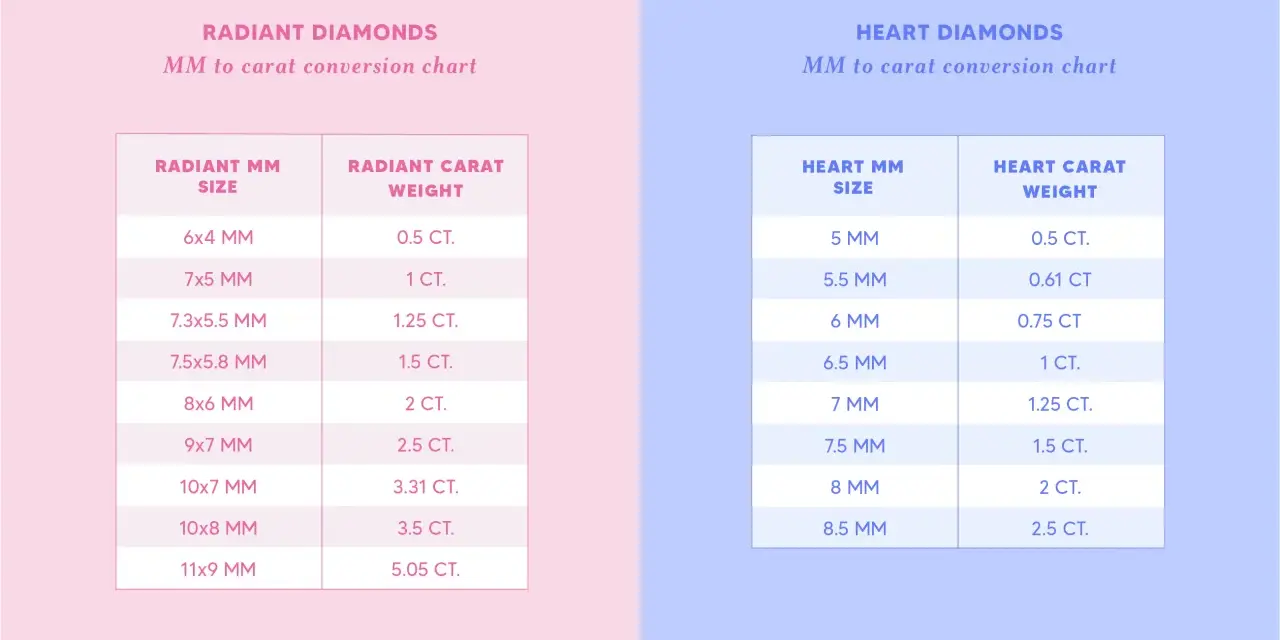
Diamond buying becomes much easier once you separate the numbers that describe a stone’s mass, the numbers that describe its physical footprint, and the grades that describe its appearance. I usually start with carat weight, then move to millimetres, then check cut, colour, and clarity before I think about price or setting. That is the clearest way to understand how a diamond is measured and whether it will look as good on the hand as it does on paper.
The numbers that matter most when comparing diamonds
- Carat is weight, not size. One carat equals 200 milligrams, so two diamonds with the same carat can still look very different.
- Millimetres show face-up size. Length, width, and depth tell you how much of the stone you actually see.
- Cut proportions shape brilliance. Table, depth, pavilion angle, and crown angle influence how light moves through the stone.
- Colour and clarity grade appearance, not footprint. They change beauty and value, but not the diamond’s physical dimensions.
- A lab report is the cleanest comparison tool. It turns a seller’s description into measurable facts.
Carat weight tells you mass, not visual size
Carat is the most familiar diamond measurement, but it is also the one people misread most often. A metric carat equals 200 milligrams, and it is divided into 100 points, so 0.25 ct is 25 points, 0.50 ct is 50 points, and 1.00 ct is 100 points. Because carat is a weight measurement, it tells you how heavy the diamond is, not how large it looks from above. I always remind readers that a deep stone can hide weight below the girdle, while a shallower stone can spread that same weight across a wider face.
That is also why landmark sizes often feel expensive: a 0.95 ct stone may look close to a 1.00 ct diamond, but the market often treats that missing 0.05 ct as meaningful. For a buyer, the real question is not just how much it weighs, but how much presence it has in a ring. The next step is to read the millimetre measurements, because those numbers reveal the visible footprint.
Millimetres show the stone’s real footprint
Millimetres tell a more honest story about size than carat alone. On a grading report, round diamonds are listed as minimum diameter – maximum diameter × depth, while fancy shapes are listed as length × width × depth, all in millimetres. That line is the fastest way to compare two stones that carry the same weight but do not occupy the same amount of visual space. A round diamond with a very deep pavilion can weigh the same as one with a wider spread, yet look smaller when you view it in a setting.
| Measurement line | What it describes | What I look for |
|---|---|---|
| Diameter × depth | Round stones | Even diameter and sensible depth |
| Length × width × depth | Fancy shapes | Balanced shape and good face-up spread |
For fancy shapes such as oval, pear, emerald, and marquise, I pay close attention to the length-to-width ratio. It is the simplest way to judge whether the silhouette looks slim, compact, elongated, or awkward. This is where two diamonds of the same carat can diverge sharply in appearance, which is why millimetres matter so much more than most shoppers expect. Once the footprint is clear, the next question is whether the stone is using its weight well.
Cut proportions decide how the diamond handles light
Cut is the part of diamond measurement that has the biggest effect on beauty. It is not just the shape you see from the top; it is the geometry of the facets underneath and around the stone. The table, depth, crown, pavilion, girdle, polish, and symmetry all work together, and I would never judge them in isolation. A diamond can have excellent carat weight and still look flat or sleepy if the proportions are off.
- Table is the flat top facet. The table percentage helps indicate how much of the top is open to light.
- Depth is the total height from table to culet. Too much depth can hide weight; too little can leak light.
- Pavilion is the lower part of the diamond. Its angles strongly affect brightness and fire.
- Crown is the upper portion above the girdle. It influences dispersion, which is the coloured sparkle people call fire.
- Girdle is the narrow edge around the stone. It matters for durability and can affect how the diamond sits in a setting.
For round brilliants, I use proportion data as a guide, not a shortcut. A well-cut round stone is usually discussed in terms of a table size around 52 to 62 per cent and a pavilion angle around 40.6 to 41.8 degrees, but those figures only make sense as part of the full picture. A diamond should be judged as a system, not as a single number. That is the bridge to the colour, clarity, and finish grades that complete the quality story.
Colour, clarity, and finish complete the quality picture
The 4Cs are often presented as four equal pillars, but in practice they do different jobs. Carat and millimetres tell you what the diamond is physically doing, while colour, clarity, and cut describe how cleanly and attractively it presents itself. Colour grades usually run from D to Z, with D being colourless and the scale becoming progressively more tinted. Clarity grades move from Flawless down through the inclusion scales, and they tell you how visible internal characteristics are under magnification and, sometimes, to the naked eye.
| Factor | What is measured | Why it matters |
|---|---|---|
| Carat | Weight | Helps compare rarity and pricing |
| Colour | How colourless the stone appears | Changes the look, especially in larger diamonds |
| Clarity | Internal and external characteristics | Affects cleanliness under magnification and sometimes to the eye |
| Cut | Proportions, angles, and craftsmanship | Controls brilliance, fire, and scintillation |
Polish and symmetry are easy to overlook, yet they affect how neatly the facets meet and how crisp the diamond looks in motion. In a round brilliant, those details can make the difference between a stone that feels lively and one that just looks technically acceptable. When I compare two diamonds of similar size, I use these grades to decide which one has the cleaner visual performance, not merely the bigger number on the certificate. The report is what turns that judgment from guesswork into something you can verify.
How to read a grading report without getting lost
A grading report is the practical answer to uncertainty, because it puts the stone’s measurements and grades in one place. In the UK, I would always prefer a recognised independent report over a seller’s verbal description, especially if I am comparing diamonds online or between jewellers. The report does not replace your eyes, but it gives you the facts needed to compare stones on equal terms.
| Report field | What it tells you | Why it matters |
|---|---|---|
| Shape and cutting style | Round, oval, pear, cushion, and so on | Different shapes are judged differently, especially for spread and ratio |
| Measurements | Length, width, and depth in mm | Shows physical size and helps explain face-up appearance |
| Carat weight | The stone’s mass | Useful for pricing and comparison, but not a size proxy |
| Colour | How colourless the diamond is | Impacts appearance, especially in larger stones |
| Clarity | Internal and external characteristics | Helps predict visible imperfections |
| Cut, polish, symmetry | How well the diamond was finished | Strongly affects light return and sharpness |
One detail I like to watch is fluorescence, because it can affect how a diamond looks in certain lighting, though it is not automatically good or bad. The report is also where you see whether the diamond has been graded as a loose stone only, which matters because mounted diamonds are harder to measure precisely. Once you know how to read the report, the common buying mistakes become much easier to spot.
The mistakes that skew diamond comparisons
Most bad comparisons start with a single number. Carat weight is the classic trap, because it is easy to assume that a bigger weight always means a visibly larger or better diamond. It does not. Here are the errors I see most often:
- Comparing carat only. Two stones can weigh the same and still look very different because one hides weight in depth.
- Ignoring shape. Ovals, pears, marquises, and emerald cuts do not present the same way as round brilliants.
- Overlooking setting style. A halo can make a centre stone look larger; a heavy mount can make it look smaller.
- Chasing colour or clarity extremes. Paying for grades you cannot see rarely improves the look on the hand.
- Reading every report the same way. A good round-brilliant report is not judged exactly like a fancy-shape report.
The practical fix is simple: compare stones by weight, measurements, proportions, and report, in that order. If two diamonds are close on paper, look at which one offers more visible spread and cleaner light return. That leads neatly to the final check I would make before spending money on a diamond in the UK.
What I would check before buying a diamond in the UK
When I narrow a choice down to two or three stones, I use a short, strict checklist. First, I confirm the carat weight and the exact millimetre dimensions, because those tell me whether the stone has real presence. Next, I check the cut data, especially on round diamonds, because a well-proportioned stone often looks brighter and more balanced than a heavier one. After that, I look at colour and clarity only as far as they affect the eye, not the certificate.
- Weight: Does the carat figure fit the budget without forcing you into a poor cut?
- Spread: Does the diamond look appropriately large face-up for its weight?
- Proportions: Do the numbers suggest good light return and sensible depth?
- Report: Is the grading from a recognised lab, and are the measurements clearly stated?
- Setting: Will the mount enhance the stone or hide part of its visual size?
If I had to reduce the whole subject to one line, I would say this: a diamond is measured by weight, seen by millimetres, and judged by proportions. That three-part view is the most reliable way to choose well, and it is the one I would trust whether I were buying a simple solitaire or a more elaborate design.