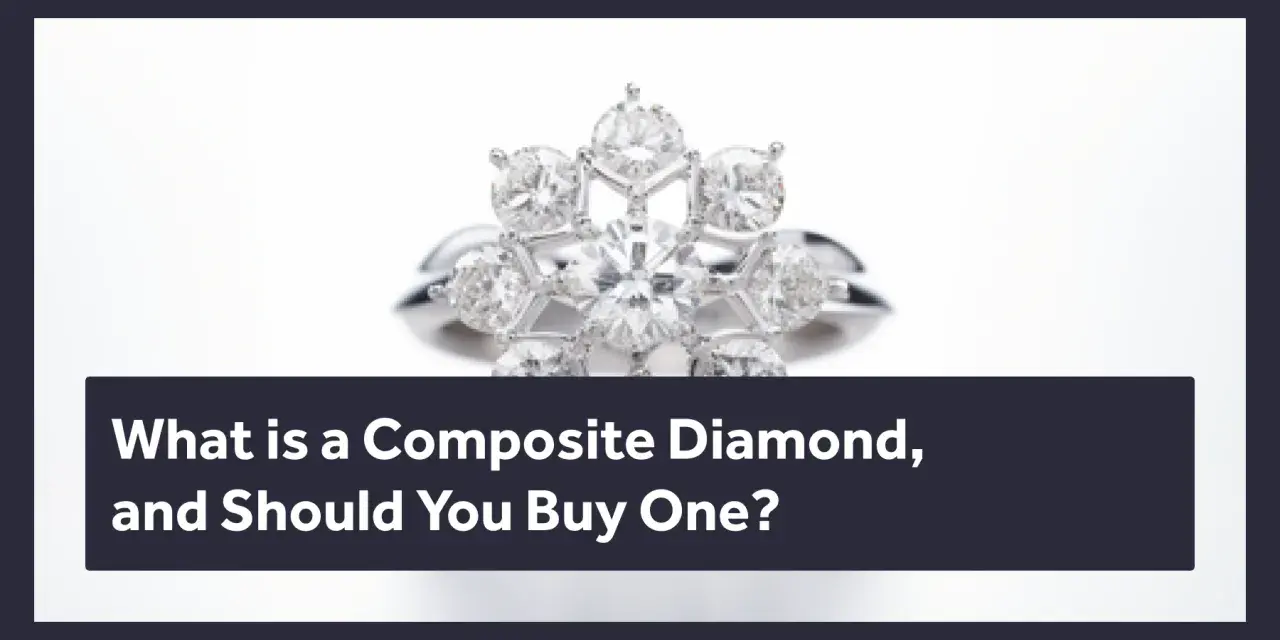
A composite diamond can look like a much larger stone than the material behind it would suggest, which is exactly why the term causes so much confusion. In practical terms, the subject sits at the crossroads of diamond construction, ring design, value, and everyday wear, so I’m going to separate those pieces clearly and show you what matters most before you buy or clean one.
What matters most at a glance
- In strict gemological language, this is an assembled stone; in retail, the wording often gets used for cluster or multi-stone diamond settings.
- Total carat weight is not the same thing as one large centre stone, and that distinction affects both price and appearance.
- The look can be impressive for the money, but there are more prongs, more joins, and usually more maintenance than with a solitaire.
- In the UK market, I would expect many pieces to sit roughly from the mid-hundreds into the low thousands of pounds, depending on metal, size, and design.
- Ask for exact stone counts, individual and total weights, and a clear written description before you commit.
What the term really means
In strict trade language, a composite diamond is not just a ring that looks busy or sparkly. It is an assembled stone, built from separate parts, and the important detail is that all of those parts are diamond. That is different from a treated single diamond, where the stone itself is altered, and also different from a simulant, which only imitates diamond’s appearance.
Retailers often use the same wording more loosely for a piece that uses several small diamonds to create the illusion of one larger centre stone. I see that most often in cluster heads, halo designs, and multi-stone rings. Once that distinction is clear, the rest of the conversation becomes much easier: you can judge whether you are buying a construction method, a visual effect, or both.
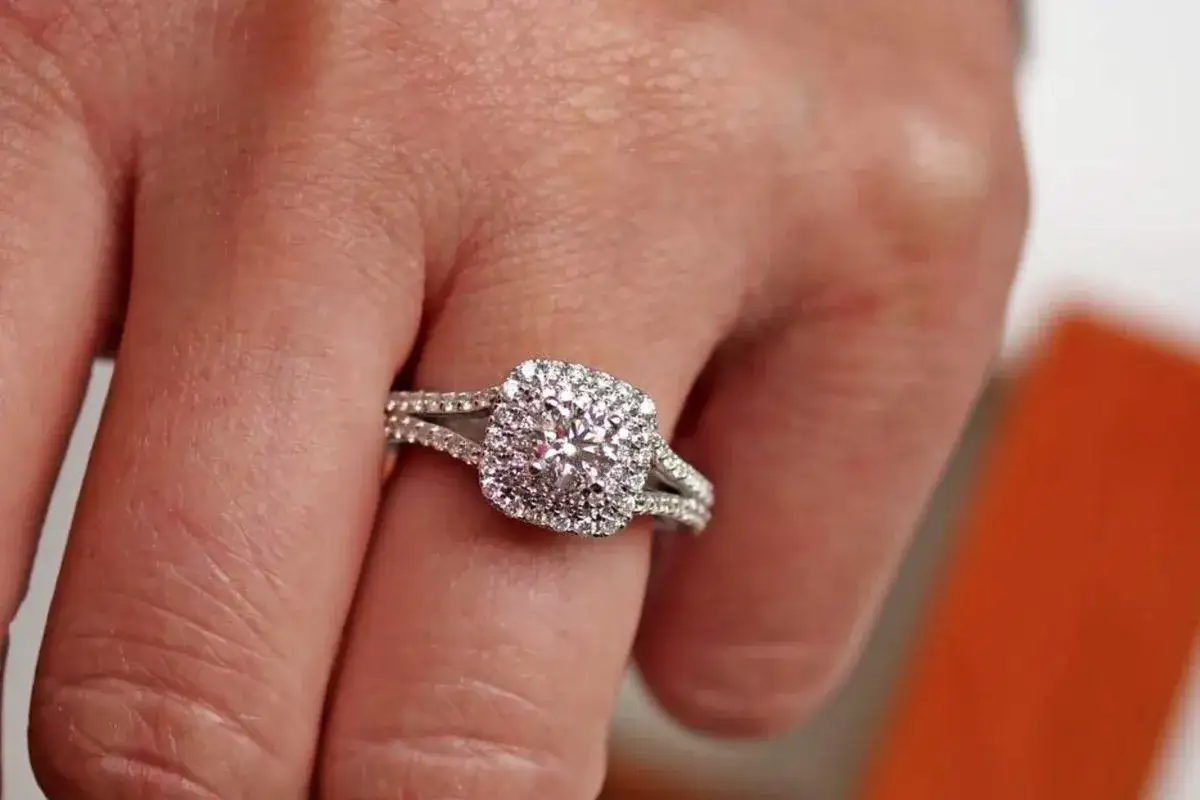
How these styles are put together
Most of the time, the jewellery version relies on placement rather than deception. Small diamonds are set tightly together so the eye reads one broader shape, often round, cushion, pear, or marquise. The more refined versions use matched stones and very clean metalwork; the weaker ones look patchy because the stones do not align well or the setting leaves obvious gaps.
Here are the structures I look for most often:
- Cluster head - several stones arranged to form a single face-up shape, usually with a larger visual spread than a solo stone at the same budget.
- Halo setting - a central diamond surrounded by a ring of smaller stones, which boosts perceived size and brightness.
- Micro-pavé - tiny diamonds set very closely together across the shank or shoulders; it adds sparkle, but repair work can be slower.
- Assembled stone - the stricter gemological version, where separate diamond parts are bonded or joined into one composite piece.
The practical issue is durability. More stones mean more prongs, and more prongs mean more points that can loosen over time. That leads naturally to the question most buyers really care about: how does this compare with a cleaner, single-stone design?
How it compares with a solitaire and a halo
When people compare options, they usually want one of three things: the biggest look for the budget, the simplest long-term ownership, or the most balanced middle ground. I find it helps to compare those choices side by side rather than treating them as interchangeable.
| Style | What you get | Main advantage | Main trade-off | Best for |
|---|---|---|---|---|
| Composite or cluster style | Several small diamonds arranged to read as one larger presence | Strong sparkle and a bigger face-up look for the money | More maintenance, more visual complexity, weaker resale story | Buyers who want impact without paying solitaire prices |
| Solitaire | One centre diamond with minimal surrounding stonework | Clear value story and simpler upkeep | Usually costs more for the same face-up size | People who want a classic, low-fuss ring |
| Halo | A centre stone framed by a ring of smaller diamonds | Makes the centre appear larger and brighter | Small stones can loosen and the style can look busier | Anyone who wants a bigger look without moving to a very large centre stone |
| Lab-grown solitaire | A single lab-grown diamond in a simple setting | One-stone look with a more accessible price point | Different market perception and resale dynamics | Buyers who prefer simplicity but want more size per pound |
The key point is that material choice and construction choice are separate decisions. A lab-grown stone can still sit in a cluster setting, and a natural diamond can be mounted in a multi-stone design. Once you separate those two ideas, the price conversation becomes much more honest.
What it usually costs in the UK
In the UK market, I would normally expect a well-made cluster or multi-stone diamond ring to start in the mid-hundreds of pounds and move into the low thousands as the gold weight, diamond total weight, and brand name rise. For simpler pieces in sterling silver or lighter gold settings, roughly £250 to £500 is a realistic starting zone. For 9ct or 18ct gold versions with better stone matching and larger visual spread, £500 to £1,800 is a more typical bracket, with premium pieces climbing beyond that.
What drives the cost is not just the total diamond weight. Stone matching, setting precision, metal quality, and after-sale servicing all matter. A piece with a large-looking top surface can still be modestly priced if the stones are small and the metal is light; equally, a tighter, cleaner build can cost more even when the total carat weight is not dramatic. That is why I always read the specs before I look at the headline look.
Used sensibly, the style can be good value. Used carelessly, it can become a bargain only in appearance. The difference is usually in the details, which is what I would check before paying.
The checks I would make before buying
If I were looking at one in a shop or online, I would ask the same few questions every time. They are simple, but they prevent most disappointments.
- Is this a cluster setting or an assembled stone? The answer should be plain, not vague.
- What is the total carat weight, and is there a separate centre-stone weight? Buyers often confuse the two.
- How many diamonds are there exactly? If the seller cannot say, that is a problem.
- How are the stones held in place? Shared prongs, micro-pavé, and channel-style details all wear differently.
- Can it be resized later? Rings with stones running far down the shank can be harder and more expensive to alter.
- Is every material clearly disclosed on the invoice? I want the written description to match the ring in my hand.
CIBJO’s diamond guidance is very clear on disclosure: the seller should state what the product is, how it is made, and any treatments or material combinations involved. That sounds formal, but in real life it simply means you should never have to guess what you are buying. If the description feels evasive, I would treat that as a warning sign rather than a stylistic quirk.
How to care for it without loosening the setting
Care is where many owners get overconfident. The diamonds themselves are hard, but the setting is doing the real work, and small stones are often more vulnerable to loss than the centrepiece. I would clean the piece with warm water, mild soap, and a soft brush, then dry it carefully with a lint-free cloth.
I would also stay cautious with ultrasonic and steam cleaners unless the jeweller has confirmed that the construction can take them. That is especially true if there are bonded sections, very fine pavé work, or a design that already shows slight looseness. According to GIA, it is a good idea to have engagement-ring prongs checked about every six months; if that feels too frequent, at least make it part of a yearly service routine.
- Remove the ring before chlorine, bleach, gym work, or gardening.
- Store it separately so small stones do not rub against harder jewellery.
- Watch for a rattling sound, a snagging prong, or any change in symmetry.
- Book a jeweller’s inspection as soon as one stone appears lower than the others.
That care routine is not complicated, but it matters more here than with a simple solitaire. The final safeguard is the paperwork, because the receipt should tell the same story as the jewellery itself.
What I would confirm on the receipt before I left the shop
For this kind of purchase, I want the receipt to do three jobs: identify the build, record the stone weights, and protect me later if I need insurance or a repair. If those basics are present, the ring is far easier to own with confidence.
- The exact style description, such as cluster, halo, or assembled stone.
- The total diamond weight, plus any individual stone weight that matters.
- The metal type and fineness, such as 9ct, 18ct, or platinum.
- Any synthetic, bonded, or treated components that form part of the design.
- The return policy, warranty terms, and whether resizing is included.
The safest version of this purchase is the one where the look, the construction, and the paperwork all agree. If you understand those three things before you pay, you can judge the ring on its real strengths instead of the impression it creates from a distance.