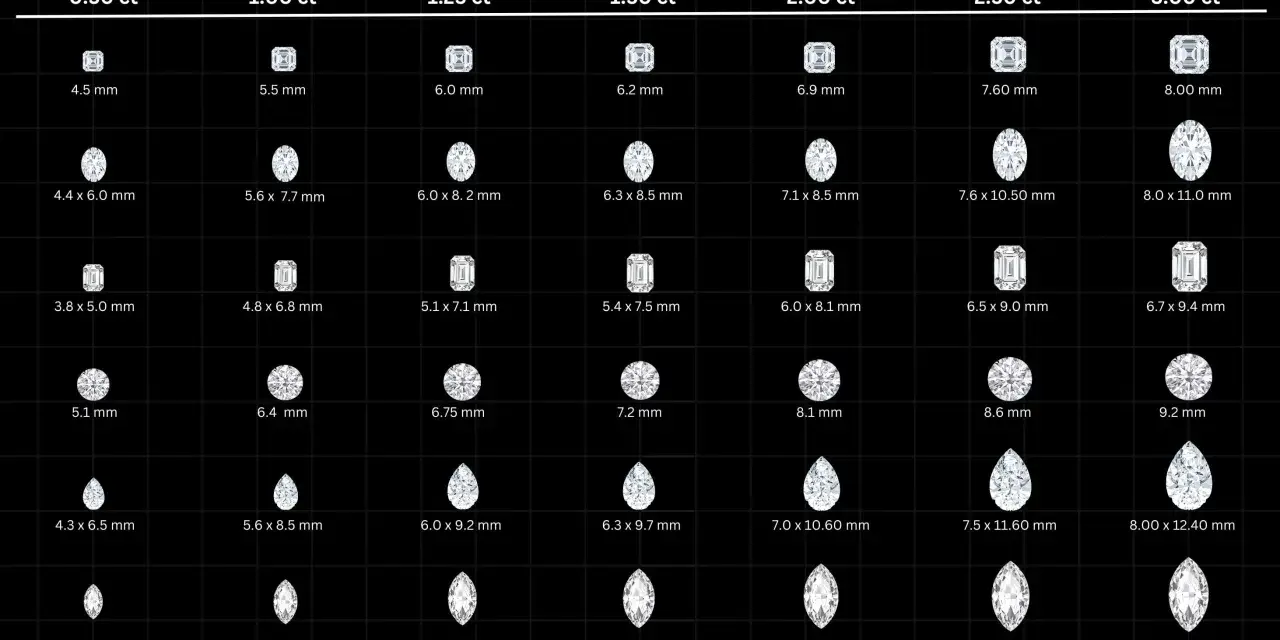
A one-carat diamond is not a fixed millimetre measurement, which is why the answer depends on shape, cut depth, and how the stone is measured. For a round brilliant, I usually expect something close to 6.4 to 6.5 mm across, but fancy shapes can look wider or narrower at the same weight. In this guide, I break down the practical size range, explain why carat and millimetres are not the same thing, and show how to read diamond dimensions without guessing.
The size is useful, but the shape is the real clue
- A round 1-carat diamond is usually about 6.4 to 6.5 mm across.
- Carat measures weight, not diameter, so two 1-carat stones can look different in size.
- Oval, pear, and marquise cuts often look larger face-up than a round stone of the same weight.
- Cut depth, girdle thickness, and setting style all change how large the diamond appears.
- When comparing stones, the millimetre measurements matter more than the carat number alone.
The practical size of a one-carat round diamond
If you want one straightforward answer, this is it: a well-proportioned round brilliant of 1 carat is usually around 6.4 to 6.5 mm in diameter. That is the benchmark most people mean when they talk about a “one-carat diamond size” in everyday buying conversations.
There is a small but important detail here. Carat tells you the weight of the stone, not its width. So a 1-carat round diamond is not automatically 6.5 mm exactly, and it is not guaranteed to look the same as another 1-carat round diamond from a different cutter or collection. I treat 6.4 to 6.5 mm as the realistic target, not a rigid rule.
That number is only the starting point, though, because weight and width are not the same measurement.
Why carat weight and millimetres tell different stories
GIA is very clear on the basic point: carat measures weight, not size. One carat equals 200 milligrams, but the visible diameter depends on how the diamond is shaped and how much of its weight sits below the girdle rather than across the top.
This is where many buyers get tripped up. A diamond can carry a lot of its weight in depth, which makes it heavier without making it look wider from above. Another stone can spread more across the finger and appear larger even if it has the same carat weight.
The three terms I pay attention to most are:
- Depth - how much of the diamond sits below the top face.
- Girdle thickness - the outer edge of the diamond, which can add weight without adding much visible size.
- Face-up size - how large the stone looks when you view it from above.
Once you understand that, shape becomes the next piece of the puzzle.
How shape changes the millimetres
At the same carat weight, shape can change the visible width quite a bit. Round stones use more of their weight in depth, while elongated shapes tend to spread that weight across the surface. That is why some cuts appear noticeably larger on the hand even when the scale says they are the same weight.
| Diamond shape | Typical 1-carat size | What it usually means visually |
|---|---|---|
| Round brilliant | 6.4-6.5 mm | The standard benchmark, balanced and classic. |
| Princess cut | About 5.5 x 5.5 mm | Square and compact, usually with less spread than a round stone. |
| Cushion cut | About 5.5 x 5.5 mm | Soft corners and a deeper profile that can reduce face-up width. |
| Oval cut | About 7.7 x 5.7 mm | Often looks larger because the length runs across the finger. |
| Pear cut | About 7.7 x 5.7 mm | Elongated and visually strong, especially in slimmer settings. |
| Emerald cut | About 7 x 5 mm | Elegant and open, though not as spread-heavy as oval or marquise. |
| Marquise cut | About 10 x 5 mm | Usually the biggest-looking option per carat because of its length. |
Those measurements are best read as practical benchmarks, not promises. Two 1-carat ovals can still differ enough in length and width to look noticeably different, which is why shape alone never tells the whole story. From here, the real question is what makes one stone look fuller than another even when the cut is the same.
What makes one one-carat diamond look larger than another
When two diamonds share the same carat weight, the one with the better spread often looks larger. Spread simply means how much visible width the diamond gives you for its weight, and it is one of the most useful concepts in diamond buying.
I watch three things closely:
- Cut proportions - A stone cut too deep can hide weight below the surface, which makes it look smaller face-up.
- Table and crown balance - These proportions affect brightness and the way the diamond returns light, which changes the sense of size.
- Setting style - A slim band, halo, or bezel can change how large the diamond seems once it is worn.
There is a trade-off here. A shallower diamond can spread wider, but if the proportions are poor, it may lose brightness or look flat. A very deep diamond may look smaller but still have excellent sparkle if the overall cut is strong. In other words, bigger-looking is not the same thing as better-looking.
That is why certificate measurements matter so much when you compare stones side by side.
How to read diamond measurements before you buy
On a grading report, a round diamond is usually listed by diameter and depth, while fancy shapes are listed as length x width x depth. That detail matters more than many shoppers realise, because it tells you how the diamond actually presents itself in real life.
For a round stone, I like to see the minimum and maximum diameter closely aligned. When the difference is small, the diamond is usually more symmetrical, and the size feels more even across the face. For fancy shapes, the length-to-width ratio tells you whether the diamond looks squarer or more elongated.
When you compare stones, use this simple filter:
- Look at the full measurements in mm, not just the carat weight.
- Compare the diameter or length-to-width ratio with stones of the same shape.
- Check whether the stone carries a lot of weight in depth, because that can reduce visible size.
- Use the report as a reality check before you judge the diamond in a ring setting.
If you are choosing between two stones that look similar on paper, the one with the cleaner, more efficient spread often looks better once it is mounted. That leads to the final practical question: what should you prioritise if you want a one-carat diamond that feels right on the hand?
What I would check before choosing a one-carat stone in the UK
If I were buying a one-carat diamond for a ring in the UK, I would start with the millimetre measurement I actually want to see, then work backwards to the carat weight. For a classic round look, 6.4 to 6.5 mm is the number to keep in mind. If I wanted more visible size without moving much in weight, I would look closely at oval, pear, or marquise shapes.
I would also pay attention to the finger and the setting. A 6.5 mm round diamond can look quite different on a slim hand versus a broader one, and a halo setting will make the centre stone read larger than a plain solitaire. That is not marketing fluff; it is just the way visual proportions work.
- Prioritise cut quality before chasing a full 1.00 carat label.
- Use mm measurements to compare stones of the same shape.
- Remember that a 0.95 to 0.99 ct diamond can look very close to a 1.00 ct stone.
- Check how the ring setting changes the stone’s apparent size.
- Choose the shape that suits the look you want, not only the number on the certificate.
The cleanest shorthand is this: a one-carat round diamond is usually about 6.4 to 6.5 mm across, but the shape, depth, and proportions decide how large it really looks. If you keep that distinction in mind, you will read diamond sizes more accurately and make a much better choice for the ring you want to wear.