Key facts at a glance
- Most lab-grown diamonds are produced by HPHT or CVD.
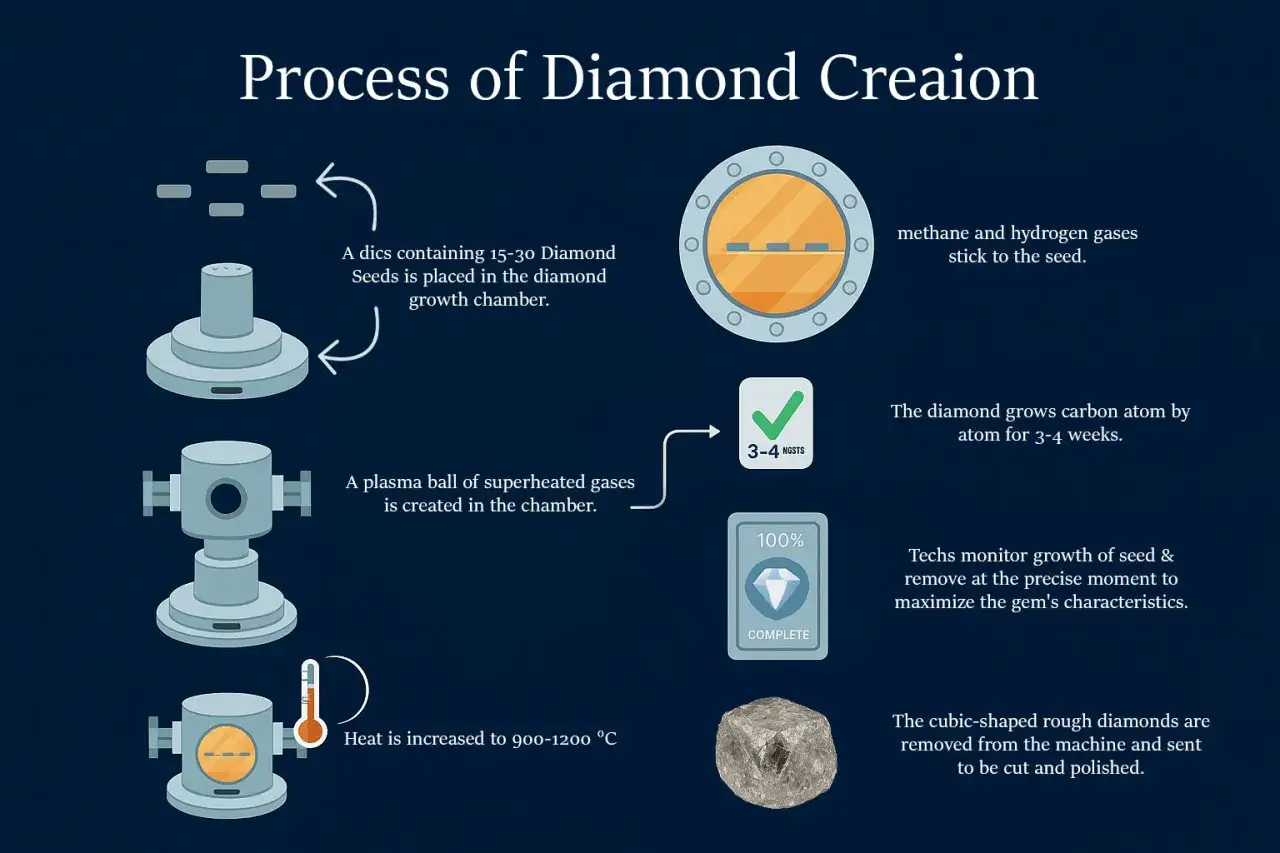
- A tiny diamond seed starts the process, and carbon atoms build onto that seed over time.
- Growth usually takes about 1 to 4 weeks, although HPHT can be faster or slower depending on size and quality.
- After growth, the rough crystal is cut, polished, and graded much like a mined diamond.
- Colour, clarity, and size depend on how tightly temperature, pressure, gas chemistry, and purification are controlled.
- In the UK, clear disclosure matters, so the stone should be described as lab-grown, synthetic, or laboratory-created when that is what it is.
A diamond starts with a seed, not a finished stone
The simplest way to understand lab-grown diamonds is to forget the word "manufacture" for a moment and think in terms of controlled crystal growth. A tiny diamond seed is placed into a chamber or press, and carbon atoms are encouraged to settle onto it in the same crystal structure as diamond. That seed is the starting point; without it, the carbon has nothing to organise around.
That matters because diamonds do not appear all at once. They build atom by atom, and the environment has to be stable enough for the carbon to attach in the correct pattern rather than turning into graphite or another form of carbon. In practice, that means heat, pressure, purity, and timing all have to be tuned very carefully. From there, the choice of process determines how the crystal grows, which is where HPHT and CVD come in.
HPHT and CVD grow diamonds in different ways
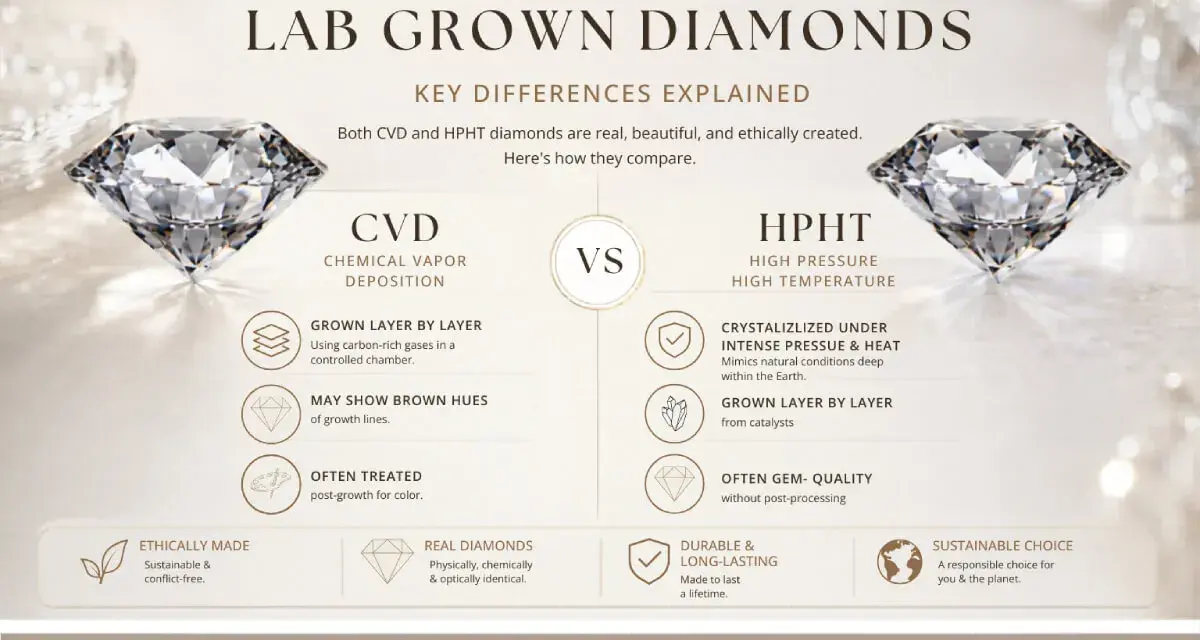
Most lab-grown diamonds are made by high-pressure, high-temperature (HPHT) or chemical vapour deposition (CVD), and GIA notes that these are the two dominant growth routes. I find the distinction useful because it explains not just how the diamond is formed, but also why the finished stone may show different growth features, colour behaviour, or treatment history.
| Method | How it works | Typical conditions | Why it is used |
|---|---|---|---|
| HPHT | A diamond seed sits in a press with a carbon source and a metal flux that helps dissolve and move carbon to the seed. | Very high heat, around 1300 to 1600°C, and extreme pressure above about 870,000 psi. | It can grow gem-quality diamond relatively quickly and is useful for certain colour outcomes. |
| CVD | A diamond seed is placed in a low-pressure chamber filled with carbon-rich gas, then the gas is activated so carbon deposits on the seed layer by layer. | Low pressure and high heat inside a plasma reactor, but far less pressure than HPHT. | It gives manufacturers fine control over the crystal and is widely used for jewellery-grade stones. |
Why the growth environment changes the finished diamond
Not every lab-grown diamond finishes with the same look, and that is not a flaw. It is the result of how much control the grower has over the chamber, the seed, and the carbon source. If the process is stable, the crystal can grow cleaner and more evenly. If it is not, the stone may need more correction later.Size follows time and stability
Larger stones take longer because the crystal has to stay balanced while it grows. Commercial growth often takes about one to four weeks, and some HPHT runs can finish faster or stretch longer depending on the target size and quality. The larger the stone, the more important consistency becomes, because small disruptions can show up later as strain or growth lines.
Colour is often managed after growth
Colour is where many buyers misunderstand the process. A diamond can be grown with a certain colour in mind, but some stones are also treated after growth to improve appearance, especially to make them more colourless or to create particular fancy colours. That is normal in the lab-grown market, but it is also exactly why buyers should ask what, if anything, happened after the crystal came out of the reactor.
Read Also: Diamond Cuts & Shapes - Which Sparkles Best For You?
Clarity depends on control, not wishful thinking
Clarity is shaped by the presence of impurities, inclusions, and stress patterns inside the crystal. In HPHT stones, the growth may leave features linked to the press and flux. In CVD stones, growth can happen in stages, which is why some crystals need cleaning or additional treatment between growth cycles. A cleaner stone is usually the product of better control, not luck.
Once you understand those fingerprints, the next step is the part most people never see, which is turning rough crystal into a polished gem.
What happens after the crystal grows
When the growth run is finished, the rough diamond still has to be cut and polished. This is where jewellery craftsmanship matters just as much as science. The rough crystal is inspected, mapped, and planned so the cutter can decide how to maximise brilliance while keeping as much weight as possible.
The tools used here are the same kind of tools used for mined diamonds, because the material itself is the same crystal structure. Sawing, laser cutting, faceting, and polishing all aim to reveal the best optical performance. A stone may lose noticeable weight during this stage if the cutter removes areas with strain or unwanted inclusions, but that trade-off often improves sparkle and symmetry more than keeping a few extra points would.
After cutting, the diamond is graded for the standard jewellery factors: cut, colour, clarity, and carat. For most buyers, cut quality has the biggest effect on sparkle. A well-cut one-carat diamond can look more lively than a poorly cut stone that is technically larger. That is the practical lesson hidden inside the growth process, and it becomes even more useful once you are buying in the UK.
Why UK buyers should care about labels and reports
In the UK, clarity in wording matters. The ASA has ruled that ads should not leave the word "diamond" hanging on its own when the product is lab-grown; qualifiers such as synthetic, laboratory-grown, or laboratory-created should be clear and consistent throughout the copy. I treat that as a useful buying signal as much as a compliance issue, because vague language usually means a seller is trying to blur the origin story.
If I were checking a stone for a client or a reader, I would want three things in writing:
- The growth method, meaning HPHT or CVD.
- Whether the stone had post-growth treatment.
- A grading report from a recognised gem laboratory.
That paperwork tells you more than the marketing copy ever will. It also helps you compare stones on equal terms, which is especially important when two diamonds look similar in photos but differ in growth method, treatment, or clarity. Once the paperwork is clear, the final decision becomes much easier: you are choosing on design, value, and personal preference rather than guesswork.
The practical takeaway for choosing a lab-grown diamond
If you want the shortest honest answer, it is this: a lab-grown diamond is grown by giving carbon the right conditions to form crystal, then finishing that crystal like any other fine gemstone. The main variables are the growth method, the control of the reactor or press, and what happens after the rough diamond is removed. Everything else, including the final sparkle, follows from those variables.
- Choose cut first if sparkle matters most.
- Ask about HPHT or CVD if you want to understand the stone’s origin better.
- Check whether any post-growth treatment was used.
- Expect clear labelling from reputable UK sellers.
- Use the report, not the marketing phrase, to judge the stone.
For jewellery buyers, that is the real value of understanding how a diamond is grown in a lab. It helps you read the stone properly, compare it fairly, and buy with fewer illusions, which is exactly the kind of confidence a good piece of jewellery deserves.