The choice between lab-grown and natural diamonds is not really about whether one is “real” and the other is not. It is about origin, price, rarity, and the kind of value you want the piece to hold over time. In this guide, I break down what changes, what does not, and how I would approach the decision for a ring, pendant, or gift in the UK market.
What matters most when you compare lab-grown and natural diamonds
- Both are diamonds in the mineral sense, with the same basic carbon crystal structure.
- Hardness and wear resistance are the same; both score 10 on the Mohs scale.
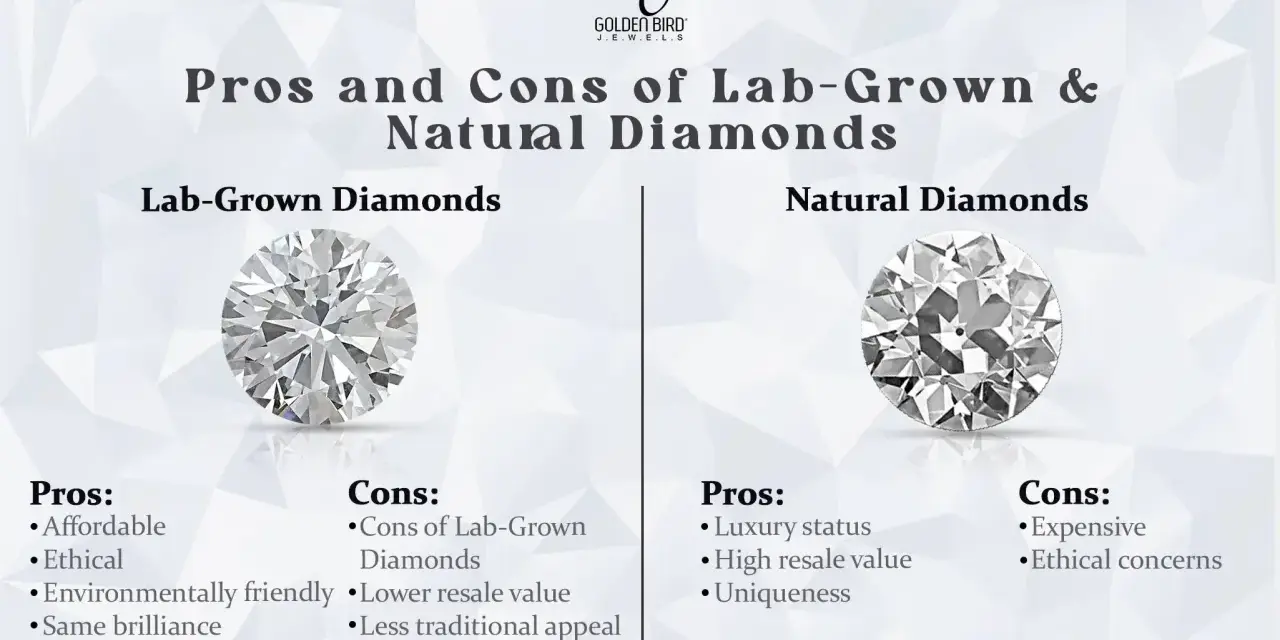
- Lab-grown stones are usually much cheaper, often 40-80% less for similar size and quality.
- Natural diamonds still carry the edge in rarity and resale appeal, though resale is never guaranteed.
- The smartest purchase usually comes down to priorities: bigger stone and lower cost, or rarity and long-term value.
What the comparison really comes down to
The lab-grown diamonds vs real diamonds question is really shorthand for a much better one: do you care more about geological rarity, or about getting a larger or higher-quality stone for the same budget? Lab-grown diamonds are real diamonds, but they are not natural diamonds, and that distinction is where most of the practical differences start.
Natural diamonds formed deep within the Earth over millions or billions of years. Lab-grown stones are created in controlled conditions in a matter of weeks or months, using processes that reproduce the same crystal structure. So when people say “real” in everyday conversation, they usually mean “natural” or “mined”, not “synthetic” or “fake”. That is an important distinction, because lab-grown diamonds are not the same thing as moissanite or cubic zirconia, which are simulants rather than diamonds.
For buyers, the issue is less about chemistry and more about what the stone represents. If you want rarity and a geological story, natural still wins. If you want beauty, size, and a more flexible budget, lab-grown often makes more sense. Once that is clear, the next question is how the stones are actually made and recognised.
How lab-grown diamonds are made and identified
There are two main ways lab-grown diamonds are produced: HPHT and CVD. HPHT stands for high pressure, high temperature, and it recreates the intense conditions that form diamonds underground. CVD stands for chemical vapour deposition, where carbon-rich gas is used to build a diamond crystal layer by layer. Both methods produce genuine diamond, not a lookalike.
HPHT and CVD in plain English
HPHT is closer to the geological story: you start with a carbon source, apply extreme pressure and heat, and grow a crystal. CVD is more engineered; it builds the stone in a chamber under carefully controlled conditions. In practical buying terms, you do not need to become a scientist, but it helps to know that the production method can affect growth patterns, internal features, and sometimes price.
Read Also: Diamond Appraisal Guide - Get Your True Valuation
Why lab testing matters
GIA notes that lab-grown and natural diamonds are chemically and optically so similar that ordinary gemmological observation is not enough to separate them reliably. That is why a proper grading report matters so much. If the seller is serious, the report should state the origin clearly, and many stones also carry a microscopic laser inscription that links the diamond to its report.
In the UK market, I would treat vague wording as a warning sign. If the listing avoids saying whether the stone is natural or laboratory-grown, ask for the report before you think about size or sparkle. Once origin is clear, the comparison becomes much easier to judge in real life.
Sparkle and durability are almost identical in daily wear
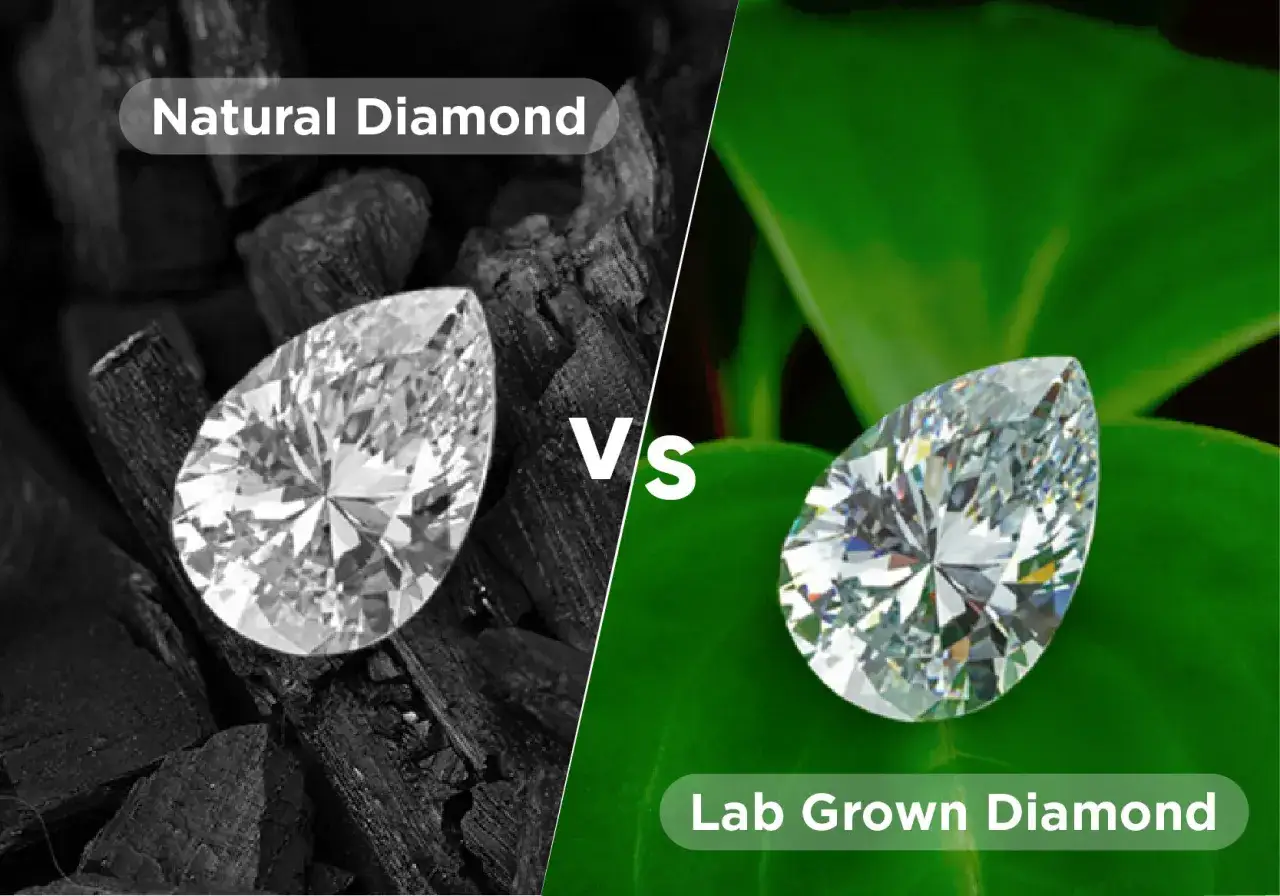
For most buyers, this is the section that matters most. Lab-grown and natural diamonds have the same basic physical properties, so they perform almost identically in a ring, necklace, or pair of earrings. Both are exceptionally hard, both resist scratches well, and both can chip if they take a sharp knock at the wrong angle.
The 4Cs still apply to both stones: cut, colour, clarity, and carat. If I had to rank them in order of practical importance for everyday beauty, I would start with cut, then colour, then clarity, and only then size. A well-cut stone will usually look better than a larger but poorly proportioned one, regardless of whether it came from the ground or a lab.
| Origin | Grown in a laboratory by HPHT or CVD, usually in weeks | Formed underground over millions or billions of years | Origin affects rarity, not day-to-day sparkle |
|---|---|---|---|
| Composition | Pure carbon crystal, hardness 10 | Pure carbon crystal, hardness 10 | Wear resistance is essentially the same |
| Look | Usually indistinguishable without lab equipment | Also judged by the same 4Cs | Buy by report, not by eye alone |
| Size for budget | Often allows a larger centre stone for the same spend | Usually requires a bigger budget for the same carat | Lab-grown often wins on visible impact |
| Resale | Usually weaker second-hand value | Better resale potential, but still variable | Important if secondary-market value matters to you |
| Certification | Report should state laboratory-grown origin | Report should state natural origin | Independent grading protects you from confusion |
In other words, the daily-wear question is easy: if the setting is secure, both stones will behave like diamonds. The real difference shows up when you look at pricing and resale, because that is where the market starts treating them very differently.
Price and resale are where the gap opens up
This is where lab-grown diamonds usually make the strongest case. As a rule of thumb, they are often 40-80% less expensive than natural diamonds of similar size and grade, and sometimes the gap is even wider. In practical buying terms, that can mean a one-carat lab-grown stone sits in the low four figures or below, while a comparable natural diamond usually costs several thousand pounds more.
The reason is simple: natural diamonds are scarce by nature, while lab-grown diamonds can be produced at scale. That scalability pushes the price down. It also means lab-grown prices can move quickly when supply increases, which is one reason I would never buy one as a financial investment. Buy it for beauty and wear, not because you expect the market to reward you later.
Natural diamonds hold a different kind of value. They are still not a guaranteed investment, but they tend to have stronger recognition in the second-hand market, especially for high-quality, well-documented stones. If resale matters to you, think in terms of relative loss rather than profit. And do not confuse an insurer’s replacement figure with what a jeweller would pay to buy the stone back.
That leaves the ethical question, which is where many buyers feel most conflicted. The answer is more nuanced than the marketing on either side suggests.
Ethics and sustainability need a closer look
Lab-grown diamonds avoid mining, which is a real advantage if your priority is reducing land disturbance and the social risks tied to extraction. But the story does not end there. Lab-grown production can still be energy intensive, and the footprint depends heavily on how the manufacturer powers its facilities. A stone grown with cleaner electricity tells a very different sustainability story from one produced on a carbon-heavy grid.
Natural diamonds are not automatically unethical either. Responsible sourcing, traceable supply chains, and established certification schemes have improved the market a great deal. If you want a natural diamond with a smaller footprint, I would seriously consider a pre-owned stone. It gives you the geological rarity and the vintage romance without forcing you into a fresh extraction story.
FTC guidance in the US has long stressed clear disclosure for laboratory-created diamonds, and I think the principle is just as useful for UK buyers: transparency matters more than branding language. If a seller leans hard on “eco” or “ethical” without explaining the details, ask what power source, sourcing standard, or chain of custody sits behind the claim. Once you know that, the choice becomes far more honest.
How I would choose for an engagement ring or gift
If I were buying for an engagement ring, I would start with the person wearing it, not the category. Lab-grown and natural diamonds solve slightly different problems, so the best choice depends on what you want the piece to say.
- Choose lab-grown if you want the largest or highest-grade centre stone for a fixed budget.
- Choose lab-grown if you care more about visual impact than about resale or rarity.
- Choose natural if the story of geological rarity matters to you.
- Choose natural if you want better second-hand recognition and a more traditional heirloom feel.
- Consider pre-owned natural diamonds if you want a mined stone but prefer a more restrained environmental footprint.
For earrings and pendants, I am even less concerned about resale and more focused on design. Lab-grown stones can be an excellent fit there because you often get more visible sparkle for the money. For a ring worn every day, I would pay close attention to the setting, the metal, and the cut quality before I worried about origin. A secure setting and a strong cut matter more than most buyers realise.
Cleaning is the same for both: warm water, mild soap, a soft brush, and a careful rinse. Once a year, have the setting checked, especially if the ring has fine prongs or a high profile. That is the sort of maintenance that actually protects the stone, whatever its origin.
The checks I would make before paying in 2026
Before I buy either type of diamond, I want proof, not promises. The sales copy can be polished; the report should be precise. In 2026, those checks matter more than ever because the market is crowded, and the visual difference between stones is usually not enough to guide a safe purchase.
- Ask for the grading report and confirm that it states natural or laboratory-grown clearly.
- Put cut first, because a well-cut diamond will usually look better than a bigger but duller one.
- Compare colour and clarity with a real budget ceiling; do not overpay for grades you will never notice at normal viewing distance.
- Check the return policy and any buy-back or upgrade terms, especially if resale matters to you.
- Inspect the setting as carefully as the stone; a weak setting can ruin a good diamond faster than origin ever will.
- Be sceptical of vague sustainability language unless the seller explains the sourcing or energy story clearly.
If I had to reduce the whole decision to one sentence, I would say this: lab-grown diamonds give you more stone for your money, while natural diamonds give you rarity and stronger secondary-market appeal. The right choice is the one that matches how the piece will actually be worn, valued, and remembered, not the one that sounds best in a sales pitch.