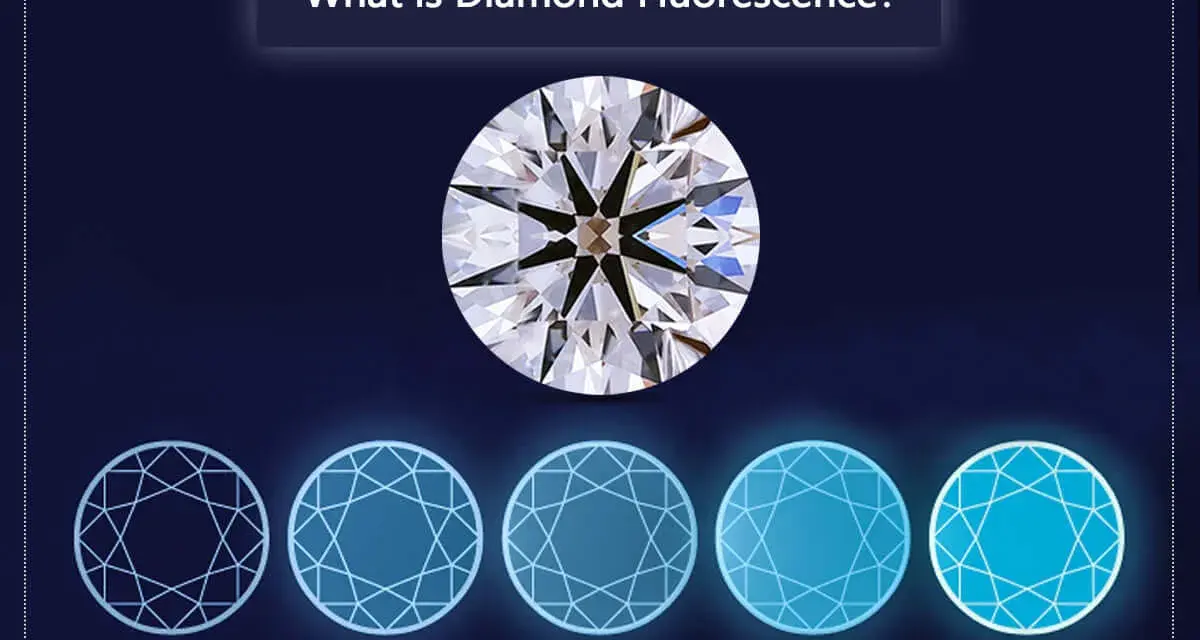
Diamonds can look perfectly ordinary in daylight and still change under ultraviolet light. So, do diamonds glow under UV light? Sometimes they do, usually because of fluorescence, and the effect can range from no visible reaction to a strong blue glow. In this article, I explain what the glow means, why it happens, how to check it properly, and when it matters for appearance or value.
The short answer is yes, but only some diamonds fluoresce
- About 25% to 35% of diamonds show some fluorescence under long-wave UV light, and more than 95% of those glow blue.
- The effect is temporary: when the UV source is removed, the glow stops.
- In most stones, fluorescence has little or no visible effect in everyday wear.
- Very strong fluorescence can occasionally make a diamond look hazy or oily, but that is uncommon.
- Fluorescence is a useful clue, not proof of whether a diamond is natural or lab-grown.
What diamond fluorescence actually is
Fluorescence is the visible light a diamond emits after absorbing ultraviolet energy. In practical terms, that usually means a diamond may glow when it is exposed to long-wave UV from sunlight or a UV lamp, then go back to looking normal once the light source is gone. The stone is not creating light on its own; it is re-emitting energy it has absorbed.
That is why the glow can be easy to miss in ordinary indoor lighting but obvious under the right lamp. It also explains why some diamonds seem to do nothing at all: they simply do not have the crystal defects or trace elements needed to produce a visible reaction. Once that basic idea is clear, the next question is what colour and strength you are likely to see.
What colours and strengths you can expect
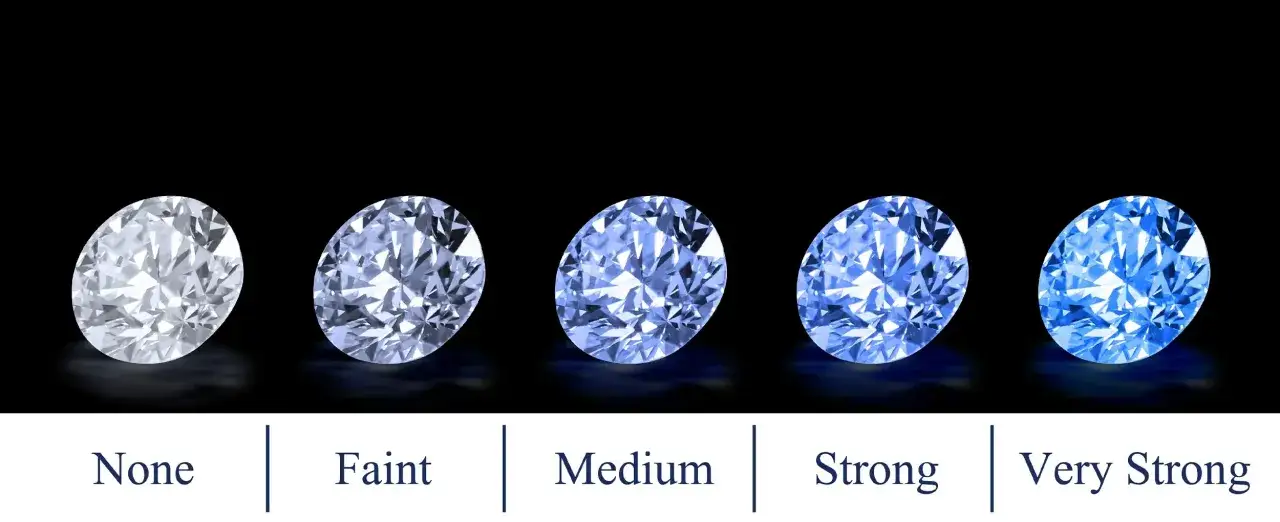
Most fluorescent diamonds glow blue. That is the common pattern by a wide margin, while yellow, orange, green, or white reactions are much rarer. In grading terms, the reaction is usually described as none, faint, medium, strong, or very strong, which gives you a quick sense of how visible the effect may be under UV light.
| Fluorescence grade | What it usually looks like | How I would read it |
|---|---|---|
| None | No visible glow under UV | Very common and not a negative on its own |
| Faint | A subtle reaction that may be hard to notice | Usually insignificant in normal wear |
| Medium | A clear glow under UV | Worth noting, but not automatically a problem |
| Strong | A bright, obvious glow | Can be attractive or distracting depending on the stone |
| Very strong | An intense glow that is easy to see | Rarely noticeable in a bad way, but it deserves a closer look |
On GIA reports, fluorescence is recorded as none, faint, medium, strong, or very strong, and the colour is noted when it is more pronounced. That matters because the grade tells you more than the fact that a diamond glows; it tells you how much it glows, which is what often affects appearance. After the colour and strength are clear, the real mystery is why some stones react so strongly while others stay silent.
Why some diamonds glow and others do not
The short version is that a diamond’s crystal structure is never perfectly uniform. Tiny defects and trace elements inside the lattice can absorb UV light and release some of that energy as visible light. Nitrogen is often linked with blue fluorescence, while other defects and trace combinations can lead to different colours or to no visible glow at all.
That makes fluorescence a natural feature, not a treatment. I tend to think of it as part of the stone’s internal character: useful, sometimes attractive, and occasionally a nuisance if it is very strong. It is also why two diamonds with the same colour grade can behave differently under the same UV lamp.
Fluorescence and phosphorescence are not the same thing
Fluorescence appears only while the UV light is on. Phosphorescence keeps going after the light source is switched off, sometimes for a few seconds or longer. That lingering glow is rare in natural diamonds and can be a screening clue in some HPHT lab-grown stones, but it is never something I would treat as a final answer on its own.| Feature | Fluorescence | Phosphorescence |
|---|---|---|
| When it appears | Only while UV light is present | After the UV light is removed |
| What it suggests | Common natural response in some diamonds | Can be a useful screening clue in certain stones |
| How reliable it is | Interesting but not diagnostic | Still not diagnostic without proper gem testing |
That difference is useful, but it is still only part of the picture, which is why the testing method matters so much.
How to test a diamond without fooling yourself
If I were checking a diamond at home or in a shop, I would start with a proper long-wave UV source rather than a phone torch or random light app. A dedicated UV lamp or jeweller’s viewing cabinet gives a far more reliable result. I would also darken the room, because stray light makes weak fluorescence much harder to judge.
- Check the diamond under long-wave UV first, then compare it in normal light.
- Watch for colour, brightness, and whether the glow is even or patchy.
- If the stone is set, remember that the mounting can block some UV and hide part of the effect.
- Do not use the glow as proof of natural origin or lab-grown origin.
- Wear UV protection and never look directly into the lamp.
Short-wave UV can be useful in gem screening too, especially when someone is comparing natural and laboratory-grown stones, but I would treat it as a specialist tool rather than a casual buying test. If the result still feels unclear, I move from testing to interpretation, because a glow only matters if it changes how the stone looks or prices out.
Does fluorescence change beauty or value
This is where the conversation usually becomes more nuanced. In many diamonds, fluorescence has no visible downside in everyday wear, and some people even prefer the look of medium to strong blue fluorescence in lower-colour stones because it can make them appear a touch whiter in certain lighting. That is why I would never dismiss a diamond solely because it fluoresces.
The exception is the small minority of stones with very strong fluorescence that can look hazy, milky, or oily in some light. GIA’s long-running studies suggest that fewer than 0.2% of fluorescent diamonds show that effect, so the concern is real but uncommon. In other words, fluorescence is usually a detail, not a defect, and the stone itself has to prove whether it behaves well.
In the UK market, that means I would judge fluorescence alongside cut, colour, clarity, and certification rather than treating it as a standalone warning sign. Once you separate rare edge cases from ordinary behaviour, the buying decision becomes much more straightforward.
The UV clues I trust when buying a diamond in the UK
When I am weighing up a diamond, I trust the full picture more than the glow. A clean grading report, a sharp cut, and good transparency matter far more to daily beauty than a UV reaction that only appears under specific conditions. If fluorescence is present, I read it as context, not drama.- For a colourless or near-colourless diamond, I check carefully for haze if the fluorescence is strong or very strong.
- For a slightly warmer stone, I do not reject blue fluorescence automatically, because it can be neutral or even helpful in appearance.
- For lab-grown versus natural questions, I treat UV behaviour as a screening clue only and rely on a proper lab report for certainty.
- For everyday wear, I prioritise cut quality and light return, because those are what you notice most on the hand.
For me, fluorescence is a detail worth reading, not a reason to panic. If the diamond still looks crisp, bright, and lively in daylight, the UV reaction is usually just one more line in its story.