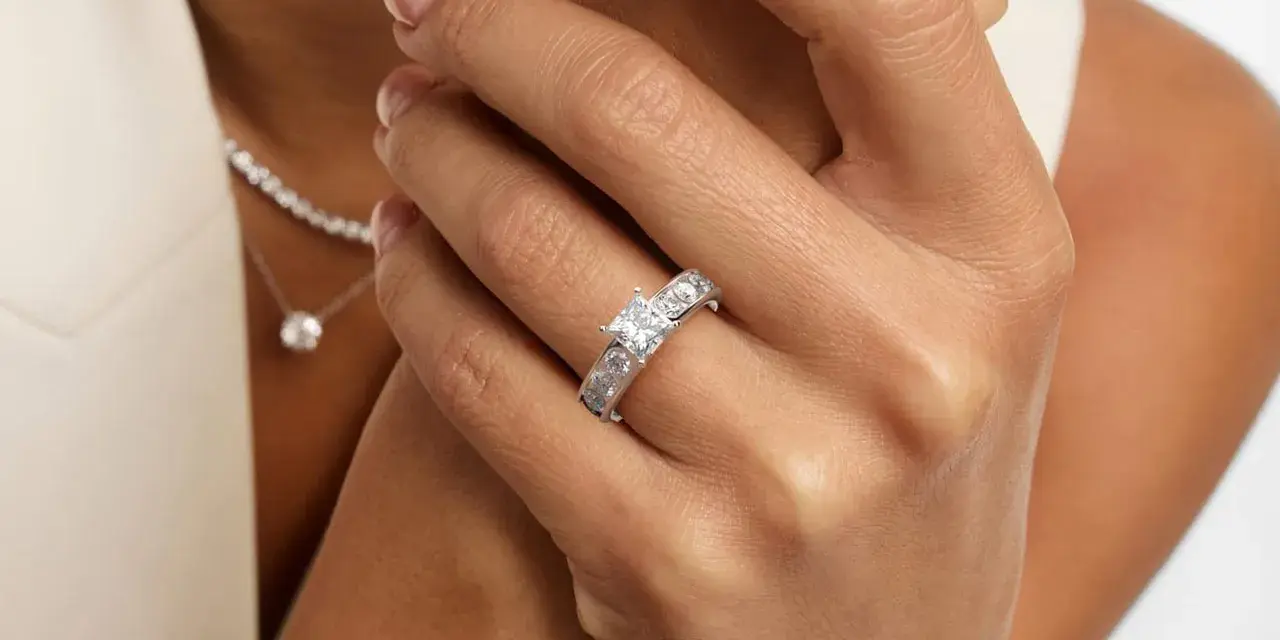
The essentials in one glance
- Shape: square or slightly rectangular, with four pointed corners.
- Cut style: modified brilliant faceting, usually with 50+ facets.
- Look: bright, crisp sparkle with a modern, geometric feel.
- Main trade-off: the corners need protection because they can chip more easily.
- Best use: engagement rings and other pieces where you want strong sparkle without a round shape.
A princess cut is a square brilliant, not just a square diamond
GIA describes the shape as a square modified brilliant, which is the key difference between a princess cut and a step-cut square such as Asscher. That faceting pattern matters: instead of broad, mirror-like flashes, you get a lively pattern of light that feels sharper and more energetic.
The cut is relatively modern, developed in the late 1970s and widely associated with the 1980s. In practice, I think that modern origin still shows in the look: it feels cleaner and more architectural than many older diamond shapes. Depending on proportion, the stone may read as perfectly square or slightly rectangular, but the classic version is close to a square face-up outline.If you want the short version, this is not a square diamond that was merely trimmed into shape; it is a deliberately engineered cut meant to maximise sparkle in a square silhouette. That is why it sits so comfortably in contemporary ring designs, especially in the UK where platinum and white gold settings are still such strong favourites.
Once the shape makes sense, the next question is why it looks so bright in motion.
Why the shape throws so much light
The princess cut earns its reputation from the way its facets return light. Brilliance is the white light reflection, fire is the coloured flash, and scintillation is the sparkle pattern you see as the diamond moves. A good princess cut delivers all three with a crisp, energetic feel.
Because the faceting is arranged in a brilliant style, the stone can look alive from almost every angle rather than flat or sleepy. Many buyers also like the fact that a princess cut often gives strong face-up presence for its carat weight, although the exact result still depends on depth and proportions. A deep stone can hide weight below the surface, so two diamonds with the same carat weight can look noticeably different in size.
That mix of sparkle and geometry is the reason the cut has stayed popular for years. The sensible follow-up is how it compares with the other shapes people usually consider at the same budget.
How it compares with other popular diamond cuts
When I compare princess cuts with other fancy shapes, I look at sparkle, outline, and how much care the setting will need. A table makes the trade-offs easier to see.
| Cut | Look | Sparkle style | Main strength | Main drawback |
|---|---|---|---|---|
| Princess | Square with pointed corners | Bright, crisp, and energetic | Modern style with strong brilliance | Corners need protection |
| Round brilliant | Perfectly round | Balanced, classic sparkle | Best-known light performance | Usually the highest price per carat |
| Cushion | Square-ish with rounded corners | Soft flashes with a gentler feel | Romantic, forgiving outline | Less geometric and often less crisp |
| Asscher | Square with cropped corners | Step-cut, mirror-like flashes | Art Deco character and clarity | Less brilliance than a princess cut |
| Radiant | Square or rectangular with softened corners | Busy, lively sparkle | Brilliant look with a bit more corner safety | Shape can feel less crisp |
The broad pattern is straightforward: choose princess if you want a modern square look with plenty of movement; choose round if you want the benchmark for symmetry and all-round sparkle; choose cushion if you prefer softer edges; choose Asscher if you like a more architectural, vintage feel. Radiant sits between princess and cushion, but with softened corners and a slightly different flash pattern.
For a British buyer, the princess cut often lands in that useful middle ground between polished minimalism and obvious sparkle, which is why it works so well in solitaire, halo, and three-stone settings alike. The next issue is less about style and more about quality control.
How to judge the quality of a princess cut diamond
Shape is the first filter, but the details decide whether the stone feels balanced or awkward. I usually start with the outline, then check the corners, then look at the certificate and the stone's light performance.
Check the outline first
A well-cut square princess should look even on all sides. If you want the purest square feel, look for a length-to-width ratio close to 1.00; once the ratio moves past about 1.05, the shape starts to read more rectangular. Slight elongation can be attractive, but it should look intentional rather than accidental.
Inspect the corners and girdle
The corners are the weak point, which is why I pay attention to how they're protected. Sharp points that sit too exposed are more vulnerable to chipping, especially if the girdle is very thin near the corners. A tiny chamfer at the corner can improve durability without changing the visual character too much.
Read Also: Internally Flawless Diamond vs. Simulant - UK Buyer's Guide
Let cut quality do the heavy lifting
With princess cuts, a great cut matters more than chasing a higher grade on paper alone. A lively stone should show even brightness across the face, not a dull centre with brightness only around the edges. If you can compare two diamonds side by side, the better one usually looks cleaner and more cohesive in motion.
For grading and confidence, I would always want a report from GIA, IGI, or another reputable lab rather than relying on marketing copy. That matters even more if you are comparing natural and lab-grown diamonds or shopping online. Once the stone itself is sorted, the setting becomes the next practical decision.Settings and care that protect the corners
Princess cuts look bold, but they are not forgiving if the corners are left exposed. V-shaped prongs are the classic solution because they guard each point without crowding the stone, and bezel settings offer even more protection if you want a very secure everyday ring. Claw or round prongs can work too, provided the corners are properly covered.
- Choose protection first: if the ring will be worn daily, keep the corners covered.
- Think about your routine: gym sessions, gardening, DIY, and heavy cleaning are all moments to remove the ring.
- Clean gently: warm water, mild soap, and a soft brush are usually enough.
- Check the setting regularly: I'd have prongs inspected once or twice a year if the ring is worn often.
It is worth remembering that diamonds are hard, not unbreakable. A sharp blow to a corner can still chip a princess cut even when the rest of the stone is perfectly sound. That is why a secure setting is not a luxury detail; it is part of the design.
Once the protection is right, the final choice is really about whether the shape feels like the right match for the person wearing it.
What I would prioritise before buying one
If I were choosing a princess cut in 2026, I would focus on three things before I let the rest of the details distract me: the outline, the corner protection, and the overall sparkle pattern. A stone that looks crisp, balanced, and bright face-up will usually be far more satisfying than one with a bigger spec sheet but a flatter appearance.
- Pick the silhouette first: decide whether you want a strict square or a slightly longer shape.
- Match the setting to the lifestyle: the more active the wearer, the more important the corner protection.
- Compare in the same light: natural light and mixed indoor light can show differences that a display case hides.
- Balance beauty and value: princess cuts often offer strong visual impact without the premium that round brilliants usually carry.
For me, that is the real appeal of the princess cut: it gives you a clean modern outline, strong sparkle, and enough individuality to feel special without becoming difficult to wear. If you want a diamond that looks contemporary on the hand but still delivers classic brilliance, this shape remains one of the most convincing choices.