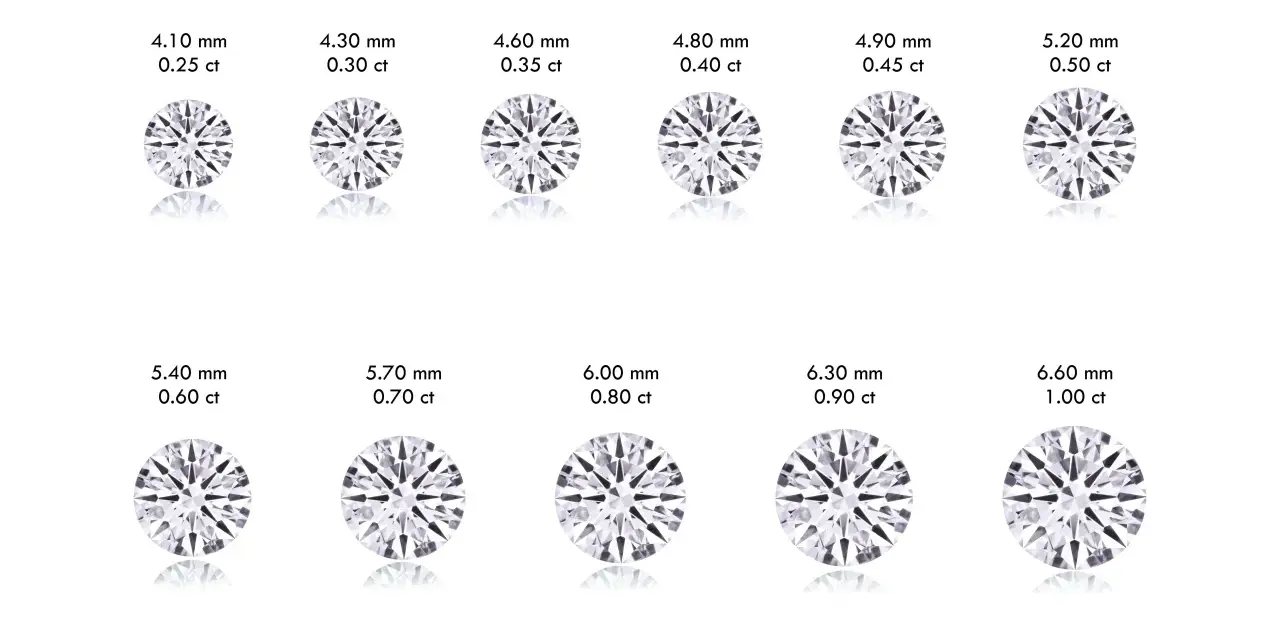
Diamond size is often judged in two different ways, and they do not mean the same thing. The mm vs carat question matters because carat tells you how much a stone weighs, while millimetres tell you how much of the finger it is likely to cover. Once you understand that difference, it becomes much easier to compare diamonds honestly, avoid overpaying for the wrong metric, and choose a stone that looks right in the setting you actually want.
The main difference is that carat measures weight while millimetres show face-up size
- Carat is a weight unit; millimetres describe the diamond’s physical dimensions.
- A well-cut 1.00 ct round diamond is usually around 6.5 mm across.
- Depth, cut quality, and shape can make two stones with the same carat look noticeably different.
- For round diamonds, compare carat and diameter together; for fancy shapes, compare length and width as well.
- Price often jumps at "magic sizes" such as 1.00 ct, so a slightly lighter stone can be better value.
What millimetres and carats actually measure
The simplest way to think about it is this: carat is weight, not visible size. GIA defines one carat as 200 milligrams, or 0.20 g, and that standard is used globally. Millimetres, by contrast, tell you the stone’s physical dimensions, usually its length, width, and depth.That difference matters because two diamonds can weigh the same and still cover the finger differently. A stone with more depth carries more weight below the top view, while a stone with a broader spread uses more of its weight where you can actually see it. Do not confuse carat with karat, which refers to gold purity.
In practice, I treat carat as the pricing and rarity number, while millimetres tell me what the diamond will look like on the hand. That split is the foundation of the whole comparison, and it is the reason a size chart is only useful when you read it alongside the cut. Once you see that distinction, the next question is why the same carat can still look different.
Why two diamonds with the same carat can look different in size
Weight is only one part of the story. A diamond’s cut proportions decide how that weight is distributed, and that distribution changes the face-up look more than most buyers expect.- Depth is the vertical height of the stone. A deeper diamond can keep more weight hidden below the surface, so it may look smaller than a shallower stone of the same carat.
- Spread is how much surface area the diamond shows from above. A stone with better spread can appear larger without adding weight.
- The girdle is the diamond’s widest edge, where the crown meets the pavilion. If the body is cut very deep or very shallow, the visible diameter changes.
- Cut quality affects more than sparkle. It also shapes how efficiently the weight translates into visible size and light return.
This is where buyers sometimes make a mistake: they chase carat alone and ignore the proportions that control what the diamond actually looks like. A well-cut 0.90 ct stone can often appear more balanced than a poorly proportioned 1.00 ct stone, especially once it is set. That is why a chart becomes meaningful only when you know which shape you are comparing next.
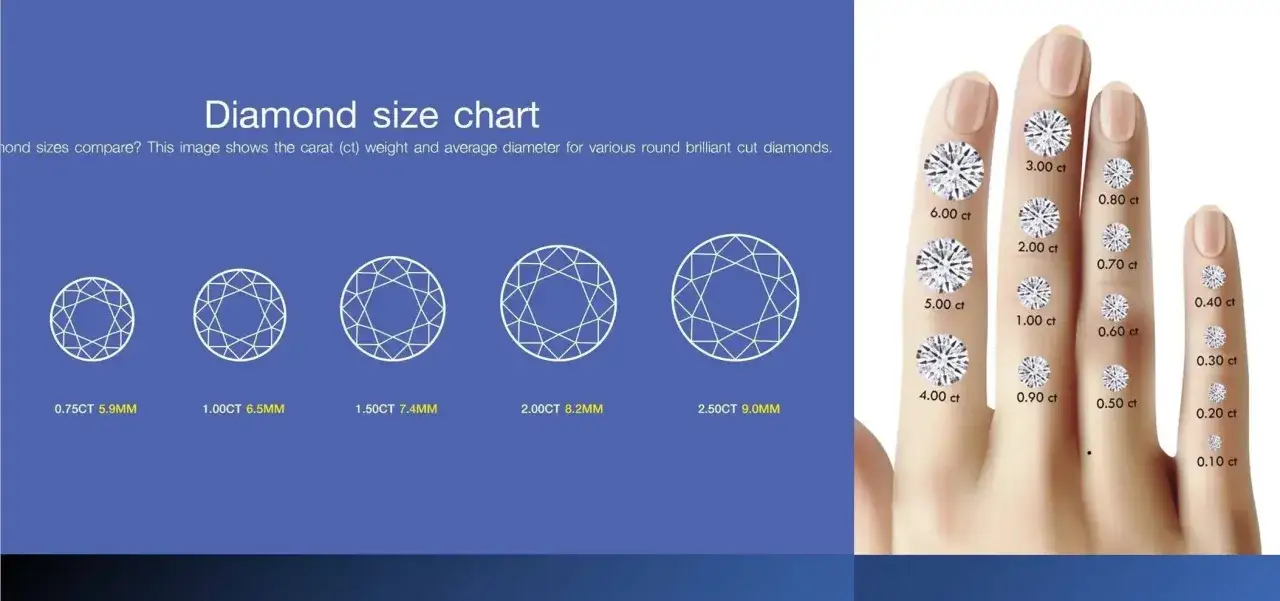
A round diamond size guide you can actually use
For round brilliants, mm-to-carat comparisons are at their most straightforward, because round diamonds are usually the benchmark people have in mind. The figures below are approximate face-up diameters for well-cut stones, so a slightly different cut can measure a touch larger or smaller.
| Carat weight | Typical round diameter | What it usually feels like on the hand |
|---|---|---|
| 0.25 ct | About 4.1 mm | Small, delicate, and best when you want subtle sparkle |
| 0.50 ct | About 5.1 mm | Clearly visible without looking oversized |
| 0.75 ct | About 5.8 mm | A sweet spot for people who want presence but not drama |
| 1.00 ct | About 6.5 mm | The classic benchmark size most buyers recognise |
| 1.50 ct | About 7.3 mm | Noticeably larger, with a stronger visual footprint |
| 2.00 ct | About 8.1 mm | Substantial and immediately apparent |
What matters here is not the exact decimal point, but the pattern. Diameter grows much more slowly than price does once you move through the popular carat thresholds. That is why a 1.50 ct diamond does not look 50% wider than a 1.00 ct diamond, even though it weighs half as much again.
For value-seeking buyers, that gap is useful. A diamond that falls just below a popular threshold can sometimes give almost the same visual size for noticeably less money, especially if the cut is strong. Round brilliants are the easiest benchmark, but they are not the whole story, because shape changes the equation quickly.
Shape changes the mm-to-carat relationship
Once you move beyond rounds, the comparison gets less tidy. The same carat weight can look broader, longer, or deeper depending on the outline of the stone.
| Shape | How it tends to look | Why that matters |
|---|---|---|
| Round | Balanced and easy to compare | Best shape for using standard size charts |
| Oval | Longer face-up spread | Often looks larger than a round of the same carat |
| Pear | Elongated with a pointed end | Can create a graceful, larger-looking silhouette |
| Marquise | Very spread-focused | Strong visual length, especially on slender fingers |
| Emerald | Broad and elegant | May look sizeable, but the open step cut changes the sparkle |
| Cushion or princess | More variable in depth | Carat can hide in the body of the stone, so dimensions matter more |
The practical takeaway is simple: do not compare carat numbers across different shapes as if they were equal on the hand. A 1.00 ct oval, for example, often covers more visible surface than a 1.00 ct round, while a deeper cushion can look smaller than either. If the goal is to maximise apparent size, millimetres matter even more than carat once the shape stops being round.
That is also why the listing details matter more than a single headline number.
How I read a diamond listing before I trust the size claim
When I look at a listing, I read it in this order: weight, measurements, cut, then setting. That sequence helps me separate what the diamond is from how the seller is presenting it.
- Start with the carat weight to understand the price band and the rarity level.
- Check the millimetres to see the real face-up size, ideally as length × width × depth.
- Look for the cut grade or proportions, because a well-cut stone usually gives better spread and better light return.
- Compare the shape with the chart, because the same carat behaves differently in an oval, round, or emerald cut.
- Read the report if one is available. GIA reports list both weight and measurements, which is exactly what you need when the numbers on the page seem too neat.
In the UK, this is especially helpful when you are shopping online and cannot judge scale in person. A listing that shows only carat is incomplete in my view; a listing that shows both carat and millimetres gives you enough information to make a sensible comparison.
One more thing: settings change perception. A halo, for example, can make a centre stone read larger, while a bezel can make the diamond feel more framed and compact. That does not change the actual mm, but it absolutely changes the way the stone presents on the finger. Once you know how to read the listing, the remaining problem is avoiding the traps that still catch experienced buyers.
The mistakes that make size comparisons go wrong
- Assuming carat equals size. It does not. It is weight, and weight can be hidden in depth.
- Ignoring the shape. A 1.00 ct round and a 1.00 ct oval do not show the same footprint.
- Chasing exact thresholds too hard. The jump from 0.99 to 1.00 ct is often bigger on the price tag than on the hand.
- Forgetting finger proportions. The same 6.5 mm round can look modest on a wider finger and quite prominent on a smaller one.
- Reading only the certificate headline. Good certificates help, but they do not replace an actual check of the measurements.
The point is not to distrust carat weight. It is a useful number, and it matters for value. The problem starts when people use it as a shortcut for everything else and then wonder why the diamond looks different from the image in their head.
If you want a cleaner comparison, ask yourself a better question: what do I want the stone to do visually, and how much of its weight is actually visible from above? That question leads to the decision I would make in real life.
The rule I would use when size and sparkle both matter
The cleanest way to think about the mm vs carat choice is to separate rarity from appearance. Carat tells you what you are paying for in a market sense; millimetres tell you what you are likely to see every day on the hand.
If your priority is visual impact, I would start with mm and shape first, then use carat as a filter. If your priority is prestige, rarity, or a specific budget bracket, I would start with carat and then test the size in millimetres so you do not end up with a stone that feels smaller than expected. Either way, the best purchase is usually the one where the weight, the spread, and the cut all agree with each other.
That is the part many buyers miss: a diamond does not have to be the heaviest stone in the case to look the most elegant. When the proportions are right, even a modestly sized diamond can carry far more presence than the number alone suggests.