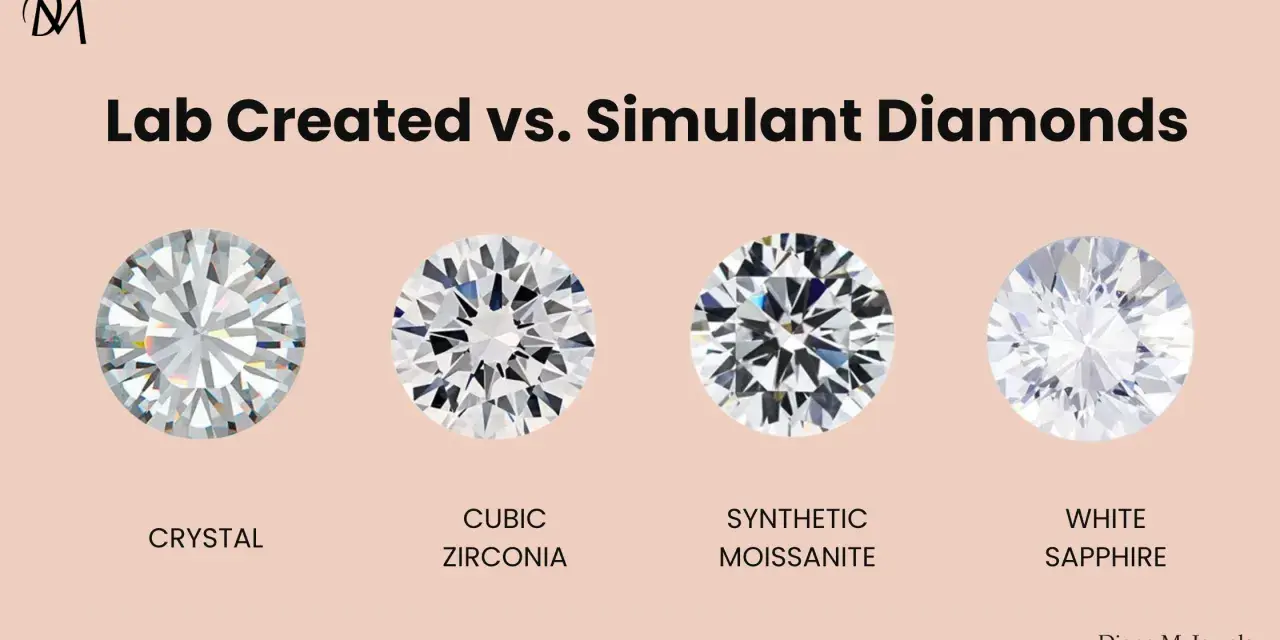
The short version is that one is a lookalike and the other is a real diamond
- Simulated diamonds imitate diamond appearance, but they are not diamond in chemical or crystal structure.
- Synthetic diamonds, more commonly sold as lab-grown diamonds, are real diamonds grown by human-controlled processes.
- Simulated stones are usually the cheapest option; lab-grown diamonds cost more, but still far less than many natural diamonds.
- For daily wear, the real questions are durability, cut quality, disclosure, and the quality of the setting.
- In the UK, the written description on the invoice matters more than the sparkle in the case, and the hallmark only tells you about the metal.
What each term actually means
In gemmology, a simulated diamond is a diamond lookalike. It may be made from cubic zirconia, moissanite, glass, or another material, and its job is to resemble diamond rather than to be one. GIA draws the line clearly: simulants only imitate the appearance of diamond, while laboratory-grown or synthetic diamonds share diamond’s chemical composition, crystal structure, and physical properties. That is why the word synthetic causes so much confusion in shops. Many retailers prefer lab-grown because it is easier for buyers to understand. A lab-grown diamond, on the other hand, is still a diamond. It forms through controlled growth rather than geological time, but the result is the same mineral. Natural diamonds take millions or billions of years to form deep underground; lab-grown stones are produced in days or weeks using technology such as HPHT, which means high pressure, high temperature, or CVD, which means chemical vapour deposition. The growth route is different, but the end material is diamond.The first practical takeaway is simple: if you want a diamond substitute, look at simulants. If you want a diamond, but not a mined one, look at lab-grown. From there, the useful comparison becomes much more specific.
A side-by-side comparison that makes the choice easier
| Feature | Simulated diamond | Synthetic diamond |
|---|---|---|
| What it is | A diamond lookalike, not diamond | A real diamond grown in a laboratory |
| Chemical structure | Different from diamond | Essentially the same as natural diamond |
| Hardness | Varies by material; cubic zirconia is about 8 to 8.5 on the Mohs scale, moissanite about 9.25 | 10 on the Mohs scale, like natural diamond |
| Appearance | Can look very convincing, sometimes with extra colour flashes | Diamond-like brilliance and fire, usually indistinguishable by eye from a natural diamond |
| Price position | Usually the lowest-cost option | Usually much cheaper than a natural diamond, but still priced as a diamond |
| Durability for daily wear | Depends on the material; softer simulants can scratch or dull more quickly | Excellent for daily wear when the setting is well made |
| Best fit | Fashion pieces, occasional wear, budget-first purchases | Engagement rings, everyday jewellery, buyers who want a real diamond at a lower cost |
If I had to reduce the table to one sentence, I would say this: a simulant gives you the look, while a lab-grown diamond gives you the look and the diamond itself. That difference explains most of the price gap, the durability gap, and the resale gap.
How they look and wear in real life
A simulated stone is judged mainly by how well it copies the visual effect of diamond. That is why cubic zirconia remains popular for sharp, bright sparkle, and why moissanite has its own following for stronger flashes of colour. The trade-off is that these materials do not behave like diamond under wear in the same way. A brand-new simulant can look excellent, but some materials are more prone to surface scratching, dulling, or a less crisp facet edge over time.
Sparkle is not the same as diamond character
Diamond has a very specific balance of brilliance and fire. That balance is hard to mimic perfectly. Moissanite often throws more rainbow flashes than a diamond, which some buyers love and others immediately notice. Cubic zirconia can look very convincing in the right light, but it rarely keeps the same sharpness for as long as diamond because it is softer and less resistant to wear.
Lab-grown diamonds behave like diamonds because they are diamonds
A synthetic diamond behaves like a diamond because it is one. Whether it was created by HPHT or CVD, its crystal structure gives it the same basic hardness and wear resistance as a mined stone. In practice, that makes it a strong choice for rings and bracelets that will be worn often. It still needs a good cut and a secure setting, though. A weak mount can make even a fine diamond look underwhelming, and no amount of terminology fixes poor craftsmanship.
GIA also notes that a lab-grown diamond cannot be separated from a natural one by eye alone, and even a loupe is not enough. If origin matters, laboratory testing is the real answer. That leads directly to the next issue, which is value and what you are actually paying for.
What you are really paying for
The price gap is where the comparison becomes commercially useful. Simulated stones are usually the budget choice because the material is inexpensive and the manufacturing cost is low. Lab-grown diamonds sit in a different bracket. They are generally far cheaper than natural diamonds of similar size and quality, but they are still sold as diamonds rather than as imitations.That is why I do not treat these two categories as interchangeable purchases. A simulant buys you the visual effect at the lowest cost. A lab-grown diamond buys you the diamond itself, but with a lower entry price than a mined stone. Natural diamonds still command the strongest rarity story, and that matters to some buyers even when the technical look is similar.
- Simulated stones are best when the main goal is appearance per pound spent.
- Lab-grown diamonds are best when the goal is a real diamond with a lower purchase price.
- Natural diamonds are usually chosen for rarity, tradition, and stronger long-term narrative value.
One practical caution is resale. I would not buy any lab-grown diamond as a financial asset. Market prices move, retail prices and second-hand prices are not the same thing, and resale rarely mirrors the original invoice. If investment value matters, you need to think very differently about the purchase. Once that is clear, the next step is learning how to shop without getting misled by wording.
How to shop in the UK without being misled
When I read a product description, I look for three things immediately. First, the stone type should be named plainly. Second, the seller should tell you whether it is simulated, lab-grown, or natural. Third, the paperwork should match the item in front of you. The FTC’s guidance is strict on disclosure, and the principle is useful well beyond the US market: a buyer should never have to guess what the stone is.
In the UK, there is one easy trap I see often: assuming that a hallmark tells you everything. It does not. A hallmark tells you about the precious metal in the setting, not whether the centre stone is mined, lab-grown, or simulated. That is why the words on the invoice, receipt, or gem report matter much more than the metal stamp.
- Ask for the exact stone description in writing.
- For lab-grown diamonds, ask for a grading or identification report.
- Check whether the retailer uses “lab-grown”, “synthetic”, or “simulated” correctly.
- Confirm the return window and resizing policy before buying an engagement ring or other high-value piece.
- Separate the stone question from the metal question; a gold hallmark does not identify the gem.
If a seller is vague, I take that as a sign to slow down. Clear terminology is not marketing fluff here; it is part of the product. From there, the only remaining question is which category actually suits your purpose.
Which option fits which buyer
The right answer depends on what the jewellery is for, not on which term sounds more premium.
- For fashion jewellery, a simulated stone is usually the sensible choice. You get the shine without paying diamond prices.
- For a ring worn every day, a lab-grown diamond makes more sense if you want diamond hardness and a lower price than mined stone.
- For a piece with family or heirloom intentions, some buyers still prefer natural diamond because the rarity story is part of the appeal.
- For the biggest look on the tightest budget, a simulant can outperform a lab-grown diamond on price alone.
I find this decision becomes much easier when the buyer says the priority out loud. If the priority is style, a simulant can be enough. If the priority is having a real diamond, lab-grown is the correct category. If the priority is rarity and tradition, natural diamond stays in the conversation. The labels are not the decision; the use case is.
The simplest rule I use when comparing them
If you only want the visual effect, buy a simulated stone and put the savings into a better setting, better metal, or a design you will actually enjoy wearing. If you want a real diamond with the same mineral structure as a mined stone, choose a lab-grown diamond and insist on clear disclosure plus proper documentation. That is the cleanest way I know to separate style choice from gemstone category.
For pieces that will be worn often, I would put cut quality, setting security, and honest labelling ahead of marketing language every time. Those are the details that change how a jewel lives on the hand, how it ages, and whether it still feels right after the first few months of wear.