The quickest way to read a diamond’s look is to separate outline from light performance
- Shape is the outline you see from above; cut style is how the facets are arranged and how the stone handles light.
- Round brilliants are the most predictable choice for sparkle, but fancy shapes can feel more personal and distinctive.
- Step cuts such as emerald and Asscher trade flash for a calmer, mirror-like effect and show clarity more easily.
- Elongated shapes such as oval, pear and marquise often look larger on the hand than a round stone of the same weight.
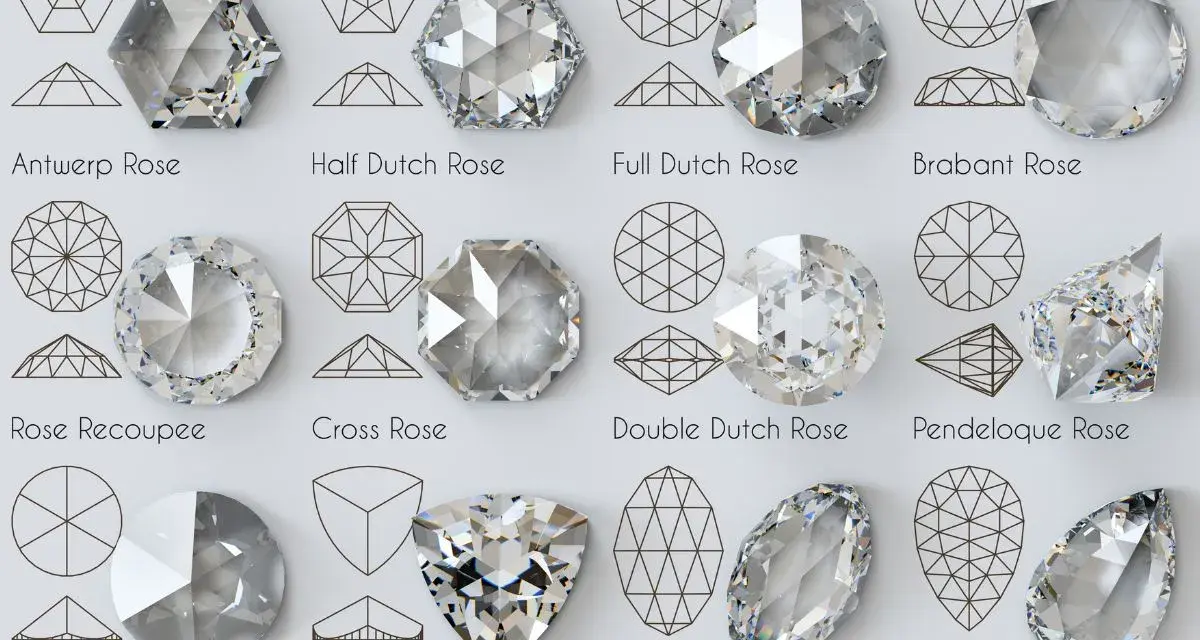
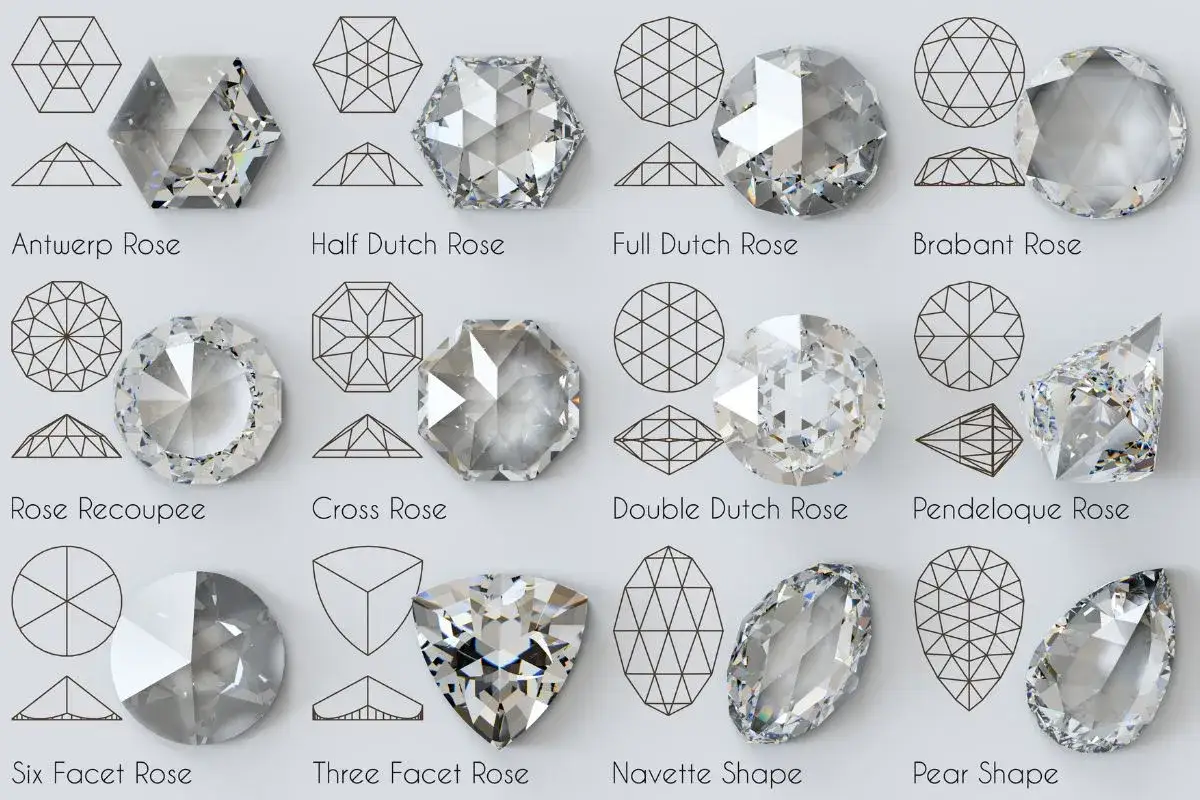
- Vintage cuts and rose cuts create a softer, more romantic look that suits antique-inspired jewellery.
Cut, shape and facet pattern are not the same thing
I usually start here because most confusion comes from mixing up three separate ideas. Shape is the silhouette: round, oval, pear, square, rectangular or heart. Cut style is the way the facets are arranged, and that arrangement determines how the diamond returns light, how much it sparkles and what kind of visual mood it creates.
That is why two diamonds with the same outline can feel completely different. A round brilliant may have 57 or 58 facets and throw back fast, bright flashes, while an emerald cut uses long step facets that create a slower, more architectural look. On standard lab reports, only round brilliants receive a formal cut grade; other shapes are judged more through polish, symmetry and their face-up appearance. Once that distinction is clear, the rest becomes far easier to read. The next step is understanding the main faceting styles themselves.
The faceting styles that change how a diamond behaves
| Style | What it looks like | What it does well | Main trade-off |
|---|---|---|---|
| Brilliant cut | Many small triangular and kite-shaped facets that create a lively, busy pattern | Maximum sparkle, strong fire and good masking of small inclusions | Can look more active than elegant if you prefer a quieter surface |
| Step cut | Long, parallel facets that read like a set of mirrored steps | A calm, elegant “hall of mirrors” effect and strong geometric lines | Shows colour and clarity more easily, so quality matters more |
| Mixed cut | A combination of brilliant and step-like elements | Balances sparkle with shape definition | Can sometimes look too busy or too quiet if proportions are off |
| Antique cut | Hand-cut proportions, often with a higher crown, smaller table and softer symmetry | A romantic, candlelit glow with real character | Less predictable than modern precision cutting and often smaller face-up for the weight |
| Rose cut | A domed top with triangular facets and usually a flat base | Delicate shimmer and a very low profile | Less brilliance than modern cuts and more visible colour or inclusions |
In practical terms, brilliant faceting is about energy and brightness, step faceting is about calm structure, and mixed faceting sits somewhere in between. That is why a radiant cut can feel much more lively than an emerald cut, even when both are rectangular, and why a vintage stone can feel softer and more intimate than a modern one. I find this distinction especially useful when a client says they want a diamond that feels “classic” but not boring. The shape shortlist comes next, and that is where most people start to recognise their own taste.
The shapes people compare most often
| Shape | What it does visually | Best for | Watch out for |
|---|---|---|---|
| Round | The most balanced and universally bright look | Maximum sparkle and a timeless choice | Usually the least distinctive in silhouette and often the most expensive per carat |
| Oval | Elongates the finger and often looks larger than a round of the same weight | A softer, elegant look with strong brilliance | Can show a dark centre shadow if the cut is poor |
| Pear | A teardrop shape that feels graceful and slightly dramatic | Pendants, drop earrings and statement rings | The pointed tip needs protection in the setting |
| Marquise | Long, narrow and highly elongating on the hand | Bold vintage style and strong visual size for the weight | Fragile points and symmetry are critical |
| Princess | Square outline with a sharp, modern presence | Contemporary rings with a lot of sparkle | The corners need careful setting to prevent chipping |
| Cushion | Soft corners and a pillow-like outline | Vintage-inspired pieces and romantic settings | Can face up a little smaller than some other shapes of the same weight |
| Emerald | Rectangular, sleek and quietly reflective | A refined, architectural look | Shows inclusions and colour more readily, so clarity becomes more important |
| Radiant | Square or rectangular with cropped corners and lots of light return | People who want a modern shape with high sparkle | Can look more “crushed ice” than crisp, depending on the cut |
| Asscher | Square step cut with a strong geometric centre | Art Deco style and collectors who like symmetry | Like emerald cuts, it can reveal colour and clarity more easily |
| Heart | Highly recognisable and romantic when the proportions are right | Sentimental pieces and statement jewellery | Needs excellent symmetry and enough size to read clearly |
I treat this table as the visual shortlist. If you want maximum sparkle with the least risk, round, princess and radiant are usually the easiest to love. If you want something that feels more directional, oval, pear and marquise create length and movement, while emerald and Asscher lean into polish, restraint and geometry. Cushion and antique-inspired shapes sit in a lovely middle ground: they feel softer, but they still have enough personality to stay interesting.
One detail I always flag is the setting. Points need protection, so pear, marquise and heart shapes benefit from careful prong placement or a bezel-style mount. A well-chosen setting does more than secure the stone; it changes how complete the shape reads from a distance. That is the bridge to choosing a diamond for the way you actually wear jewellery.
How to choose a shape that fits the way you wear jewellery
When I help someone narrow the options, I normally reduce the decision to lifestyle first and style second. A beautiful diamond that feels too fragile, too busy or too flat in daily light will disappoint, even if it looks perfect in a close-up image. These broad rules help more than most people expect:
- For the brightest, safest all-rounder, choose round brilliant.
- For a lengthening effect, look at oval, pear or marquise.
- For a modern, crisp look, consider princess or radiant.
- For an elegant, understated look, emerald and Asscher are the strongest options.
- For a softer, romantic feel, cushion, rose cut and old European-style stones work beautifully.
- For a symbolic or personal statement, heart shapes can be meaningful, but only if the symmetry is strong.
The other factor I would never ignore is how much maintenance you are willing to accept. Sharp corners need more protection, open step facets show more internal characteristics, and antique cuts are charming precisely because they do not look machine-perfect. That is not a flaw; it is the personality of the stone. The point is to choose the kind of imperfection you can happily live with. Once the visual direction is set, quality checking becomes much more straightforward.
What I check before I buy one
If a diamond looks good on paper but not in motion, I keep looking. The best way to judge any stone is to see how it behaves under different light, because sparkle, contrast and shape integrity all change as the stone moves. My check list is simple:
- Brightness should be even across the face, not concentrated in one area.
- Symmetry should be convincing, especially in oval, pear, heart and marquise shapes.
- Polish should be clean enough that the facets look crisp rather than hazy.
- Bow-tie effect in elongated shapes should be subtle, not a dark band dominating the middle.
- Clarity and colour should suit the cut style: step cuts usually need a higher standard than brilliant cuts.
- Corner and tip protection should match the shape, especially in princess, pear, marquise and heart designs.
For round brilliants, the cut grade is the quickest filter, because the facet pattern is standardised. For fancy shapes, I rely much more on face-up appearance and craftsmanship than on any single number. A well-cut radiant can outperform a mediocre round in everyday beauty, while a poorly cut emerald can look flat even if the colour and clarity are high. In my experience, that is where buyers often make the wrong trade-off: they overvalue paper grades and undervalue the way light actually moves through the stone. The final section pulls those decisions together into a simple way of thinking about style.
The details that separate a good stone from one that only photographs well
The best diamonds are not always the brightest in the most obvious way. Some are lively and sharp, some are soft and elegant, and some are deliberately old-fashioned. What matters is whether the stone’s facet pattern matches the mood you want to wear every day. If you like clean architecture, step cuts will feel honest and composed. If you want the familiar flash that reads instantly as “diamond”, brilliant cuts are still the safest route. If you want a piece that feels more collected than bought, vintage styles usually carry that emotional weight better than modern precision ever could.
My own rule is straightforward: choose the shape for the silhouette, then choose the cut style for the light. If both are working together, the diamond feels complete. If one is fighting the other, the piece never quite settles. That is why I always recommend looking at stones in ordinary room light, not just under bright jewellery counters, and why I would rather have a slightly less famous shape with excellent facet behaviour than a famous shape that looks lifeless from across the room.
When you keep that logic in mind, the whole category becomes much less overwhelming, and far more enjoyable to shop.