Key ideas to keep in mind
- Emerald is most often associated with love, renewal, truth, and heart-centred healing.
- Its green colour ties it to growth, balance, and the heart chakra in modern crystal traditions.
- Historical stories link emerald with loyalty, eloquence, and protection, but those are cultural beliefs rather than proven effects.
- In jewellery, rings and pendants usually carry the strongest symbolic message because they are worn close and often.
- Colour, treatment, and wearability matter more than size if you want a piece that feels meaningful and lasts.
What emerald symbolises spiritually
When I strip emerald symbolism down to its essentials, four ideas keep returning: love, renewal, truth, and abundance. That is why emerald feels different from many other gemstones. It is not usually read as a loud or flashy stone; it feels more like a steady one, the sort of stone people choose when they want depth rather than drama.
In spiritual jewellery, emerald is often treated as a stone of the heart. That does not mean the same thing in every tradition, but it usually points towards compassion, emotional honesty, and the ability to stay open without becoming fragile. It also carries a gentle sense of prosperity, not in a showy way, but as something stable and lasting.
| Symbolic thread | What it usually means | How it reads in jewellery |
|---|---|---|
| Love and devotion | Commitment, tenderness, loyalty | Strong in rings and meaningful gifts |
| Renewal and growth | Fresh starts, healing, self-repair | Often chosen for milestone pieces |
| Truth and clarity | Honesty, clear speech, emotional openness | Works well for daily wear pieces |
| Abundance and prosperity | Steady success, not flashiness | Fits heirloom jewellery and career gifts |
I like that emerald’s symbolism is specific without being narrow. It can stand for romance, but it is just as comfortable standing for personal growth or a new chapter. That balance becomes clearer once you look at the colour itself.
Why the green colour matters so much
Green is doing a lot of work here. In modern crystal traditions, it is the colour most often linked with the heart chakra, so emerald is commonly read as a stone of compassion, emotional balance, and open-hearted communication. In plain language, that means it is often chosen when someone wants more ease in giving and receiving love.
There is also a very simple visual reason the symbolism works: green naturally feels restorative. It recalls spring leaves, shaded gardens, damp earth after rain, and the sense that growth can be gentle rather than forced. If I had to describe emerald’s energy in one phrase, I would call it nourishing rather than energising.
- It suggests emotional steadiness rather than emotional intensity.
- It is often used to symbolise healing after disappointment or strain.
- It carries the feel of personal growth that happens in layers.
- It is linked with balance, which is why it often suits reflective people.
That is also why emerald tends to feel more mature than playful. It gives the impression of wisdom earned over time, not borrowed from a trend. The older stories behind the stone make that impression even stronger.
The older stories that shaped emerald’s reputation
Emerald’s spiritual reputation is not a recent invention. GIA’s history notes that the stone was mined in Egypt from at least 330 BC, treasured by Cleopatra, and later carried into Incan jewellery and religious ceremonies. The same source records legends that emerald could reveal truth, sharpen speech, protect against evil, and even expose whether a lover’s oath was sincere.
Those stories matter because they show what people wanted emerald to represent. Truth, protection, eloquence, and loyalty are all linked to trust, and trust is still at the heart of most modern emerald symbolism. I would not treat those legends as literal claims, but I do think they explain why the stone still feels so emotionally charged.
Emerald also became the birthstone for May, which makes perfect sense symbolically. May sits at the point of spring when growth is visible, but not yet fully mature. Emerald captures that moment beautifully: fresh, lush, and full of possibility. It is also traditionally given for the 20th and 35th wedding anniversaries, which reinforces its connection with lasting bonds rather than brief passion.
So when people respond to emerald as a spiritual stone, they are not only reacting to colour. They are inheriting a long cultural memory around honesty, renewal, and treasured commitment. That naturally leads to the next question: how should you wear it if you want the symbolism to feel personal?
How emerald’s meaning changes across jewellery pieces
The same stone can feel quite different depending on where you place it. A ring reads as a statement to the world, a pendant sits close to the heart, and earrings feel more subtle and polished. In practice, that changes the emotional tone of the piece as much as the outfit does.
| Jewellery piece | Symbolic feel | Best for |
|---|---|---|
| Ring | Commitment, confidence, visible intention | Anniversaries, promises, self-gifts |
| Pendant | Heart-centred, personal, reflective | Daily wear, private intention, layering |
| Earrings | Subtle clarity, elegance, composed energy | Workwear, evenings, understated styling |
| Bracelet | Continuous reminder, movement, ease | Casual wear and stacking |
If I were choosing emerald for a spiritual reason, I would usually start with a pendant. It sits close to the chest, so the symbolism feels direct without becoming theatrical. If the piece is meant to mark a vow or a public commitment, a ring makes more sense. That choice matters even more when you start thinking about colour, setting, and durability.
How to choose an emerald piece with the right feel
The best emeralds are not always the biggest ones. Colour is the first thing I would look at, because it shapes both value and symbolism. A vivid, evenly distributed green usually feels richer and more alive than a larger stone with a dull or muddy tone. When emerald is beautiful, the colour looks confident rather than dark.
I also think it helps to be realistic about how emerald is made and sold. Most emeralds on the market are treated to reduce the appearance of surface-reaching fractures, so treatment disclosure is not a footnote; it is part of the purchase. If a jeweller cannot clearly explain how the stone was treated, I would slow down and ask more questions.
| What to check | Why it matters | My practical rule |
|---|---|---|
| Colour | It drives both beauty and symbolism | Prioritise lively green over sheer size |
| Treatment disclosure | It affects value, care, and longevity | Ask exactly what was done to the stone |
| Setting | It affects protection in everyday wear | Choose a protective setting for rings |
| Metal | It changes the mood of the piece | Use white metal for crispness, gold for warmth |
Metal choice does more than most people expect. White gold or platinum gives emerald a cooler, sharper look, which suits a modern aesthetic. Yellow gold makes it feel richer and more antique. Rose gold softens the contrast and pushes the piece towards romance. Those are not spiritual rules, but they do affect how the symbolism is received. Once you know that, it becomes much easier to compare emerald with other green stones.
How emerald compares with other green stones
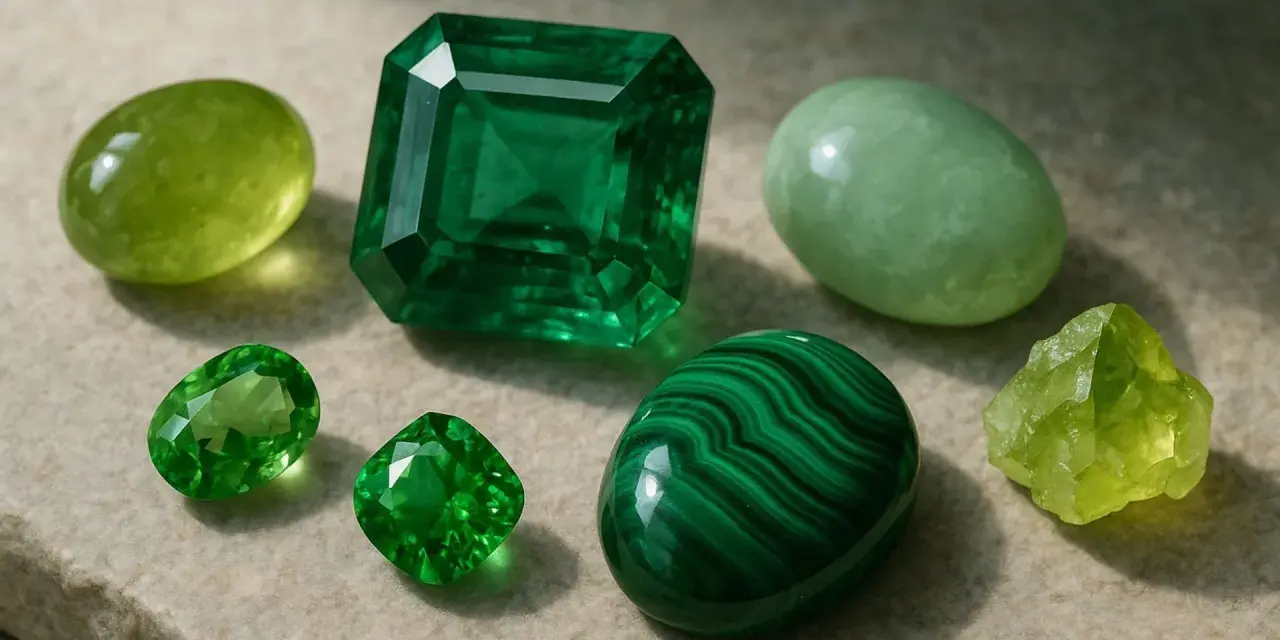
Emerald is often grouped with jade, peridot, and green aventurine, but I would not treat them as interchangeable. They all belong to the broad language of green, yet they speak in different tones. Emerald feels the most ceremonial and refined. It is the stone I would pick when I want the symbolism to feel mature, intentional, and a little more formal.
| Stone | Typical symbolic meaning | Overall feel in jewellery |
|---|---|---|
| Emerald | Love, renewal, truth, prosperity | Regal, emotionally layered, heirloom-like |
| Jade | Harmony, longevity, luck, protection | Calm, balanced, talismanic |
| Peridot | Lightness, warmth, fresh starts | Bright, lively, less formal |
| Green aventurine | Opportunity, optimism, everyday luck | Casual, approachable, easy to wear |
That comparison matters because the wrong stone can dilute the message you want to send. If you want a piece that feels ceremonial and emotionally serious, emerald is usually the strongest choice. If you want something more relaxed or playful, another green gem may fit better. And whichever stone you choose, care still matters.
What to remember before wearing emerald every day
Here is the practical side that gets overlooked: emerald is beautiful, but it is not carefree. GIA rates it at 7.5 to 8 on the Mohs scale, yet it still has only fair to good toughness, which means knocks and pressure can be an issue. GIA also notes that heat can damage emeralds and that steam or ultrasonic cleaning is risky because many stones contain filled fractures.
That does not make emerald a poor jewellery choice. It simply means you should wear it with intention, not treat it like an indestructible diamond substitute. If I were advising a client, I would keep these rules simple:
- Remove emerald rings for gym sessions, gardening, and heavy housework.
- Clean the stone with warm soapy water and a soft brush.
- Avoid steam and ultrasonic cleaners unless a gemmologist has said the stone can handle them.
- Store emerald separately so harder gems do not scratch it.
- Check the setting regularly, especially on rings and bracelets.
If the piece is antique, heavily included, or richly oiled, I would treat it as jewellery with presence rather than something to wear without thinking. That is not a drawback; it is part of emerald’s character. The stone asks for more care, and in return it gives you a deeper sense of meaning.
How I read emerald symbolism without overcomplicating it
When I put all of this together, emerald stands for a love that matures, a truth that does not need to shout, and a renewal that feels calm rather than sudden. That is why it works so well in jewellery: it carries meaning without becoming theatrical.
If you are choosing an emerald piece, I would keep three questions in mind. What intention do you want the stone to carry? How often will you wear it? And how much care are you realistically prepared to give it? Answer those honestly, and the right piece usually becomes obvious. That is the most practical way to honour the spiritual meaning of emerald while still choosing a jewel you will actually enjoy wearing.