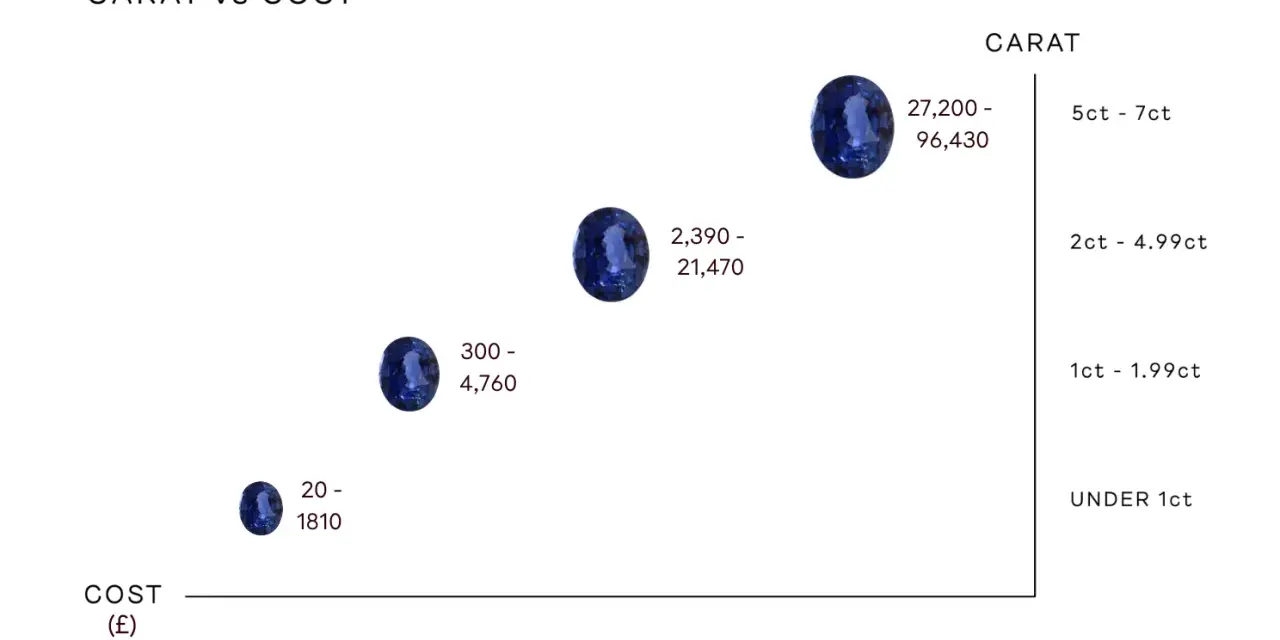
A useful gemstone price chart is really a decision tool. It helps you see where a stone sits on the market, why one gem jumps from affordable to expensive, and which qualities are worth paying for in a ring, pendant, or strand of pearls. I have rounded the figures here to current UK retail levels so the guide feels practical rather than abstract.
Key points at a glance
- Gemstone prices are driven by rarity, colour, clarity, cut, size, treatment, and origin.
- Common stones such as amethyst, citrine, and topaz can be very affordable, while ruby, emerald, alexandrite, and fine sapphire move into the premium tier fast.
- Price per carat does not rise in a straight line, especially once you get into larger stones.
- Pearls are usually priced by size, lustre, shape, and matching, not in the same way as faceted gemstones.
- For UK buyers, the smartest comparison is usually loose stone versus loose stone, or strand versus strand, with taxes and setting costs added separately.
How gemstone prices are built
The cleanest way I know to read gemstone pricing is to treat it as a stack of value factors rather than a single number. GIA’s framework for coloured stones is still the most useful one: colour, clarity, cut, size, treatment, and origin all shape the final figure. If two stones look similar at a glance, the one with richer colour, better transparency, and a cleaner cut usually sits higher on the chart.
Colour tends to matter most in coloured gems. A sapphire that looks vivid and balanced will usually beat a duller, darker stone of the same weight. Clarity comes next, but not every gemstone is expected to be flawless; emeralds and many tourmalines naturally show inclusions, and that is part of the territory rather than a defect by itself.
Cut is often underestimated. A well-cut stone throws light back to the eye more cleanly, while a poorly cut gem can look flat even if the rough material was expensive. Treatment matters too: heat, fracture filling, diffusion, irradiation, dyeing, and coating can all change value, sometimes dramatically. Origin can add a premium when the market associates a place with exceptional material, but it should never be treated as a shortcut for quality on its own. Once you see those layers, the chart becomes much easier to read.
Why size changes the bill so fast
Gemstone pricing is rarely linear. In other words, doubling the carat weight does not usually double the price. GemSelect’s market guides make this point clearly: a 1-carat stone may cost around $1,000, while a 2-carat stone of the same type and quality can jump to roughly $4,000 or more. That is the reality of rarity, not just weight.
Carat is a unit of weight, not size, and that distinction matters. A dense stone can look smaller than a lighter stone at the same carat weight, and cut style changes the face-up appearance as well. That is why I always tell readers to compare both the carat figure and the millimetre size, especially when they are shopping for a ring setting or trying to match a replacement stone.
The sharpest increases usually appear in gems that are already scarce: ruby, sapphire, emerald, alexandrite, fine tanzanite, and top-grade tourmaline. Once a stone passes certain size thresholds, the price can climb faster because large, clean rough is much harder to find. That is why the chart below is useful, but also why you should read it as a range, not a promise.
A practical gemstone price chart in pounds
These are broad UK retail ranges for loose stones in 2026-style market conditions, rounded to keep the guide readable. Mounted jewellery, branded pieces, and certificates can push the final retail price higher.
| Gemstone | Typical UK retail range | What usually pushes it higher |
|---|---|---|
| Amethyst | £1-£15 per carat | Rich purple colour, large clean stones, strong cut quality |
| Citrine | £2-£25 per carat | Natural, untreated material and deeper golden colour |
| Topaz | £5-£15 per carat for common material; £400+ per carat for Imperial topaz | Rare colour, strong clarity, larger stones, premium origin |
| Peridot | £8-£115 per carat | Vivid green tone, larger stones, cleaner eye-clean examples |
| Garnet | £4-£50 per carat for common red garnets; £300-£13,000+ per carat for tsavorite or demantoid | Rare colour, bright saturation, desirable variety, strong origin story |
| Tourmaline | £15-£200+ per carat | Strong pink, vivid blue, bi-colour stones, neon Paraíba-style colour |
| Aquamarine | £15-£750+ per carat | Deeper blue, fine clarity, larger well-cut stones |
| Opal | £10-£250 per carat for commercial material; £150-£1,000+ per carat for fine black opal | Play-of-colour, dark body tone, brightness, pattern |
| Tanzanite | £60-£1,000+ per carat | Deep blue-violet colour, good saturation, larger calibrated stones |
| Sapphire | £30-£500 per carat for commercial stones; £750-£1,500+ per carat for fine unheated stones | Strong colour, untreated material, top clarity, classic blue tones |
| Emerald | £50-£5,000+ per carat | Intense green, good transparency, lower visible filling, respected origin |
| Ruby | £60-£15,000+ per carat | Strong red colour, excellent transparency, rare origin, minimal treatment |
| Alexandrite | £300-£8,000+ per carat | Clear colour change, strong saturation, larger stones, rarity |
In practice, I use the lower end of the table for commercial jewellery and the upper end for fine collector-grade material. The most misleading mistake is comparing a treated, commercial stone with a top-quality untreated one and assuming the gap is just a matter of branding.
Why pearls need their own pricing logic
Pearls sit in the jewellery world, but they do not behave like faceted gemstones. They are usually priced by size, lustre, shape, surface quality, nacre thickness, matching, and overall appearance rather than by carat alone. A strand that looks beautifully matched and has a mirror-like glow will always feel more valuable than a strand that is the same size but uneven in colour or finish.
| Pearl type | Typical UK retail range | What usually pushes it higher |
|---|---|---|
| Freshwater cultured pearls | £20-£150 per strand | Better roundness, higher lustre, cleaner surfaces, stronger matching |
| Akoya cultured pearls | £150-£800+ per strand | Sharper lustre, symmetry, larger size, better colour matching |
| Tahitian cultured pearls | £250-£1,500+ per strand | Deep dark body colour, attractive overtones, size consistency |
| South Sea cultured pearls | £800-£10,000+ per strand | Large size, silky lustre, strong nacre, matched luxury strands |
| Natural pearls | Auction-level pricing rather than normal retail | Extreme rarity, documented provenance, collector demand |
For pearls, I would usually compare strand prices rather than trying to force them into a carat-based gemstone chart. That simple shift makes the numbers feel far more logical, and it is the reason pearl shopping becomes much easier once you stop treating it like sapphire or ruby buying.
How to use the chart when shopping in the UK
The chart only helps if you compare the right thing. A loose, untreated stone is not directly comparable with a mounted gem in a finished ring, and a single pearl is not the same buying unit as a matched strand. I would use this short checklist every time:
- Check the unit first and make sure the price is per carat, per stone, or per strand.
- Ask whether the stone has been treated, and if so, how.
- Compare like with like on colour, clarity, cut, and size, not just on the name of the gem.
- For expensive stones such as ruby, sapphire, emerald, or alexandrite, ask for a lab report or certificate.
- Factor in UK delivery, setting costs, resizing, and any import charges if you are buying from outside the country.
- Look at the stone in neutral daylight if you can, because shop lighting can flatter almost anything.
I also pay close attention to durability. A gemstone can look beautiful on paper and still be the wrong choice for a ring that will be worn every day. If a buyer wants hard-wearing jewellery, I usually steer them towards sapphire or spinel before something more fragile, even when the fragile stone looks tempting on the chart. That trade-off is exactly what separates a good purchase from an expensive mistake.
Where I would start at different budgets
Price charts are most useful when they help you narrow the field. If I were shopping in real life, I would usually think in budget bands rather than by gemstone name alone.
| Budget | Stones I would shortlist | Why they make sense |
|---|---|---|
| Under £50 | Amethyst, citrine, common garnet, smaller peridot, freshwater pearls | You can usually buy attractive colour without paying for rarity |
| £50-£250 | Better aquamarine, topaz, opal, tourmaline, akoya starter pearls | This band opens up more interesting colour and cleaner cuts |
| £250-£1,000 | Tanzanite, sapphire, spinel, fine opal, matched pearl strands | Quality starts to matter more than size, and the stones feel more special |
| £1,000+ | Ruby, emerald, alexandrite, fine sapphire, tsavorite, demantoid, South Sea pearls | This is the tier where rarity and origin begin to drive the conversation |
My bias here is simple: I would rather buy a slightly smaller stone with better colour and cut than chase a bigger gem with tired colour or obvious compromise. In jewellery, that choice usually ages better and feels more deliberate.
The details I would check before paying more
There are a few things a chart will never tell you, and those are often the details that change the real value of a gem or pearl. Price should always be read alongside proof, finish, and wearability.
- Is the colour natural-looking under daylight, or only impressive under indoor lighting?
- Are treatments fully disclosed, especially for ruby, sapphire, emerald, and pearl jewellery?
- Does the cut make the most of the material, or does the stone look sleepy and overdeep?
- Is the setting protecting the gem, or is the price inflated by metal and branding rather than the stone itself?
- For pearls, is the lustre crisp and reflective, and are the shapes and colours actually well matched?
That is the real value of a gemstone price chart: it gives you a map, but it does not replace judgement. Use it to spot sensible ranges, then weigh the stone in front of you with a clear eye. When those two things line up, you are usually looking at a purchase that makes sense both visually and financially.