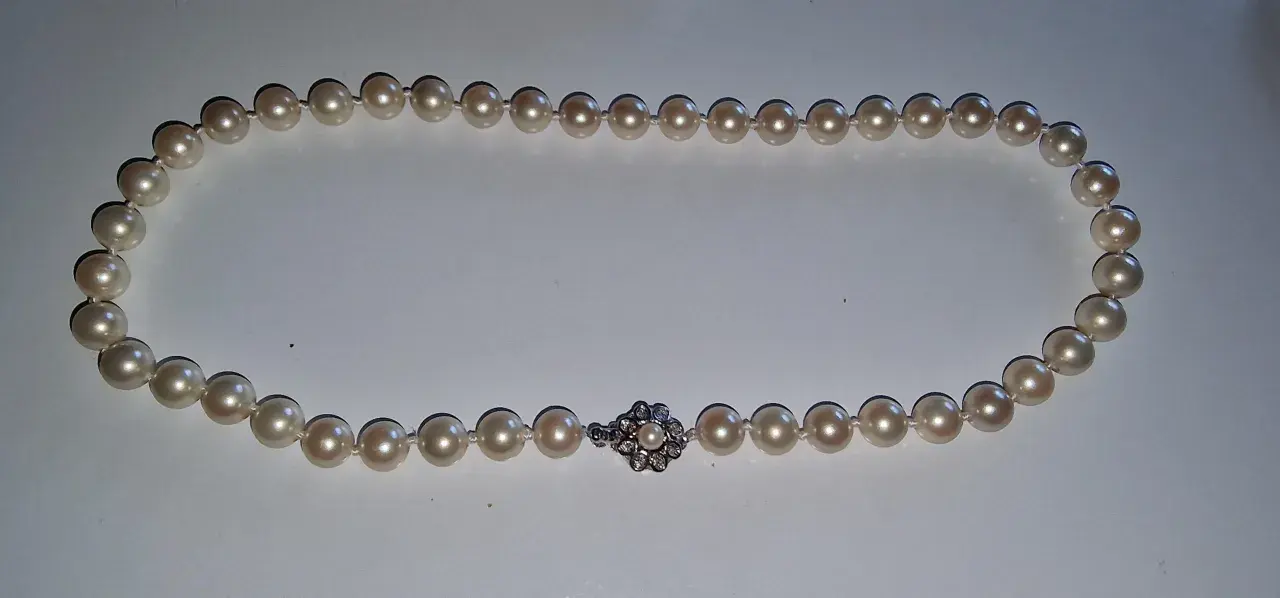
Pearls look straightforward until you have to judge one in real life. Knowing how to tell if pearls are real matters because the word “real” can mean natural, cultured, or imitation, and those three categories are not worth the same amount or verified in the same way.
In this guide, I’ll walk through the most practical checks I trust, what each one can and cannot prove, and when it is smarter to stop guessing and get a professional opinion. That is the difference between buying with confidence and paying too much for a piece that only looks convincing at first glance.
Key signs that separate genuine pearls from imitations
- Real pearls usually have depth, not just shine. Their lustre looks layered and soft rather than flat or plastic.
- The lightest home checks are useful, but not final. Touch, temperature, weight, and sound can all point you in the right direction.
- Drill holes and surface texture reveal a lot. Crisp holes, nacre layers, and tiny natural irregularities are good signs.
- Cultured pearls are still genuine pearls. They are formed by a mollusc, even if a person started the process.
- Glass and plastic imitations can fool one test. The reliable approach is to combine several clues, not rely on a single trick.
- For high-value strands, get a report. A UK jeweller or gemmology lab can identify the pearl type far more confidently than home testing can.
Real, cultured, and imitation pearls are not the same thing
The first mistake I see all the time is treating “real” as the opposite of “cultured”. In gemmology, that is not correct. A cultured pearl is genuine because it forms inside a mollusc and builds the same nacreous layers as a natural pearl; the difference is that a human began the process by inserting a bead or a small piece of tissue.
Imitation pearls are different. They are manufactured to look pearl-like and are often made from glass, plastic, shell beads, or other materials coated to mimic nacre. That distinction matters because a strand can be authentic and still be cultured, while a very convincing costume piece may be completely synthetic.
So before testing anything, decide what question you are actually trying to answer: is this piece genuine pearl jewellery, or is it a fake made to resemble one? Once that distinction is clear, the next step is to use simple checks that reveal how the surface and structure behave.
Start with the quickest checks you can do at home
I usually start with the easiest tests because they tell you a surprising amount in a few seconds. None of them is absolute on its own, but together they build a reliable picture.
The tooth test
Lightly drag the pearl across the edge of your front teeth. A genuine pearl often feels faintly gritty or sandy because nacre has microscopic layers; a fake usually feels smooth or glassy. Use a gentle touch, though. I would never recommend grinding a valuable strand against your teeth just to chase certainty.
Temperature and weight
Real pearls tend to feel cool when you first pick them up and then warm gradually against the skin. They also usually feel more substantial than plastic imitations. That said, this is where many people get misled: glass fakes can be cool and surprisingly heavy, so temperature and weight are best treated as supporting evidence rather than proof.
Read Also: Gemstone Families - Why Chemistry Matters for Your Jewelry
Sound and strand behaviour
If you softly tap two pearls together, genuine pearls usually make a muted, soft click rather than a sharp glassy ring. You can also gently roll the strand in your hand and notice whether the pearls feel dense and organic or unnaturally uniform. A perfectly consistent look is not automatically fake, but it is a reason to keep checking.
Used together, these quick checks can separate obvious costume pieces from genuine pearl jewellery, and that makes the visual inspection far more meaningful.
Inspect the surface, drill holes, and lustre
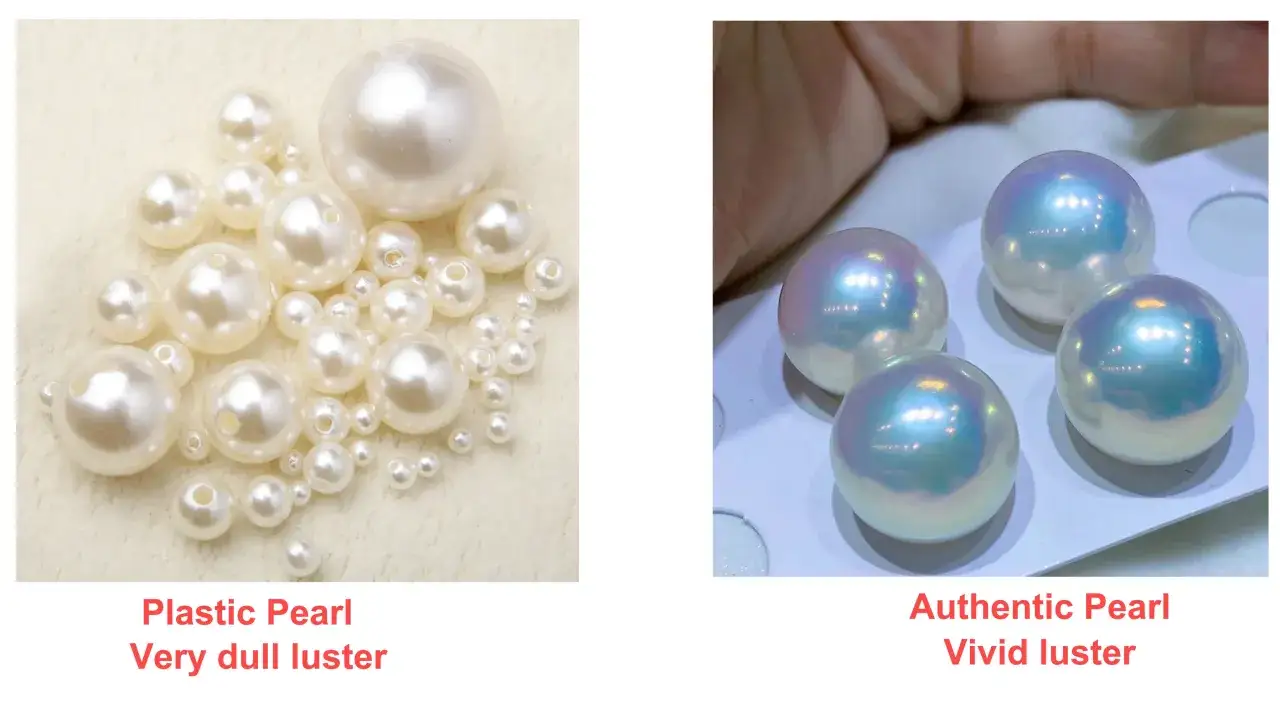
When I want a better answer, I move from touch to close observation. This is where pearl imitations often give themselves away, especially under strong daylight or a simple magnifier.
Look first at the lustre. Genuine pearls usually show a soft inner glow, not a hard, mirror-like shine. That glow should feel layered, as if the light is sitting inside the pearl rather than only bouncing off the surface. If the finish looks flat, overly glossy, or painted on, I become cautious immediately.
Next, inspect the surface for tiny irregularities. Real pearls often have minute ridges, dimples, or slight variation from one pearl to the next. They are rarely identical. Imitations, by contrast, often look too symmetrical or too clean, as if every bead came from the same mould.
The drill holes matter as well. On genuine pearls, the edges are usually crisp and may show slight evidence of nacre layers. On imitations, the hole can look moulded, chipped in a suspiciously uniform way, or coated with build-up from paint or shell-based finish. If the pearl is still mounted, that clue may be hidden, which is why you should never depend on one feature alone.
This is also where a strand’s craftsmanship helps tell the story. Knotting between pearls, a well-made clasp, and consistent stringing can suggest care and value, but they do not prove authenticity. They simply make the piece worth a closer look, which leads naturally to the common ways genuine pearls and fakes get confused.
Compare the main pearl types side by side
One reason pearl shopping creates confusion is that people mix up appearance with origin. A simple comparison usually clears that up faster than a long explanation.
| Type | How it forms | What it usually looks like | What it means for value |
|---|---|---|---|
| Natural pearl | Forms inside a mollusc without human intervention | Often irregular, sometimes rare, with organic depth | Usually the most valuable, especially with strong provenance |
| Cultured pearl | Forms inside a mollusc after human assistance begins the process | Can be round, highly lustrous, and beautifully matched | Genuine pearl jewellery, with value based on size, lustre, surface, and matching |
| Imitation pearl | Man-made from glass, plastic, shell, or coated materials | Often very uniform, with a painted or coated finish | Usually costume-level value unless part of a designer piece |
The biggest practical takeaway is simple: cultured does not mean fake. If a pearl was grown by a mollusc, it is still a genuine pearl. What changes is how it was initiated and how much value the market places on its size, lustre, surface quality, nacre, and matching.
Once you understand that, the next question becomes why some pearls still fool home tests even when they are not genuine.
Why some clues can mislead you
Home testing is useful, but it has blind spots. I would rather be honest about those limits than pretend a quick check gives a courtroom-level answer.
- Glass imitations can feel heavy and cool. That means a fake can pass the weight and temperature checks even if it fails the surface test.
- Plastic fakes can feel too light. That makes them easier to spot, but only if you already have another pearl to compare them with.
- Old genuine pearls may look dull or yellowed. Age, wear, cosmetics, and storage conditions can soften lustre without making the pearls fake.
- Very uniform cultured strands can look suspicious to beginners. In reality, careful matching is a sign of quality, not automatically an imitation.
- Shell-based or coated imitations can look convincing at a glance. They may even imitate the feel of nacre well enough to fool a casual buyer.
- Surface treatments can change the appearance of genuine pearls. Bleaching, dyeing, or optical brightening can make them look unusually clean or bright.
This is why I always combine several signs instead of chasing a single “gotcha” test. If two or three clues agree, you are on firmer ground. If they contradict each other, the piece needs a deeper inspection, especially if money or sentiment is involved.
When a UK jeweller or lab is worth it
If the pearls are inexpensive fashion jewellery, a home check may be enough for your own peace of mind. If they are an heirloom, an estate piece, or something you plan to insure or resell, I would stop there and use a professional.
In the UK, a reputable jeweller can often give an initial opinion, but a gemmology lab is better when you need documentation. The Birmingham Assay Office, for example, offers pearl certification and related gemmological services, and that kind of report is far more useful than a verbal guess. A proper lab can use X-ray radiography to see whether there is a solid nucleus, layered nacre, or another internal structure that home testing can never reveal.
That matters because some pearls that look identical on the outside are very different on the inside. A report can tell you whether the pearl is natural or cultured, whether it is saltwater or freshwater, and whether treatments or unusual construction are present. It also avoids the false confidence that comes from a clasp hallmark, because a hallmark only tells you about the metal, not the pearls themselves.
For valuable strands, vintage jewellery, or pieces with incomplete paperwork, professional identification is not overkill; it is the practical way to avoid expensive mistakes.
The checks I trust before I pay full price
My own rule is straightforward. I trust the quick home tests only as a first screen, not as a final verdict. If the lustre looks layered, the surface has small natural irregularities, the drill holes look clean rather than moulded, and the piece behaves like a dense organic gem in the hand, I am reasonably confident that I am dealing with genuine pearls.
If the answer still matters after that, I want a proper identification. That is especially true for antique jewellery, high-value strands, or anything I might insure. The cost of being wrong is simply too high when a few minutes with a professional can settle the matter properly.
So the practical takeaway is this: start with touch, light, and close observation, but do not confuse “looks convincing” with “is genuine”. When the clues line up, you can buy with confidence. When they do not, it is smarter to let a jeweller or lab confirm what the pearls really are.