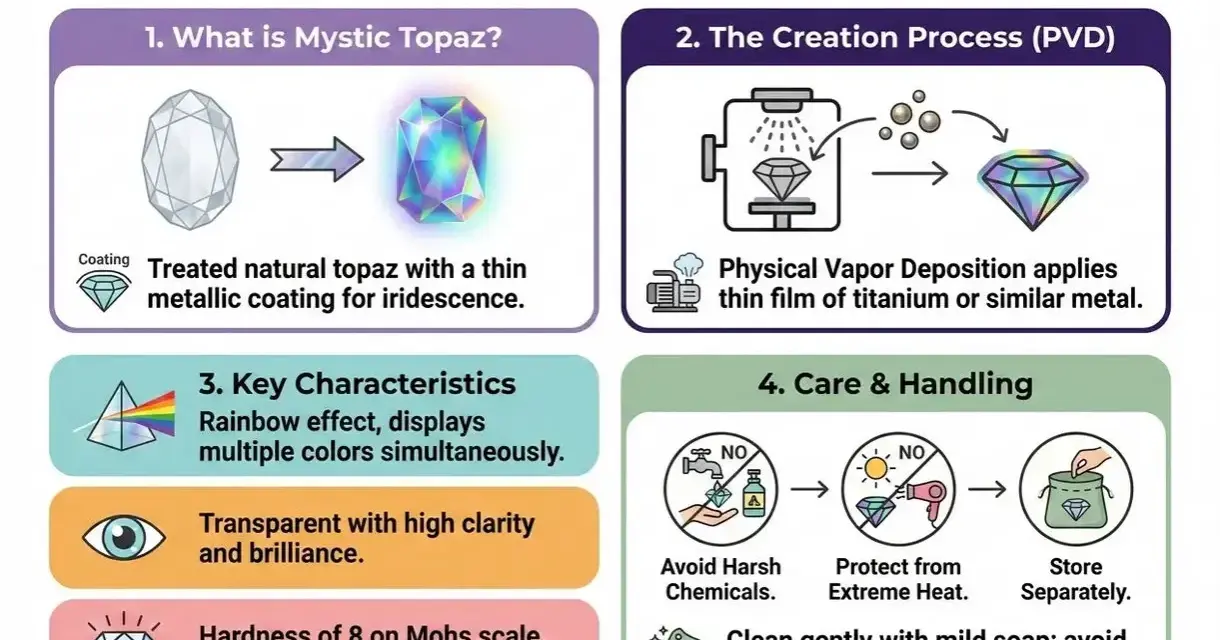
Mystic topaz is the kind of gemstone that looks almost unreal at first glance: a single stone with flashes of green, blue, pink, gold, and violet. To answer what is mystic topaz in plain terms, it is a real topaz gemstone with a thin metallic coating that creates that rainbow finish. I’ll break down how the treatment works, what it means for durability, and how to choose and care for it in everyday jewellery.
Key facts about mystic topaz at a glance
- It starts as natural topaz, usually colourless, before the rainbow effect is added.
- The colour comes from a thin surface coating, not from the stone’s natural crystal structure.
- Topaz itself is hard, but the coating is the more delicate part, so abrasion is the main risk.
- Warm water and mild soap are the safest cleaning options.
- Ultrasonic cleaners, steam, and buffing wheels can damage the finish.
- It is often best worn in pendants, earrings, or protective ring settings.
How mystic topaz gets its colour
The rainbow effect is created by applying an extremely thin metallic film to the surface of the stone, usually by vacuum or physical vapour deposition. In simple terms, light reflects off the coating and interferes with itself, which produces the shifting colours you see when the stone moves. The body of the gem is still topaz; the colour is sitting on top of it, not growing from inside it.
That distinction matters more than many buyers realise. A coated gem can look spectacular, but the visual finish depends on the surface staying intact. That is why mystic topaz behaves differently from an unenhanced stone, even though the base mineral is still topaz.
Why it is treated, not naturally rainbow-coloured
Natural topaz can be colourless, blue, yellow, pink, orange, brown, or a mix of those tones, but it does not naturally show the same kaleidoscopic sheen. The rainbow look is an engineered finish, which is why it is usually described as a treated gemstone rather than a naturally coloured one. I think that is the cleanest way to understand it: the stone is genuine, but the colour effect is added.
| Stone | How the colour appears | What that means in practice |
|---|---|---|
| Natural topaz | Colour comes from the crystal itself and trace elements | The colour is part of the stone, not a surface finish |
| Mystic topaz | Thin metallic coating over colourless topaz | The effect is brilliant, but the surface needs gentler handling |
| Blue topaz | Usually created by heat and irradiation treatment | Also treated, but it does not rely on the same rainbow coating |
This is also why good sellers should be clear about disclosure. If a gem is presented as a natural rainbow stone, that is a red flag. The more honest the description, the easier it is to judge whether the piece fits your expectations and your budget. That leads straight into the question of how well it wears.
What its durability means in daily wear
Topaz scores 8 on the Mohs hardness scale, so the base stone is fairly hard and resists scratching better than many gems. But hardness is only half the story. Topaz also has a natural cleavage, which means it can split more easily along a certain plane if it takes a hard knock. Add a surface coating on top, and the finish becomes the most delicate part of the whole stone.
| Property | What it means | Why it matters |
|---|---|---|
| Mohs 8 hardness | The topaz body is fairly hard | It handles normal contact better than soft gems |
| Surface coating | The colour sits on the outside | Abrasive cleaners or rubbing can dull the effect |
| Cleavage | The stone can split if struck sharply | Rings and bracelets need more protection than pendants |
For that reason, I would not treat it like a throw-on-anytime stone. Earrings and pendants are usually the safest everyday choices because they avoid the constant knocks that a ring or bracelet takes. If you want it in a ring, a bezel or similarly protective setting is a smarter choice than an exposed mount. That practical difference is where many people either love the stone or become disappointed by it.
How I would clean and store it
The safest routine is simple: warm water, a small amount of mild washing-up liquid, and a soft cloth. If you need a brush, use one with very soft bristles and barely any pressure. Rinse the piece in a bowl rather than directly over the sink, then dry it with a lint-free cloth so you do not leave water spots behind.
- Avoid ultrasonic cleaners and steam cleaners.
- Do not use toothpaste, silver polish, or abrasive cloths.
- Keep it away from buffing wheels and harsh jewellery cleaners.
- Store it separately in a soft pouch or lined box so other pieces do not scratch the coating.
- Take it off before gym sessions, gardening, heavy cleaning, or anything that can knock the stone.
GIA notes that the coating is not very durable, which matches how I would handle it in practice: gentle cleaning only, no shortcuts. If the piece includes pearls as well, I would follow the pearl-safe approach first, because pearls are even more sensitive to perfume, cosmetics, and acids. In mixed gemstone-and-pearl jewellery, the most delicate material should set the care routine.
How to judge quality and value when buying
The best mystic topaz stones are not necessarily the biggest ones. What matters most is the evenness of the coating, the strength of the rainbow flashes, the cut, and how securely the gem is mounted. A well-cut stone can show colour across the face without looking patchy or dull at the edges.
Here is the buying checklist I would use:
- Look for a clear treatment disclosure.
- Check that the rainbow effect is even rather than blotchy.
- Inspect the edges and crown for scratches or worn patches.
- Prefer protective settings if the stone is going into a ring.
- Treat unusually cheap stones with caution if the seller is vague about how they were made.
In the UK, I would expect a reputable jeweller to be straightforward about the treatment. The value of this gem comes from its visual impact and craftsmanship, not from rarity in the way a fine untreated colour stone might. Once you know that, it becomes much easier to decide whether the piece is a good buy or just a flashy one.
Where it fits in jewellery design
Mystic topaz works best when the setting is doing some of the visual work for it. White gold and sterling silver usually sharpen the cool flashes, while yellow or rose gold softens the look and gives the stone a warmer frame. I tend to like it most in earrings and pendants, where the colour can move freely and the coating is less likely to suffer from daily friction.It also pairs neatly with pearls when the design is restrained. The contrast is elegant: pearls bring softness and understatement, while the coated topaz adds energy and light. The key is not to let the two materials fight each other. If the piece is busy, the rainbow effect can start to look overworked; if the design is clean, the stone reads as deliberate rather than loud.
That makes it a strong choice for statement jewellery, cocktail pieces, and occasion wear. For an heirloom ring that you plan to wear every day, I would be more cautious and look closely at the setting before committing.
The simplest way to keep the colour bright
If you remember only three things, make them these: treat the coating as the fragile part, clean the stone gently, and store it so nothing rubs against the surface. Those habits do more for the look of the gem than any polish or product ever will.
That is the real answer behind the stone’s appeal. Mystic topaz gives you the drama of a rainbow gem, but it rewards the same kind of careful ownership you would give to any treated or delicate jewellery. If you choose a well-set piece and keep the care routine simple, the colour can stay vivid and wearable for a long time.