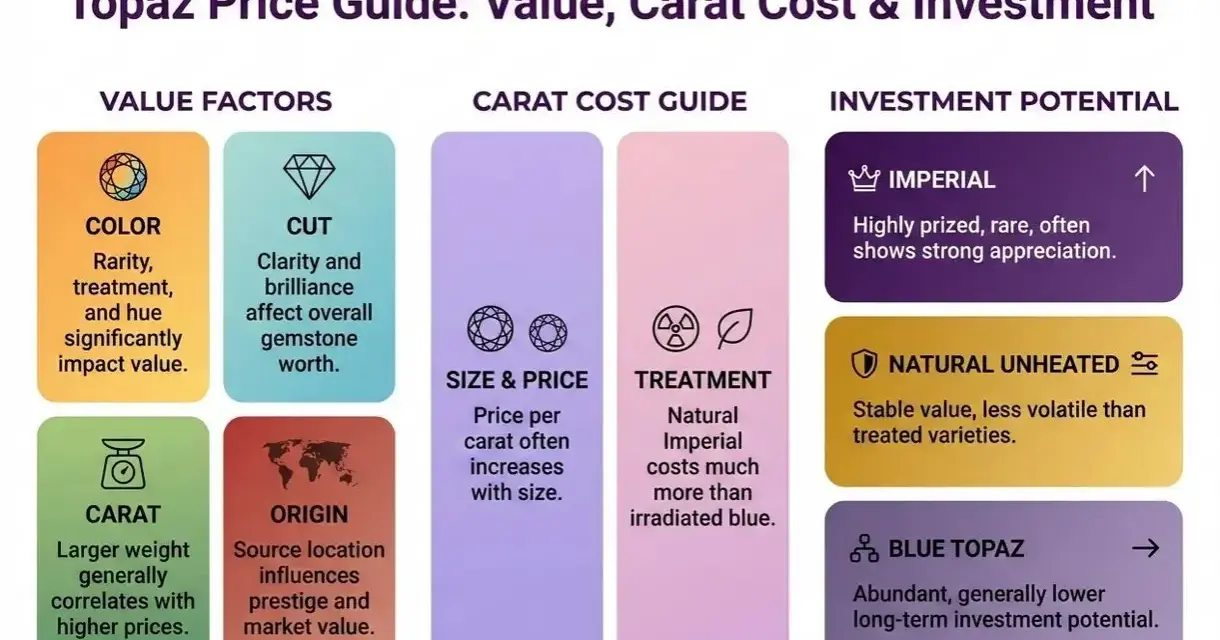
Topaz sits in two very different price worlds: common blue stones are usually budget-friendly, while fine imperial topaz can become a serious collector gem. There is no single answer to how much is topaz worth, because the price depends on colour, treatment, size, cut, and whether you are looking at a loose stone or a finished ring. In the UK, that difference matters even more because the setting, brand, and VAT can easily outweigh the gem itself.
The short version is that topaz ranges from budget-friendly to collector-grade.
- Treated blue topaz is usually the cheapest variety and often sells for only a few dollars per carat in wholesale trade.
- Colourless and brown topaz are also inexpensive, while fine imperial topaz can jump to very high per-carat prices.
- Rich orange, pink, and red topaz are the premium colours, especially when they are natural and well cut.
- UK jewellery prices often reflect metal, diamonds, and craftsmanship more than the stone itself.
- Disclosure matters: if a seller is vague about treatment or origin, I would treat the asking price with caution.
What topaz usually costs at different quality levels
I separate topaz into a few practical market tiers, because that is the only way the pricing makes sense. According to GIA, treated blue topaz moved from an early-market retail price of $20 to $40 per carat to wholesale prices of a few dollars or less per carat, while Pala International puts colourless topaz at under $8 per carat and fine imperial topaz above $1,000 per carat in large sizes.
| Topaz type | Typical loose-stone value | What that usually means in practice |
|---|---|---|
| Treated blue topaz | Wholesale: a few dollars or less per carat; retail ring sizes often around $25 per carat | Affordable, attractive, and widely available |
| Colourless or brown topaz | Usually under $8 per carat | Often used as the starting material for treated blue stones |
| Yellow or golden topaz | Generally modest, unless colour is unusually strong | More interesting than colourless, but still not rare enough for a major premium |
| Imperial topaz | Often above $1,000 per carat for large fine stones | The collector end of the market |
| Pink or red topaz | Can reach about $3,500 per carat at retail | Extremely rare, especially above 5 carats |
That spread is why a loose blue topaz can feel almost trivial in price, while a fine orange-red stone can sit in a completely different league. Once you understand that spectrum, the next question is why colour matters so much more than size in some topaz and not in others.
Why colour changes the value more than size
I care most about colour when I price topaz. Blue topaz is common because the colour is usually created by treatment, so supply is broad and prices stay low. Natural strong blue topaz is rare in nature, which is why untreated blue stones can be more interesting to collectors than the commercial material you see in most shops.
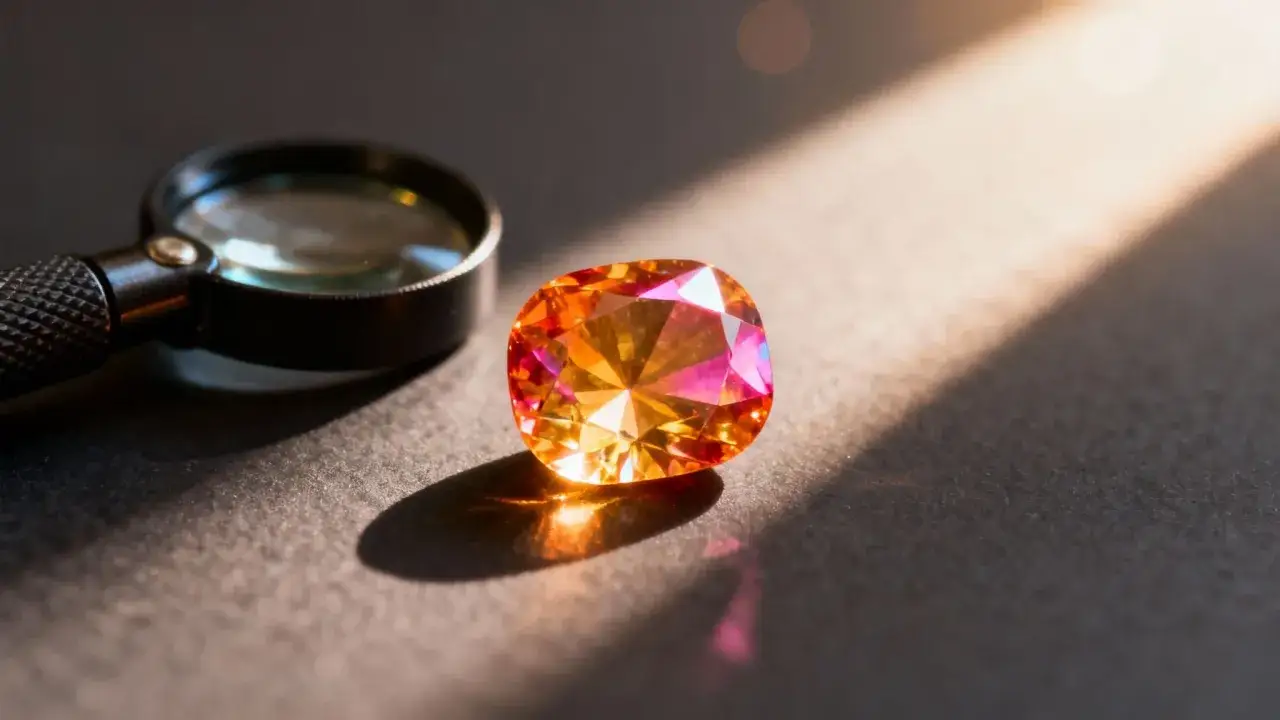
Imperial topaz is the opposite case. Rich orange, pinkish-orange, pink, and red tones are scarce, and that rarity is what pushes the price up. The strongest premiums usually go to stones with vivid saturation and a clean, lively appearance rather than pale, washed-out colour.
Origin can matter too, but only in specific situations. GIA has noted that Texas topaz can carry a higher regional value because collectors care about its provenance, yet that is the exception rather than the rule. For most buyers, colour quality still matters more than the mine label. That brings us to the next piece of the puzzle: treatment.
Treatments and origin can change the price dramatically
When I appraise topaz, the first thing I want to know is whether the colour is natural, treated, or coated. Treated blue topaz is made by irradiation and heat, and that process produces the vivid blue shades that fill mainstream jewellery cases. It is attractive, stable under normal wear, and intentionally affordable.
- Irradiation plus heat usually means commercial blue topaz, so the value is in the look rather than the rarity.
- Coated stones, such as mystic topaz, are fashion pieces and should not be priced like rare gems.
- Natural imperial topaz is the category that deserves the real premium.
- Documented origin can add value only when collectors care about the locality.
One detail I always stress is stability. The blue produced by normal treatment is generally stable in everyday wear, but a seller should still disclose the treatment clearly. If the treatment story is missing, incomplete, or confusing, I would assume the stone is less valuable, not more. After treatment, the next big value driver is how the stone is cut and how big it really is.
Cut, clarity and carat weight are the details that move the needle
Topaz is often eye-clean, which means clarity is not usually the main price driver. That is useful for buyers because it shifts attention back to the parts that actually matter: colour, cut, and size. Topaz crystals are commonly elongated, so cutters often choose oval or pear shapes to preserve weight, and they may use emerald cuts or deeper pavilions when they want to intensify colour.
| Value factor | What I look for | Price effect |
|---|---|---|
| Cut quality | Symmetry, polish, and whether the shape strengthens the colour | Can make the difference between ordinary and impressive |
| Clarity | Eye-clean appearance with no obvious chips or windows | Usually modest impact compared with colour |
| Carat weight | Actual size and how much colour the stone keeps as it grows | Blue topaz rises very little per carat; imperial topaz can rise sharply |
That last line matters. Blue topaz does not usually become dramatically more expensive just because it is larger, but imperial topaz can climb fast as the carat weight rises. In other words, size only becomes a serious value lever when the colour is already rare. From there, the retail picture in the UK starts to make much more sense.
What topaz jewellery costs in the UK
Loose-stone prices and jewellery prices are not the same thing. In the UK, I usually see sterling silver blue-topaz pieces starting around £59 to £95, 9ct gold designs sitting roughly in the £179 to £449 range, and gold pieces with diamonds or more elaborate settings moving into the high hundreds or above. Once a design becomes branded, substantial, or diamond-heavy, the price can jump into four figures very quickly.
That gap is important because the metal and craftsmanship often cost more than the stone itself. A small blue topaz in silver can be a lovely buy without being valuable in a gemstone sense, while a much more expensive ring may simply reflect 18ct gold, diamonds, and design work. I would not judge a topaz piece by its ticket price alone.
- Silver and simple settings usually give the best entry-level value.
- Gold and diamond accents push the price up even if the topaz is still commercial-grade.
- Designer pieces can cost far more than the gemstone would ever be worth loose.
If you are comparing two rings, necklace prices can be misleading, so the smarter question is what part of the cost is actually the gem. That is the lens I use when I decide whether a topaz is fairly priced.
How I check whether a topaz is fairly priced
I use a simple sequence when I evaluate topaz for purchase or resale. It keeps me from paying collector money for a commercial stone, which is the most common mistake I see.
- Ask whether the stone is natural, treated, or coated.
- Check the colour first, because it drives value more than almost anything else.
- Compare price per carat, not just the total tag.
- Separate the stone value from the setting value.
- For imperial or unusual stones, ask for origin details and any lab paperwork.
- Make sure the seller explains any treatment in plain language.
If the answer is vague, I get cautious fast. For common blue topaz, an independent appraisal is usually not worth the cost unless the jewellery itself is expensive. For fine imperial topaz, especially in stronger colours and larger sizes, paperwork and expert identification can absolutely pay for themselves. That is the point where topaz stops being a pretty purchase and starts behaving like a true gemstone asset.
The simplest rule for judging topaz value well
If I had to reduce topaz pricing to one rule, it would be this: buy the colour you love, but pay for rarity only when the rarity is real. Blue topaz is a smart, attractive jewellery stone, but it is not a scarce gem in the market. Imperial topaz, by contrast, is rare enough that treatment, origin, colour strength, and size genuinely matter.
That is why the best value often comes from a well-cut commercial stone in a good setting, while the best long-term collectible potential sits with documented natural imperial material. If you are buying in the UK, I would focus first on disclosure and colour, then decide whether you are shopping for jewellery value or gemstone value. The two are not the same, and with topaz the difference can be enormous.