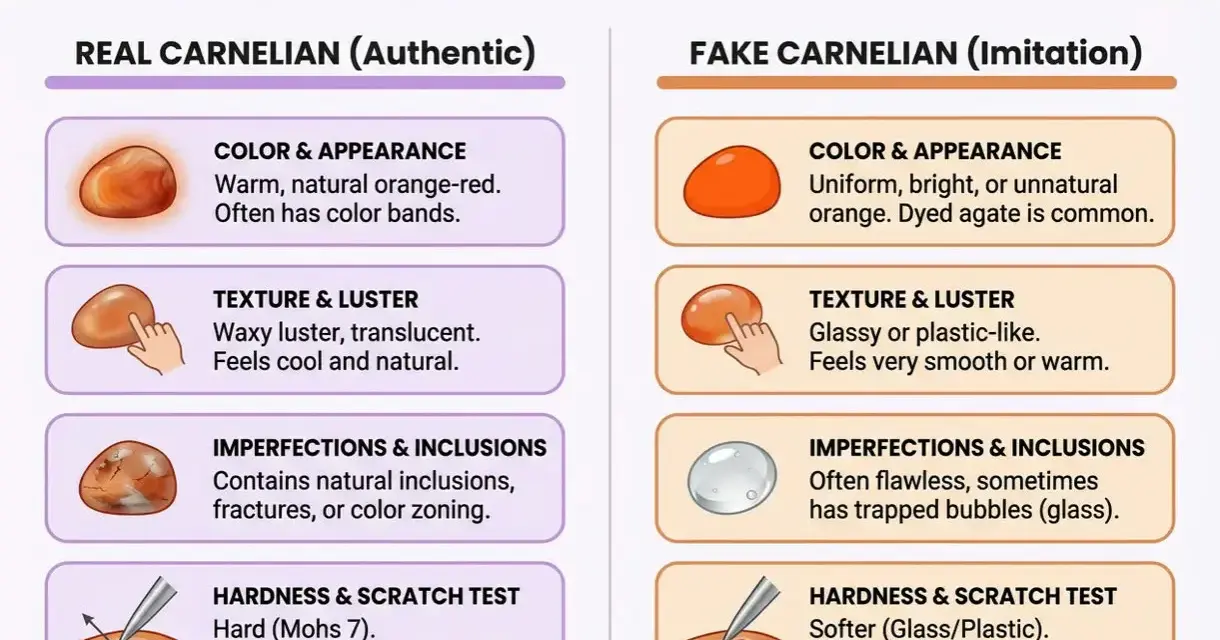
A natural carnelian piece is rarely perfect, and that is part of the appeal. In this guide I look at what sets untreated carnelian apart, how to judge colour and finish, what to ask before buying in the UK, and how it behaves in jewellery alongside pearls. I also cover care, value, and the small tells that separate a genuine, untreated stone from one that has been colour improved.
Key things to know before choosing an untreated stone
- Carnelian is an orange-red to reddish-brown variety of chalcedony, so subtle variation is normal and often desirable.
- Many commercial pieces have been heated or dyed, so treatment disclosure matters if you want a stone that has not been enhanced.
- At home, you can spot warning signs, but you cannot prove treatment status with certainty by eye alone.
- Untreated stones often look softer and more layered than heavily enhanced material, especially in bead strands and cabochons.
- Carnelian is sturdy enough for regular wear, but pearls in the same piece change the care routine completely.
What untreated carnelian actually is
Carnelian belongs to the chalcedony family, which is a microcrystalline form of quartz. Its colour usually runs from soft peach-orange to deep reddish brown, and that colour is commonly linked to iron in the stone rather than to a coating or dye. The best untreated examples do not look flat or overly uniform; they have a quiet depth that becomes more obvious when light moves across the surface.
I think this is why carnelian has stayed popular for centuries. It takes a clean polish, reads well in small carved forms, and keeps its warmth even when the design is simple. That made it ideal for seals, intaglios, beads, and later for jewellery that wanted colour without the hardness or brilliance of a faceted gem.
The treatment history matters because carnelian has long been heated to deepen colour. That does not make every enhanced stone poor, but it does mean the phrase “untreated” has real value for buyers who want the material in its original state. From here, the question becomes practical: how do you recognise the difference without guessing?How to recognise a stone that has not been treated
You can learn a lot from colour behaviour, transparency, and the way the stone handles light. Untreated carnelian usually looks more layered than synthetic-looking alternatives, and it rarely has that too-perfect, evenly sprayed orange that dye can create. Even when the colour is strong, it still tends to feel organic rather than painted on.
| Clue | What it can suggest | Why I pay attention |
|---|---|---|
| Natural tonal shifts | Often consistent with untreated chalcedony | Real stone usually has some internal variation instead of one flat shade |
| Colour concentrated near cracks or drill holes | Possible dyeing | Dye often collects where the material is more porous or damaged |
| Very even, bright orange across every bead | Possible heating or dyeing | Uniformity alone is not proof, but it is a warning sign |
| Waxy to vitreous polish with slight translucency | Common in genuine chalcedony | This is one of the most convincing visual traits when the cut is good |
| Seller can describe treatment clearly | Better transparency | Good disclosure is often more useful than marketing language |
The important limitation is this: a home inspection can raise questions, but it cannot certify a stone. If you want strong reassurance, ask for a written disclosure that says whether the piece is untreated, heated, or dyed. For more expensive stones, a lab report is the cleanest answer. I would treat any vague wording such as “natural style” or “genuine stone” as incomplete until the treatment status is stated plainly.
That kind of scrutiny matters even more when the stone is being sold as a premium piece, because the next decision is not just whether it is real, but whether it is worth the asking price and the way it is described.
What to look for when buying in the UK
In the UK market, I would start with the listing language, then move to the photographs, then to the seller’s disclosure. The order matters. A beautiful image tells you almost nothing if the description is vague, and a very low price can sometimes tell you more than the glossy presentation.
- Ask whether the stone is untreated, heated, dyed, or simply polished.
- Request daylight photos of the exact item, not a stock image of a similar stone.
- Check whether the colour is consistent across the whole strand or carving.
- Look closely at drill holes, edges, and surface fissures for staining.
- For antique or carved pieces, ask whether any restoration, re-threading, or replacement beads were used.
- Prefer sellers who are comfortable putting treatment information in writing.
As a rough buying guide, untreated stones tend to justify a premium when the colour is attractive, the polish is clean, and the seller is specific. Still, carnelian is not a stone where the highest price always equals the best piece. A slightly softer orange with depth and honest variation can be more attractive than a bright, over-processed bead strand that looks loud under showroom lighting.
If you are buying online, I would also pay attention to how the stone is presented in relation to other gems. That becomes especially important when carnelian is paired with pearls, because the same design language that flatters one material can flatten the other if the proportions are wrong.
Why carnelian and pearls work so well together
Carnelian and pearls are a stronger pairing than many people expect. The warm, earthy glow of carnelian gives pearls a richer frame, while the soft luster of pearls stops carnelian from reading as too heavy or too autumnal. In a good design, each material makes the other look more deliberate.
I like three combinations in particular:
- White or cream pearls with carnelian create the cleanest contrast. This is the most classical look and works well in necklaces and drop earrings.
- Black pearls with carnelian feel sharper and more modern. The dark surface makes the red-orange colour look deeper.
- Blush pearls with carnelian soften the palette and suit vintage-inspired jewellery, especially brooches and bead necklaces.
Metal choice changes the mood as well. Yellow gold warms the stone and makes the whole piece feel richer. Silver or white gold creates more contrast and can be the better choice if the carnelian is already dark. For carved pieces, I think simple settings usually work best; the stone should not have to compete with elaborate metalwork.
There is also a practical side to this pairing. Pearls are much softer than chalcedony, so a mixed piece must be handled as a pearl piece, not as a hard-stone piece. That leads directly into care, where most mistakes happen.
How to care for carnelian without damaging surrounding pearls
Untreated carnelian itself is fairly durable, but a piece that includes pearls should be cleaned for the benefit of the pearl, not just the stone. Pearl surfaces are delicate, and they dislike strong chemicals, ultrasonic cleaners, and steam. I would never treat a carnelian-and-pearl jewel as if it were a simple quartz bracelet.
- Wipe the piece with a soft, dry cloth after wearing.
- Use warm water with a little mild soap only when deeper cleaning is needed.
- Avoid soaking for long periods, especially if silk thread or glue is involved.
- Keep it away from perfume, hairspray, bleach, and household cleaners.
- Store it separately so the carnelian cannot rub against harder gems or metal edges.
If the piece is carnelian-only, a soft brush and mild soapy water are usually enough to keep the polish bright. The weak point is not scratch resistance so much as impact: chalcedony can chip at an edge if it knocks against a hard surface. For a necklace or bracelet that includes pearls, I would also check the thread regularly, because an attractive old strand is only as secure as its knotting.
Good care protects appearance, but it also protects value, which is the next thing buyers usually want to understand.
What really drives value in a good piece
With carnelian, value is less about rarity than about quality of colour, finish, and honesty of description. A good untreated stone does not need to be screamingly bright. It needs to look complete, well cut, and believable as a natural material.
| Value factor | What raises appeal | What weakens it |
|---|---|---|
| Colour | Rich but believable orange-red with depth | Flat, neon, or artificial-looking uniformity |
| Surface and polish | Even polish, clean edges, minimal chips | Scratches, pits, or a dull finish that hides the stone |
| Cut or carving | Balanced cabochons, neat beads, crisp carving | Poorly proportioned shapes or sloppy drilling |
| Treatment disclosure | Clear statement of untreated status | Vague, defensive, or missing information |
| Design context | Thoughtful pairing with pearls or simple metalwork | Overdesigned settings that distract from the stone |
Provenance can also matter, especially in antique jewellery. A carved seal, an Edwardian brooch, or a well-preserved strand of beads can be more desirable than a larger modern stone because the craftsmanship adds meaning. That is one reason I would rather own a modest but honest piece than a heavily improved stone with no clear story behind it.
What I would choose first for lasting appeal
If I were choosing one piece for long-term wear, I would look for an untreated carnelian stone with a warm, layered colour, a clean polish, and a setting that does not force the gem to carry the whole design on its own. For mixed jewellery, I would choose pearls that are visibly healthy and then let the carnelian provide the accent, not the other way around.
- Choose colour that looks natural in daylight, not just under shop lighting.
- Prefer clear treatment disclosure over a slightly cheaper price.
- Use simple settings for carnelian and gentle handling for any pearls nearby.
- Trust stones with depth and character more than stones that look aggressively perfect.
That approach usually leads to the most satisfying purchase: a piece that feels honest, wears easily, and still looks elegant years later.