I find the simplest way to think about sapphires is to separate the map from the marketing. They are mined in a handful of famous classical regions and in a wider ring of active modern deposits, and the source often tells you as much about a stone’s history as about its colour. For jewellery buyers, that matters because origin can influence rarity, reputation, and price, but it never replaces cut, clarity, or treatment disclosure.
Key sapphire sources and what they mean for buyers
- Sapphires come from both river gravels and hard-rock deposits, so the geology is as important as the country name.
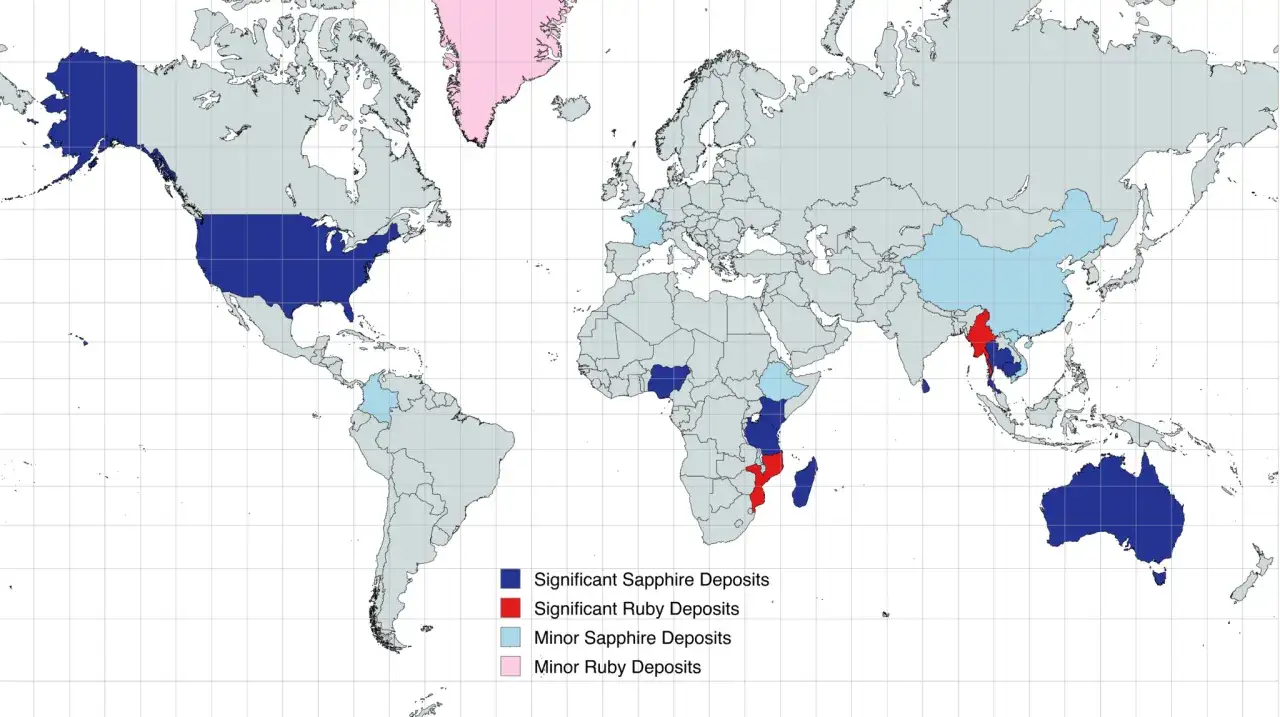
- Sri Lanka, Myanmar, Madagascar, Australia, Montana, and East Africa are among the best-known sources.
- Origin can add value, but it does not rescue weak colour, poor cut, or unclear treatment.
- Some deposits are historic and rare, while others are active commercial sources with broad supply.
- For UK buyers, provenance is useful when it is backed by a lab report and honest treatment disclosure.
The main sapphire-producing regions today
The short answer is that sapphires are not limited to one “best” country. They are mined across Asia, Africa, Australia, and North America, with a few regions carrying far more prestige than others. I usually start by looking at the source category first, because a stone from a famous geological setting often behaves differently from one found in a newer commercial field.
| Region | What it is known for | Typical deposit style | Practical note |
|---|---|---|---|
| Sri Lanka | Long-established source of fine blue and pastel sapphires | Mostly alluvial gravels and residual deposits | One of the most respected classical origins, especially for bright, lively colour |
| Myanmar | Highly prized royal-blue material and collector stones | Metamorphic deposits | Famous for prestige, but fine stones are still judged individually |
| Madagascar | Major modern supplier with a wide colour range | Mixed metamorphic and basalt-related deposits | Important for both commercial jewellery and higher-end gems |
| Australia | Large-volume production, often in darker blues and greenish tones | Mostly basalt-related and alluvial | Geoscience Australia notes that New South Wales once supplied about 70% of the world’s sapphires in the 1980s |
| Montana, USA | Distinctive teal, blue-green, and parti-colour sapphires | River gravels and alluvial deposits | Useful if you want a more contemporary colour palette |
| Tanzania and Kenya | Growing East African supply, including recent finds | Mixed modern deposits | Important for newer production and a broader colour mix |
| Kashmir | Legendary cornflower-blue stones | Historic high-altitude metamorphic source | Mostly a historic or collector origin now, not a routine commercial source |
Thailand and Cambodia also matter, although they are easy to misunderstand because mining, cutting, and trading often overlap there. That is one reason sapphire geography can sound simple at first and then become more nuanced the moment you look closely. Once you know the main regions, the next step is understanding why the same gemstone can look so different from one deposit to another.
How geology changes what a sapphire looks like
Sapphire is corundum, but the rock environment around it changes the trace elements, inclusions, and colour behaviour. GIA separates classical metamorphic sources such as Sri Lanka, Myanmar, Kashmir, and Madagascar from basalt-related sources such as Australia, Thailand, Cambodia, Nigeria, and Ethiopia, while some Montana and Tanzanian stones fall into their own non-classical groups. That geological setting matters because it shapes everything from body colour to how easy the stone is to identify later.
Alluvial gravels
Alluvial sapphires have been weathered out of their original rock and concentrated in rivers or ancient gravels. They are often easier to recover because miners can wash and sort sediment, but the parcel is usually mixed, which means quality varies a lot from stone to stone. Sri Lanka and Montana are the classic examples I think of here.
Basalt-related deposits
Basalt-related sapphires tend to come from younger volcanic landscapes. They are often associated with more commercial supply and can produce darker blues, greenish tones, or stones with a more inky character. Australia is the best-known example, and parts of Thailand and Cambodia fit this pattern too.
Read Also: Gemstone Families - Why Chemistry Matters for Your Jewelry
Metamorphic sources
Metamorphic deposits are the ones collectors talk about most because they can produce exceptionally elegant colour and a more refined look. Myanmar, Sri Lanka, Kashmir, and some Madagascan deposits sit in this group. These are not automatically “better” stones, but they often produce the kind of colour that makes people stop and look twice.
That geology lesson leads directly to the next question: why do some origins carry such a strong premium when the chemistry is still sapphire either way?
Why some origins carry a premium
Origin can change the emotional and commercial story of a sapphire, but it does not change the laws of gem quality. When I look at stones for jewellery, I treat origin as an amplifier, not a rescue mechanism. If the colour is weak or the cut is flat, a famous name on the label will not do much for the stone itself.
| What origin can influence | What origin cannot fix |
|---|---|
| Rarity and collectability | Poor colour saturation |
| Historical prestige | A badly proportioned cut |
| Market perception | Visible fractures or low clarity |
| Price premium for certain well-known localities | Missing treatment disclosure |
That is why Kashmir, Myanmar, and Sri Lanka continue to carry so much weight in the trade, and why Madagascar has grown in importance as a modern source. Fine stones from any of these places can be exceptional, but the premium is strongest when the gem also has strong colour, good transparency, and a clear paper trail.
In practice, I would never let origin outrank the basics. The best sapphire is still the one that looks beautiful in the light it will actually be worn in, not the one with the loudest origin story.
How to read a sapphire origin claim before you buy
This is the part that saves buyers from the most disappointment. A seller can describe a sapphire in glowing terms, but the useful questions are usually much narrower: Was the origin identified by a lab? Is the treatment disclosed? Does the colour still look convincing outside a sales environment? Those three checks tell you far more than a polished paragraph of marketing copy.
- Ask whether the origin is laboratory-confirmed. A dealer opinion is not the same thing as an independent report.
- Check treatment disclosure. Heat treatment is common in sapphire and does not automatically reduce beauty, but it should be stated clearly.
- Look at the stone under neutral light. Origin prestige means very little if the gem only looks good under one showroom lamp.
- Match the stone to its use. A daily-wear ring needs durability and balanced colour; a collector piece may justify more emphasis on provenance.
- Be cautious with vague language. Phrases like “Kashmir-style” or “Burmese-type” often mean the seller is leaning on association rather than proof.
For buyers in the UK, I would be especially careful when a sapphire’s story sounds more impressive than its documentation. The stronger the claimed origin, the more I want to see hard evidence behind it. A modest but honest origin statement is usually more trustworthy than a dramatic one with no lab support.
What the sapphire map means for jewellery in the UK
For everyday jewellery, the smartest purchase is often not the rarest origin, but the stone that gives the best balance of colour, durability, and value. A well-cut Sri Lankan or Madagascan sapphire can look elegant in a ring or pendant without carrying the price pressure of a collector-level origin. That is one reason these sources remain so relevant in modern jewellery design.
- If you want a classic bright blue, Sri Lanka is a strong place to look.
- If you want prestige and scarcity, Myanmar and Kashmir sit at the top of the conversation.
- If you want teal or blue-green character, Montana is one of the most distinctive origins.
- If you want broad choice and good availability, Madagascar and Australia are important modern sources.
My rule of thumb is simple: let origin narrow the field, then let the stone itself make the final case. Colour, cut, treatment, and transparency should still do most of the work, because that is what you will actually see every time the piece is worn.
The source tells a story, but the stone still has to earn it
Sapphires are found in a surprisingly wide network of places, but only a few origins have become genuinely iconic. Sri Lanka, Myanmar, Madagascar, Australia, Montana, Tanzania, Kenya, and Kashmir each bring something different to the market, whether that is prestige, colour range, or distinctive geological character. Knowing the source helps you read the stone more intelligently, but it should always sit alongside the basics of gem quality.
That is the part I find most useful: once you know the source map, you stop treating sapphire as one generic gemstone and start seeing the differences that actually matter. In jewellery terms, that makes every choice clearer, whether you are buying a simple everyday piece or looking for something with real collector appeal.