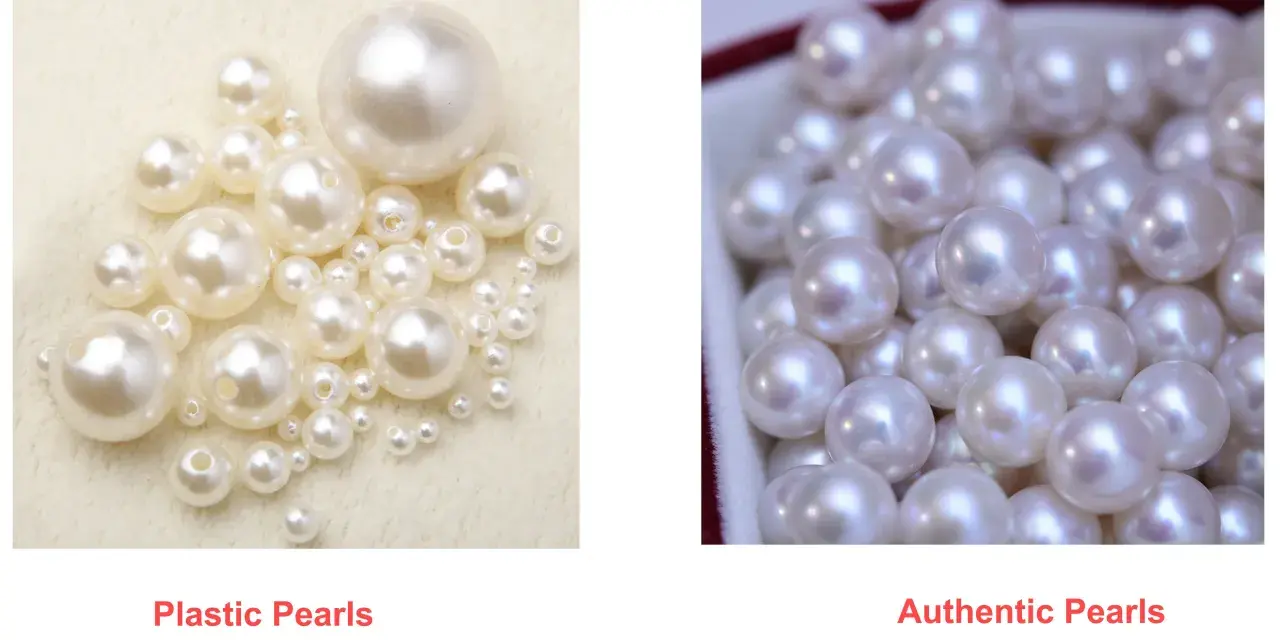
The quickest checks that separate real pearls from convincing imitations
- Real pearls include both natural and cultured pearls. Imitation pearls are usually glass, plastic or shell-based beads with a coating.
- Luster, surface and drill holes matter most. Those clues are more useful than colour alone.
- The tooth test can help, but it is not proof. Use it gently and only as one clue.
- A 10x loupe reveals far more detail. It is the fastest way to inspect nacre, coating and hole edges.
- X-ray imaging is the professional answer. It is what separates guesswork from confirmation.
- Ask sellers to describe the pearl type in writing. That matters in the UK whether you are buying online or in person.
Start with what a pearl should look and feel like
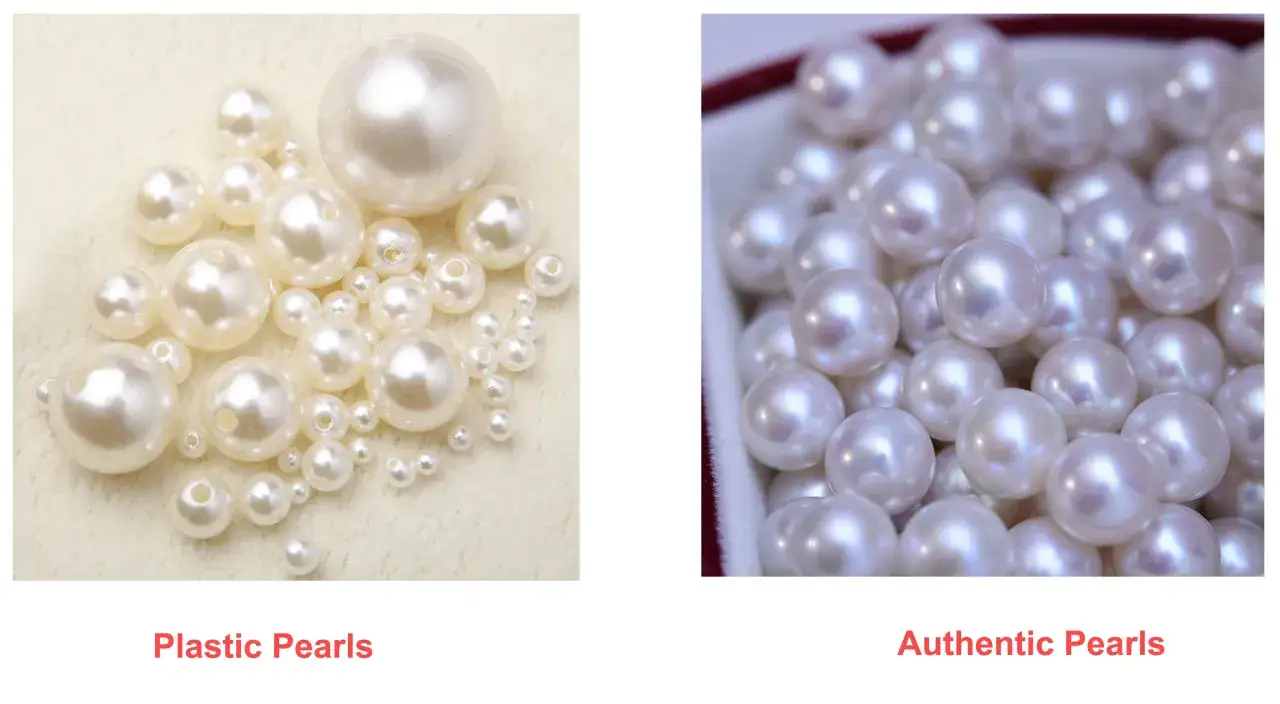
Because pearls are organic gems, not crystals, I read them through texture first. A genuine pearl usually has depth rather than a flat shine, and the glow seems to come from within the nacre, the layered mother-of-pearl material that builds the pearl itself. Even a well-matched strand normally has a little life in the surface, whereas many imitations look polished rather than luminous.
Shape helps, but I never treat perfect roundness as proof that a pearl is fake. Excellent cultured pearls can be beautifully regular, and that is part of what makes them desirable. What does raise my suspicion is a surface that looks too uniform, too printed or too glassy for the price being asked.
| Clue | What real pearls usually show | What imitations often show | How I read it |
|---|---|---|---|
| Luster | Depth, softness and an inner glow | Flat, glassy or overly shiny reflection | Useful, but not decisive on its own |
| Surface | Tiny irregularities, pits or growth marks | Too even, repeated or printed-looking finish | Strong clue when paired with other signs |
| Feel | Cool and slightly weighty at first touch | Light if plastic, sometimes cool if glass | Good for ruling out cheap plastic fakes |
| Shape | Often well matched, but not machine-identical in every case | Repeated, identical roundness | Suspicious, but never proof by itself |
One nuance matters here: a pearl that looks chalky or flat may have thin nacre, which is a quality issue rather than automatic proof of imitation. That gives you the first filter; the next clue is the one I trust most because it exposes the pearl's construction rather than just its appearance.
Use close inspection to spot imitation clues
A 10x jeweller's loupe is enough for a useful check. I look first at the drill hole, because genuine pearls usually show clean, defined edges, while imitation coatings often chip, flake or build up around the opening. If the hole reveals a bead-like core, peeling colour or a glittery surface instead of layered nacre, I become cautious quickly.
This is also where tiny details matter more than the face-up view. A strand can seem convincing from a distance and still give itself away near the hole, especially if the finish repeats in the same way on every bead. On mounted jewellery, I use what I can see and avoid forcing the setting, because the goal is to observe, not to damage the piece. Those clues are useful, but they become stronger when I add a few safe touch tests.
How can you tell real pearls from fake pearls without damaging them?
When I want a quick answer without risking damage, I use the least invasive checks first. The tooth test, the feel of two pearls rubbed lightly together and a simple temperature comparison can all help, but none of them should stand alone.
| Test | What it can suggest | Main limitation |
|---|---|---|
| Tooth test | Real nacre often feels faintly gritty or sandy | Can be misread, and it should only be done gently |
| Rubbing two pearls together | Real pearls often feel slightly gritty rather than slippery | Only useful if the strand is robust enough to handle it |
| Temperature test | Real pearls usually feel cool at first and warm slowly | Glass imitations can also feel cool |
| Weight test | Plastic fakes are often noticeably light | Glass can be heavy and misleading |
| Sound test | Real pearls tend to sound duller and less hollow | Subtle and easy to misjudge |
Because pearls sit at about 2.5-3.0 on the Mohs scale and can be damaged by acids and chemicals, I never recommend scratch tests, vinegar or anything abrasive as an identification method. My rule is simple: a quick test should confirm a suspicion, not create one. The pattern I trust is simple too: plastic fakes usually fail on feel and weight, glass imitations can fool the weight test, and some high-quality cultured pearls are so well matched that they barely look irregular at all. That is why I read the whole set of clues together, not as isolated verdicts.
Real, cultured and imitation pearls are not the same thing
The biggest confusion I see is that people often use real, cultured and natural as if they mean the same thing. They do not. A cultured pearl is still genuine because the mollusc builds nacre around a nucleus or tissue, while an imitation pearl is a man-made bead or shell core finished to look pearly. In ordinary jewellery shopping, cultured is the category most people mean when they talk about real pearls.
| Type | How it forms | Genuine pearl? | What I assume |
|---|---|---|---|
| Natural pearl | Forms without human intervention inside the mollusc | Yes, and rare | Treat as a special case that may deserve verification |
| Cultured pearl | Human seeding or tissue insertion starts the process, then nacre builds naturally | Yes | This is the standard real pearl most buyers encounter |
| Imitation pearl | Bead or shell core with a pearly coating | No | Can look convincing, but it lacks pearl structure |
This distinction matters because a cultured strand can be fully authentic and still look beautifully uniform, while a well-made imitation can fool someone who is only judging from shine. When a seller uses vague wording like "pearl style" or "shell pearl" without saying what the piece actually is, I treat that as a warning sign rather than a reassuring label. When the stakes are higher, the fastest way to stop guessing is to let a professional look inside the pearl.
When a professional test is worth the money
For anything expensive, inherited or still unclear, I stop guessing. A good jeweller can examine the surface at 10x magnification, but the most reliable non-destructive answer comes from internal imaging; GIA describes digital X-radiography, and says microradiography is the most reliable way to see a pearl's internal structure. That is what separates a plausible-looking strand from one that can be identified with confidence.
A report can also do more than label a pearl as natural or cultured. It can record quantity, weight, size, shape, colour, origin, mollusc, environment and detectable treatments, which is useful for insurance, resale and family pieces that need a clear record. If a piece is valuable enough to insure, the cost of proper testing is usually small compared with the cost of getting the wrong answer. With that level of confirmation in mind, the last step is simply buying in a way that keeps the problem from coming back.
The last check that saves most pearl mistakes
Most mistakes are prevented before money changes hands. In the UK, I want the seller to state plainly whether the pearls are natural, cultured or imitation, whether they have been dyed or coated, and whether the strand has been restrung or repaired. I also ask for close-up photos of the drill holes, the clasp and the knots, because those details tell me more than a polished product shot ever will.
- Choose sellers who put the pearl type in writing.
- Prefer a sensible return policy, especially for online purchases.
- Ask for an independent valuation if the piece is expensive or inherited.
- Treat "pearl-style", "fashion pearl" and "shell pearl" as different from genuine cultured pearls.
- Be wary of a strand that looks machine-perfect but comes with vague wording.
I also pay attention to how the seller speaks. The best ones answer directly, without hiding behind branding language or soft adjectives. If the explanation stays vague, I would rather walk away than buy on hope. The simplest answer is to use a chain of clues: look for layered luster, check the drill holes, use touch tests gently and escalate to a loupe or lab report when the piece justifies it. If you already own pearls, keep them away from perfume, cosmetics and harsh cleaners so the surface stays readable and the jewellery lasts longer.