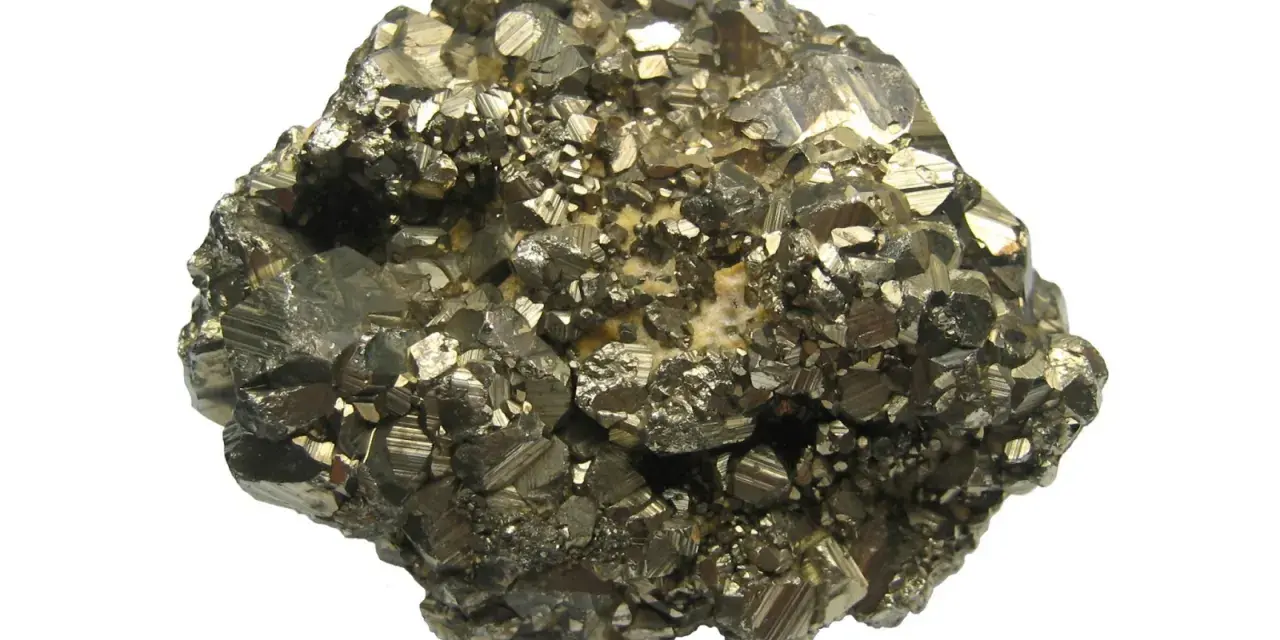
Marcasite and pyrite are often confused because they look alike at first glance, but the differences matter if you are buying jewellery, identifying a vintage piece, or trying to care for a mineral properly. This guide breaks down the marcasite vs pyrite comparison in plain English, with the visual clues, durability issues, and buying points that actually help in real life.
The real difference is structure, stability, and jewellery use
- Both minerals are iron disulphide, but they have different crystal structures.
- Pyrite is the more stable and more common jewellery material.
- True marcasite is more brittle and can deteriorate if stored badly.
- Many pieces sold as “marcasite” jewellery actually use faceted pyrite stones.
- Colour alone is not enough for identification, so crystal habit and condition matter more.
What makes these two minerals so easy to confuse
On paper, the confusion is simple: both are iron disulphide, with the same chemical formula, FeS2. The real split is in their crystal structure. Pyrite forms in the isometric system, while marcasite is orthorhombic, and that difference changes how each mineral grows, breaks, and ages.
That matters more than many buyers realise. Pyrite is usually the harder, safer, more stable choice for wearable pieces, while marcasite is the one I treat with more caution because it is more prone to decay. If you only remember one thing, remember this: same chemistry does not mean same behaviour. The next step is learning the visual signs that separate them without damaging the piece.
How to tell them apart at a glance
I always start with crystal habit, because colour can mislead you. Pyrite tends to form cubes, pyritohedra, or octahedral shapes with sharper, more geometric faces. Marcasite more often appears blade-like, tabular, radiating, or in cockscomb-like clusters. That difference is the quickest clue when a specimen is still in its natural form.
| Feature | Pyrite | Marcasite | Why it matters |
|---|---|---|---|
| Crystal system | Isometric | Orthorhombic | This controls crystal shape and how the mineral grows. |
| Typical habit | Cubic, pyritohedral, octahedral | Tabular, blade-like, radiating | Habit is often the fastest visual clue. |
| Colour | Brassy yellow to pale gold | Paler, sometimes slightly silvery | Colour helps, but it is not reliable on its own. |
| Stability | More stable | Less stable and more decay-prone | This affects long-term wear and storage. |
| Brittleness | Brittle, but generally usable | More brittle and fragile | True marcasite needs gentler handling. |
| Jewellery use | Common in “marcasite” jewellery | Rare in everyday jewellery | The trade name is not always the mineral name. |
There is one important limit here: once the material is cut, polished, or mounted in tiny stones, a visual check can stop being enough. In those cases, the structure may only be confirmed with specialist testing. That is why the next question is not just “what is it?” but “what does it mean for wear?”.
Why the distinction matters in jewellery
This is where the comparison stops being academic. If a piece contains pyrite, it is usually the more practical option for occasional wear because it resists handling better. If it contains true marcasite, I would treat it as a more delicate material that prefers gentle use, careful storage, and low moisture.
That is also why so many vintage and modern pieces are described loosely. In jewellery shops, “marcasite” often refers to tiny faceted stones set into silver, even when those stones are actually pyrite. The name has become a style label as much as a mineral label. For a buyer, that means the important question is not only what the stones look like, but whether the piece is built for durability or simply for appearance.
In practical terms, I would be more comfortable wearing pyrite-set jewellery for evenings, events, or light regular use. True marcasite is better thought of as a careful-wear material, especially in older pieces where the metal setting and the stones may both be tired. That distinction leads directly into the trade language you will see on listings and auction sites.
What jewellery sellers usually mean by marcasite
If you browse UK vintage jewellery, you will see the word “marcasite” attached to sterling silver brooches, earrings, rings, and pendants with a dark, glittering finish. In many of those pieces, the stones are tiny faceted pyrite rather than true marcasite. The style became popular because it gives a crisp, black-and-silver look that works beautifully with Art Deco geometry and Victorian-inspired designs.
I think this is where buyers get tripped up. They see the word and assume the mineral has been identified with precision, when in reality the term often describes a decorative tradition. So, when I shop or evaluate a piece, I ask three questions:
- Are the stones marketed as a style, or as a confirmed mineral?
- Is the setting sterling silver, plated base metal, or something else?
- Does the seller mention pyrite, marcasite, or both?
If the listing is vague, that does not automatically make it wrong. It does mean you should judge the piece on craftsmanship, condition, and setting quality rather than on the mineral name alone. From here, the most useful topic is care, because the wrong cleaning habit can do more damage than the stones’ natural fragility.
How I would care for each stone
For jewellery, my rule is simple: keep these pieces dry, gentle, and separate from harsher cleaning routines. I would not soak either mineral, and I would never put a marcasite piece through an ultrasonic cleaner or steam cleaner. Strong chemicals are also a bad idea, especially if the piece has aged silver, glue, or enamel nearby.
For routine care, this is the approach I would use:
- Wipe the piece with a soft, dry cloth after wearing it.
- Store it in a dry pouch or box, away from bathroom humidity.
- Keep it separate from harder jewellery so the stones are not chipped.
- Avoid perfume, hairspray, hand cream, and chlorine before wearing it.
- Check older pieces for powdery residue, dull patches, or loose stones.
If I saw active crumbling, a chalky surface, or cracking around the setting, I would stop wearing the piece until it had been inspected. That is especially true for older marcasite jewellery, where deterioration can spread if moisture keeps getting in. Once you know how to care for it, the last decision is whether a piece is worth buying in the first place.
The safest way to buy vintage-looking marcasite jewellery
When I evaluate a piece, I look for signs that the seller understands both the mineral and the construction. A good listing does not need to be overly technical, but it should be specific. If the stones are described as pyrite, marcasite, or faceted stones in silver, the wording should make sense instead of sounding copied and vague.
These are the checks that save the most regret:
- Prefer solid silver or clearly described precious-metal settings for older pieces.
- Look closely at the mounting: loose stones usually mean repair work is coming.
- Ask whether the stones are pyrite or true marcasite if the difference matters to you.
- Choose pyrite if you want a tougher piece for occasional wear.
- Treat true marcasite as a more fragile, heritage-style material.
- Be cautious if the surface already shows flaking, dark crusts, or powdery oxidation.
For most readers, the practical answer is straightforward: pyrite is the easier mineral to live with, while marcasite is the more delicate one that rewards careful handling and good storage. If you buy with that in mind, the stone’s beauty becomes the priority, not the confusion around its name.