Knowing how to identify raw topaz comes down to a few mineral clues that survive even when the stone is unpolished. Shape, heft, cleavage and context tell you far more than colour alone. In this guide I focus on the checks I actually trust when a rough crystal might be topaz rather than quartz, citrine or beryl.
Key things to know before you test a rough stone
- Topaz is usually columnar or prismatic, not rounded or sugary in appearance.
- It is hard at Mohs 8, but a perfect cleavage makes it brittle.
- Topaz has an SG around 3.5-3.6, so it feels heavier than quartz of the same size.
- Colour is unreliable: natural topaz is often colourless or pale, while strong blue is usually treated.
- The safest path is a combination of visual clues, specific gravity and, if needed, a lab report.
What raw topaz usually looks like
In rough form, topaz tends to grow as elongated, columnar or prismatic crystals rather than irregular lumps. The faces are often straight and disciplined-looking, and the terminations can be blunt, flat or slightly pyramidal instead of rounded.
That geometry matters. When I see a piece that has a clear long axis, parallel side faces and a generally made-in-layers feel, topaz stays on the shortlist. If the specimen has been rolled in a stream, the edges may be softened, so I always look for whatever is left of the crystal habit rather than expecting a textbook point.
Topaz rough can also be surprisingly clean inside. Many pieces are eye-clean, so visible inclusions are not the main clue; the outline of the crystal is usually more informative than the interior.
Once the shape makes topaz plausible, the next question is whether its breakage pattern fits.
Why cleavage matters more than a scratch test
Topaz is Mohs 8, but it is not a tough stone. It has perfect cleavage, which means it prefers to split along one flat plane, and that makes rough topaz brittle even when it feels hard.
For identification, that is more useful than a simple scratch test. On a prismatic crystal, the cleavage plane is usually at right angles to the long axis. A clean, flat break surface, especially one that looks mirror-like or steps along a single direction, is far more consistent with topaz than with quartz.
I avoid destructive tests unless the stone already has a damaged edge. A hammer, a forced chip or an aggressive scratch can destroy a specimen that might have real value. If you do any testing at all, keep it to existing broken surfaces and stop before you create new ones.
That gives you the mineral behaviour; the next step is to separate topaz from the stones it is most often mistaken for.
How topaz compares with its most common lookalikes
The first confusion point is usually quartz, especially citrine and smoky quartz. After that, I look at beryl, tourmaline and corundum, because those minerals can share colour ranges or crystal habits that mislead beginners.
| Lookalike | What usually gives it away | Why it matters |
|---|---|---|
| Quartz, citrine, smoky quartz | Hardness 7, SG around 2.65, no perfect cleavage, and a conchoidal fracture that looks curved rather than flat | The classic yellow or brown "topaz" mistake is often quartz |
| Beryl | Usually hexagonal habit, lower SG of about 2.63-2.91, and a slightly lighter feel for the same size | Aquamarine and heliodor are frequent confusion points |
| Tourmaline | Long prismatic crystals with strong lengthwise striations, SG 3.03-3.25, hardness 7-7.5 | It can look similar in the rough, but the habit and density differ |
| Corundum | Hardness 9, no cleavage, SG 3.96-4.05 | Yellow sapphire has been called "oriental topaz" in trade language, but it is not topaz |
| Peridot | Olive-green colour, hardness 7, SG 3.22-3.45, usually a different crystal style altogether | Old naming confusion still causes mistakes in mixed parcels |
Old trade names are a mess. Oriental topaz is corundum, not topaz, and topazolite is a garnet. If a seller uses an old label instead of describing the mineral properties, I treat that as a warning sign rather than a reassurance.
When colour enters the picture, the confusion only gets worse, so I treat colour as supporting evidence, not the headline.
Colour can support the ID, but it rarely proves it
GIA notes that natural topaz is most commonly colourless, and strong blue topaz is rare in nature. That matters because many of the bright blue stones people see in the market are colourless rough that has been treated with radiation and heat.
So a vivid blue crystal is not proof that you have found raw, untreated topaz. It may still be topaz, but the colour alone tells you more about treatment than identity. A rainbow surface sheen points even less to raw material, because that usually means a coating rather than a natural crystal face.
Natural topaz can be colourless, pale yellow, honey, brown, pale blue, green or pink, and it can show pleochroism, which means the colour shifts slightly when you view the crystal in different directions. Even then, I would not rely on colour as the deciding test. A stone can look convincing and still be the wrong mineral.
If a seller leans hard on "imperial" or "blue" without showing a crystal habit or a report, I stay sceptical. The next step is to use the tests that are harder to fake.
The non-destructive tests that actually work
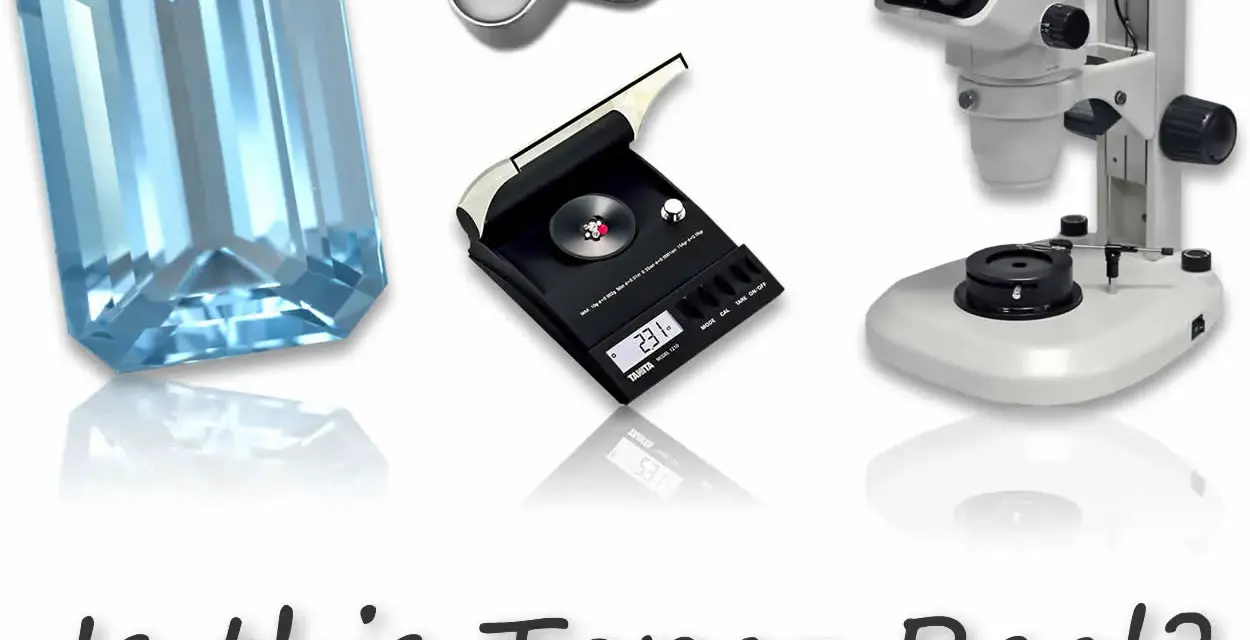
If I only had a loupe, a small scale and a bowl of water, I could still narrow a rough stone down quite a bit. The useful tests are the ones that leave the specimen intact, and specific gravity is the number I trust most. Specific gravity is the stone's weight relative to an equal volume of water.
| Test | What I look for | What it tells you | Risk |
|---|---|---|---|
| Hand heft | The same-size stone feels noticeably heavier than quartz | Topaz's density is in the right range | Low, but subjective |
| Hydrostatic specific gravity | Accurate weight in air and water | One of the best simple confirmations for loose rough | Low, if done carefully |
| 10x loupe | Flat cleavage, growth lines, and clean crystal faces | Supports topaz habit and breakage style | Low |
| Rotation in daylight | Subtle colour change between directions | Can support pleochroic topaz | Low, but not decisive |
| Scratch test | Only on an expendable chip, if at all | Shows hardness, but tells you less than people think | High, because it can damage the stone |
USGS places topaz at about 3.5 to 3.6 specific gravity, and that is the number I keep in mind when a stone feels too light to be topaz. Quartz at 2.65 is the usual comparison point, so equal-sized pieces do not weigh the same in the hand. That difference is small on paper, but it is obvious enough to matter once you compare two specimens of similar size.
Density will not identify every stone by itself, but it is one of the cleanest reality checks available before you move to provenance and paperwork.
Where topaz usually forms and why that context matters
Topaz is most at home in fractures and cavities in granite, rhyolite and pegmatite, often in hydrothermal settings where fluorine is available. It also turns up with minerals such as fluorite, cassiterite and beryl, which means the surrounding matrix can give you a useful clue.
If a rough specimen comes from a quartz-rich pegmatite, a cavity lining or an alluvial gravel derived from those rocks, topaz becomes much more plausible. If it is claimed to come from a setting that makes no geological sense at all, I lower my confidence immediately.
Waterworn rough is another point beginners miss. Topaz can survive transport as rounded or angular lumps, so the lack of a perfect crystal outline does not rule it out. What matters is whether the remaining surfaces still behave like topaz once you inspect them closely.
Context will not confirm the mineral on its own, but it can tell you whether the story is realistic before you spend time or money on a full test.
The checklist I trust before I call a rough stone topaz
- Does it show a columnar or prismatic habit rather than a random shape?
- Do the breaks look flat and planar instead of curved and shell-like?
- Does it feel heavier than a similar quartz piece?
- Is there any sign of coating, dye or surface film?
- Does the colour fit natural topaz, or does it look too uniform and commercial?
- Would a proper lab report change the answer?
If three or more of those answers line up, topaz becomes a strong candidate. If only the colour matches, I keep looking. For a valuable rough stone in the UK, I would rather pay for a reliable gemmological opinion than build a story around a label that may be wrong.
That is the practical way I approach rough topaz: start with shape, confirm with cleavage and density, then let colour and origin act as supporting clues rather than the deciding ones.