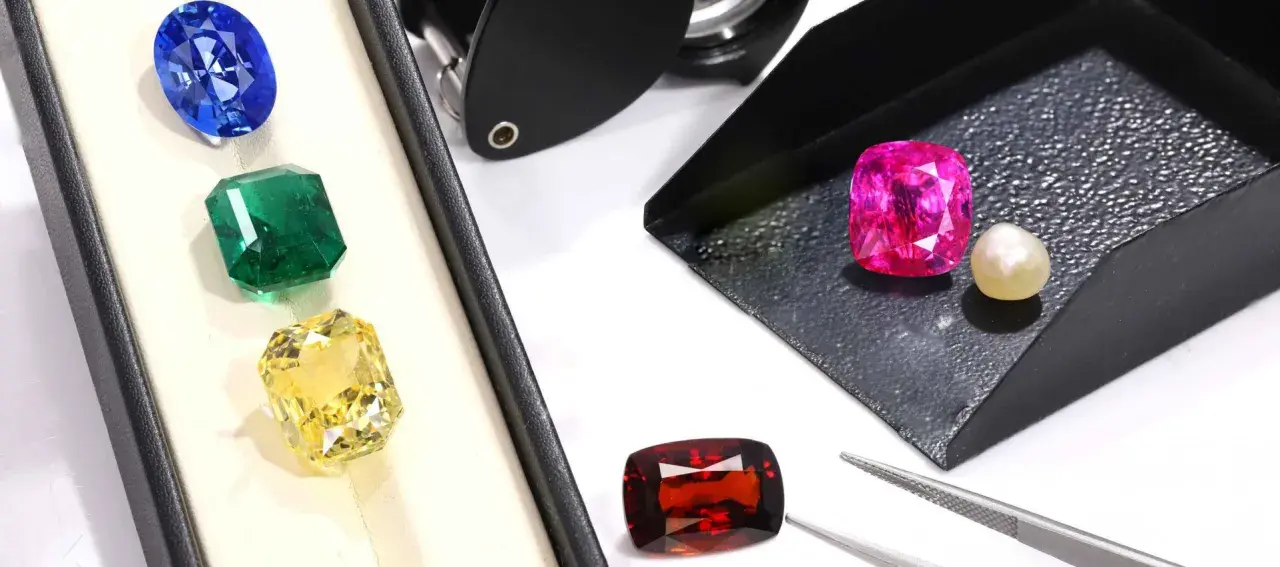
A stone’s name tells you less than its chemistry does. Ruby, sapphire, emerald and pearl may all sit in the same jewellery tray, but they do not belong to the same material class. That is why gemstone families matter: they reveal what a gem is made of, how it formed, and how it will behave in everyday wear.
The essentials at a glance
- Most gems are grouped by chemical composition and crystal structure, not just by colour or trade name.
- Silicates dominate jewellery because they cover the widest range of colours, prices, and durability profiles.
- Corundum, beryl, garnet, quartz and topaz are all related to broader mineral groupings, but they do not wear the same way.
- Hardness is only one part of durability; toughness and cleavage matter just as much.
- Pearls are not minerals at all. They are organic gem materials and need gentler care than most stones.
How chemistry and crystal structure divide gem materials
I like to treat gem classification as a map rather than a rulebook. The broad idea is simple: a mineral has a defined chemical makeup and an ordered internal structure, and both of those things influence how the stone looks, forms, and wears. In practice, this means two gems can share a colour family and still belong to very different mineral groups, while another pair can share the same chemistry but behave differently because their internal structure is not the same.
The old precious-versus-semi-precious split is too blunt for that. It tells you almost nothing about whether a stone is tough enough for a ring, whether it has cleavage, or whether it needs special care. A better way to think about it is this: species identifies the mineral itself, variety describes a colour or appearance within that mineral, and group gathers closely related minerals that share structural features.
That distinction is useful because the trade name is not always the full story. Ruby and sapphire are both corundum; emerald and aquamarine are both beryl; and garnet is not one gem but a family of related species. Once that framework is clear, the major mineral groups make far more sense.
From here, the big question is which families matter most in jewellery and why they keep appearing in different forms.
The mineral groups that dominate fine jewellery
Most stones you meet in a jewellery shop belong to a small number of mineral classes. Silicates are the largest by far, which is why they account for so many familiar gems. They are followed by oxides, carbonates, phosphates and native elements, with a few less common groups appearing in collector pieces and specialist designs.
| Family | What ties it together | Common jewellery examples | What it means in practice |
|---|---|---|---|
| Silicates | Built around silicon and oxygen in different structural arrangements | Quartz, beryl, tourmaline, garnet, topaz, zircon | The widest colour range and one of the widest price ranges; durability varies a lot from stone to stone |
| Oxides and hydroxides | Oxygen-based compounds with compact crystal structures | Corundum, spinel, chrysoberyl | Often excellent for jewellery that gets regular wear; corundum is the classic example of a strong ring stone |
| Carbonates | Carbonate chemistry, often with softer, more reactive material | Malachite, rhodochrosite, calcite | Usually better for pendants, earrings or protected settings than for hard-wearing rings |
| Phosphates | Phosphate-based mineral structures | Turquoise, apatite, variscite | Colour can be outstanding, but care and setting matter more than people expect |
| Native elements | Single elements that occur in nature in usable form | Diamond, gold, platinum, silver | Diamond is the standout gem; the metals matter more as settings than as faceted stones |
| Organic gem materials | Biological origin rather than mineral origin | Pearl, amber, coral, jet | Not part of the mineral tree, and they need different handling rules altogether |
Silicates dominate because they are both abundant and versatile. Roughly a quarter of known minerals fall into that class, and many of the stones shoppers recognise most easily come from it. That is also why a label such as quartz, tourmaline or beryl tells you something useful before you even get to colour, cut or origin.
The chemistry gives you the broad group, but structure explains why two stones from the same broad class can behave very differently. That becomes obvious once you look at colour varieties and durability side by side.
Why the same mineral can still produce different gems
The best place to see this is corundum. In its pure form it is colourless, but trace elements change its appearance dramatically. Chromium gives us ruby; iron and titanium help create blue sapphire. The underlying mineral is the same, yet the colour and market value can be completely different.
Beryl works in a similar way. Emerald and aquamarine are both beryl, but the trace elements and internal conditions that shaped them give them very different personalities. Emerald is usually judged with more tolerance for inclusions because rich colour is the main attraction; aquamarine is typically valued for clarity and clean, cool colour. The same mineral family can therefore have two very different buying logics.
Garnet is even more instructive because it is a mineral group rather than a single gemstone. Different species share a related crystal structure, but their chemistry shifts enough to create a wide range of colours and uses. I find garnet useful as a reminder that a “family” can contain real variety without losing its underlying pattern.
Hardness is only part of durability
People often overrate hardness and ignore everything else. Hardness is scratch resistance, toughness is resistance to breaking, and cleavage is the tendency to split along internal planes. Those three things do not move together, which is why a stone can be hard but still awkward in a ring.
Topaz is a good example. It has respectable hardness, yet it still deserves more caution than many buyers assume because it can be vulnerable along its cleavage directions. That is the kind of detail a family label helps you spot before a stone ends up in the wrong setting.
Once structure starts to matter, pearls look even more unusual, because they do not sit in the mineral tree at all.
Where pearls sit outside the mineral tree
Pearls are gem materials, but they are not minerals. They are organic, formed by molluscs, and built mainly from calcium carbonate with a small amount of organic binding material in layered nacre. That layered structure gives pearls their glow, but it also explains why they are much softer and more delicate than most stones. Their hardness is around 2.5-3.0 on the Mohs scale, which is very soft compared with the better-known jewellery gems.
That softness changes everything about care. I would always put pearls on after perfume, hairspray and skincare, then take them off before cleaning or exercise. They should be stored separately from harder stones so they do not get scratched, and they should be wiped gently after wear rather than aggressively cleaned.
- Keep them away from chemicals, especially perfumes, hair products and household cleaners.
- Avoid dry heat, which can dull lustre and stress the nacre.
- Store them separately from diamonds, sapphires and metal chains.
- Use a soft cloth for routine cleaning instead of harsh jewellery cleaners.
That is why pearls deserve their own category in any serious discussion of gem materials. Once they are set apart, the buying and care decisions become much easier to judge.
How this classification helps you buy better jewellery
In the UK market, I want a listing to tell me more than just the colour name. A strong description should make the mineral identity clear, mention any treatment, and hint at whether the stone is suitable for the way it will be worn. If that information is missing, the piece may still be attractive, but the buyer is being asked to trust too much on appearance alone.
Here is the practical way I read a gem label:
- Check the species first. Ruby, sapphire and emerald mean something specific; they are not just decorative colour words.
- Look for the variety name. This tells you which version of the mineral you are actually buying.
- Ask about treatments. Heat, oiling, filling, dyeing and coating can all affect care and value.
- Match the stone to the setting. Rings and bracelets demand more toughness than pendants and earrings.
- Do not assume one family behaves like another. Two stones can share a broad class and still wear very differently.
That last point is where many buyers go wrong. A stone can be beautiful, well cut and still be a poor choice for a hard-working piece if it is too soft, too brittle or too sensitive to chemicals. Knowing the family makes the difference between admiring a gem and understanding it.
The family logic also helps with value. Rarity matters, but so do colour saturation, transparency, treatment, size and durability. I would rather see a clean, honest label on a modest stone than a romantic description that hides what the material actually is, because good jewellery writing should help the reader make a better decision, not a more confused one.
The label checks I trust before I decide a stone belongs in the right group
When I am reading a gem label, I look for five things: the mineral or material name, the variety, the treatment, the intended use, and whether the piece is wearing-friendly enough for real life. If even one of those is vague, I slow down. That does not mean the jewellery is bad; it means the description is incomplete.
- Mineral name tells you what the stone fundamentally is.
- Variety tells you the colour or trade form you are actually seeing.
- Treatment tells you whether extra care or disclosure matters.
- Use case tells you whether it belongs in a ring, pendant, bracelet or strand.
- Material class tells you whether you are dealing with a mineral gem or an organic one like pearl.
That is the real value of understanding gem groupings: it turns a beautiful name into a usable decision. You do not need to memorise every species to use the system well, only the logic that links chemistry, structure and wear, because that is what helps a necklace, ring or strand age gracefully.