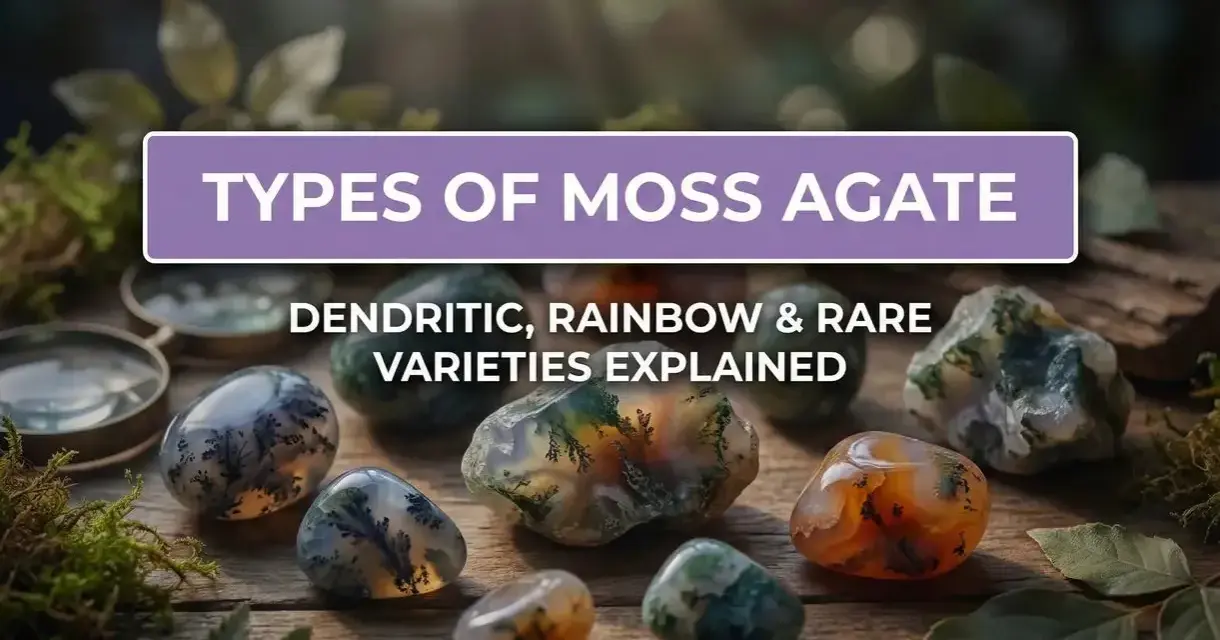
Moss agate and dendritic agate are easy to confuse at first glance, but they reward a closer look. The comparison between dendritic agate and moss agate comes down to pattern, colour, and how each stone behaves in jewellery, which matters whether you are buying a pendant, a ring, or a bead strand. In this article, I break down the visual differences, durability, styling choices, and the buying points that actually help you choose well.
The main things to know before you choose one
- Both stones belong to the chalcedony family, so they are closely related rather than completely different gems.
- Moss agate usually looks softer and greener, while dendritic agate is usually more graphic, with branching dark inclusions.
- Both typically sit around 6.5 to 7 on the Mohs scale, so they are durable enough for most jewellery when set and worn sensibly.
- Cabochons, earrings, pendants, and beads are usually the best formats for showing their patterns.
- Warm soapy water is the safest cleaning method; I would avoid steam and ultrasonic cleaners for delicate or dyed pieces.
- In practice, the best choice is often the one whose pattern feels most natural to your style, not the one with the more familiar name.
What the two stones actually are
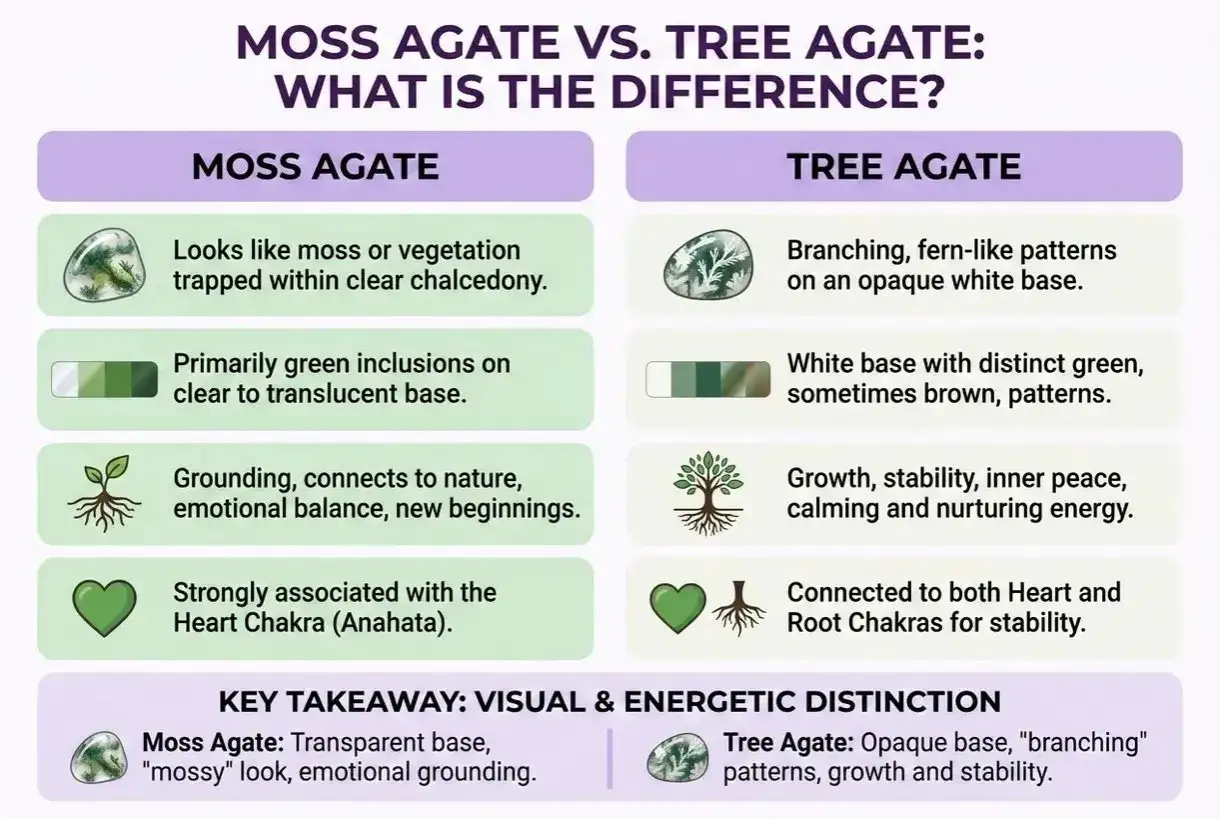
Both stones are part of the chalcedony family, which is a microcrystalline form of quartz. That is the important starting point, because it explains why they share a similar feel, similar durability, and a lot of the same jewellery uses. The difference is not in the base mineral so much as in the inclusions inside the stone, which create the signature patterns people buy them for.Moss agate usually shows green, moss-like or fern-like inclusions, often described as looking like tiny plants frozen in translucent quartz. Dendritic agate, by contrast, is known for branching tree-like markings that are often black, brown, or dark green. Those branchy forms are mineral growths, not actual plant matter, so the look is botanical even though the stone is entirely inorganic.
One detail that causes confusion is that the names overlap in trade usage. Some pieces sold as moss agate also display clear dendritic growths, and some dendritic agates have a soft mossy look. I treat the names as descriptive labels rather than strict scientific boxes. Once that is clear, the visual comparison makes much more sense. From there, the next step is learning to spot the pattern differences quickly.
How to tell them apart at a glance
The easiest way I separate them is by looking at the overall mood of the stone. Moss agate tends to feel softer and more organic, while dendritic agate usually reads as sharper and more illustrated. That difference is subtle in words but obvious in a well-lit stone.
| Feature | Moss agate | Dendritic agate |
|---|---|---|
| Typical look | Soft, mossy, cloud-like or fern-like swirls | Branching, tree-like or fern-frond inclusions with stronger outline |
| Common colour feel | Green, grey-green, milky white, sometimes earthy brown | Black, brown, dark green, or reddish-brown against a lighter base |
| Visual contrast | Usually lower contrast, more blended | Usually higher contrast, more graphic |
| Overall impression | Natural, calm, garden-like | Ink-like, painterly, almost landscape-like |
| Best cut | Cabochons that show depth and softness | Cabochons or slices that preserve the branching pattern |
When I inspect loose stones, I do not rely on colour alone. Lighting can make a moss agate look flatter than it really is, and a dendritic agate can appear almost identical to it if the inclusions are fine enough. Daylight usually reveals the pattern best, while a neutral white light shows the contrast more honestly. A seller photo taken under warm indoor lighting can make either stone look greener, darker, or more dramatic than it really is, so the next question is not just what it looks like, but how it will wear.
Which one is stronger for jewellery
From a practical jewellery standpoint, the good news is that both are reasonably sturdy. At around 6.5 to 7 on the Mohs scale, they can handle everyday wear better than many softer decorative stones. That said, hardness is only part of the story. The inclusions that make these gems beautiful can also create tiny structural differences, so a poorly cut stone or an exposed edge can still chip.
I would feel most confident with both stones in pendants, earrings, brooches, and well-designed rings with protective settings. Cabochons are usually the best choice because they protect the surface and present the pattern cleanly. A bezel setting is especially useful for rings, since it guards the perimeter better than an open prong layout. If the stone has fractures, dye, or a very thin cut, I would move it out of the daily-ring category and into occasional wear.
Cleaning should stay simple. Warm water, a little mild soap, and a soft brush are enough for most pieces. I would avoid ultrasonic and steam cleaners unless you know the stone is untreated and the setting is robust, because heat and vibration are unnecessary risks for a gem that already looks best with gentle handling. If you are buying vintage jewellery, that caution matters even more, since older settings and adhesives can be less forgiving. Once care is clear, styling becomes the fun part.
How I would style each stone
Moss agate usually works best when I want the jewellery to feel soft, botanical, and slightly romantic. It pairs naturally with sterling silver, white gold, or a subdued yellow gold frame, and it sits beautifully alongside pearls when the goal is a calm, nature-inspired look. I especially like it in oval or teardrop cabochons, because those shapes echo the stone’s gentle movement instead of fighting it.
Dendritic agate, on the other hand, has a stronger visual line. The darker branch-like inclusions give it a more graphic feel, so it works well in minimalist settings, oxidised silver, blackened metals, and simple gold mounts that do not compete with the pattern. If moss agate feels like a garden, dendritic agate feels more like an ink sketch or a winter branch silhouette. That makes it a strong choice for people who like jewellery with contrast and character rather than softness alone.
In a British wardrobe, both stones are easy to wear because they are not precious-stone loud. They look good with linen, knitwear, tailored shirts, and muted everyday colours. Moss agate leans more feminine or romantic if that is what you want, while dendritic agate often reads as a little more modern or artistic. Neither stone is locked into one style, though. The real difference is whether you want the pattern to blend in or stand out. That practical styling choice leads straight into the buying stage.
How to buy a better stone in the UK market
When I buy or recommend either stone, I look at three things first: pattern, clarity, and honesty in the listing. The pattern should feel intentional, not crowded. A stone with too much visual noise can lose the whole point of the inclusion pattern, while a stone with a balanced open area often reads more elegant once it is set. Clarity matters too, because a little translucency gives depth, especially in moss agate. Dendritic agate can handle more contrast, but the branches should still be visible rather than muddy.
I also pay attention to signs of treatment. Overly vivid green, colour pooling in cracks, or an unnaturally uniform pattern can be clues that the stone has been dyed or heavily altered. That does not automatically make it worthless, but it does change what you should pay and how you should care for it. For that reason, I prefer listings that show the stone in daylight and from more than one angle. A single polished glamour shot is not enough when the pattern itself is the product.
Price usually reflects three things more than the species name: the quality of the pattern, the size of the stone, and the workmanship of the cut or setting. In plain terms, a well-cut cabochon with clean pattern placement is often worth more than a larger stone with a messy or awkward layout. For UK buyers, that means you do not need to chase rarity to get something beautiful. A well-chosen, honest piece in silver can look more refined than a bigger stone with a weaker pattern. Once you know what to look for, the choice becomes much simpler.
The choice comes down to mood, not just mineralogy
If I had to make the decision in one sentence, I would say this: choose moss agate when you want softness, green movement, and a botanical feel, and choose dendritic agate when you want sharper contrast and a more graphic, branch-like pattern. Both are attractive, wearable, and durable enough for most jewellery styles, so the better stone is usually the one whose pattern speaks most clearly in natural light.
For everyday jewellery, I would lean toward simple settings, gentle cleaning, and a stone photo taken outdoors or near a window before I committed to a purchase. That approach filters out most disappointment. In the end, the best piece is the one that still feels interesting after the first glance, because these stones are at their strongest when the pattern keeps revealing itself slowly.