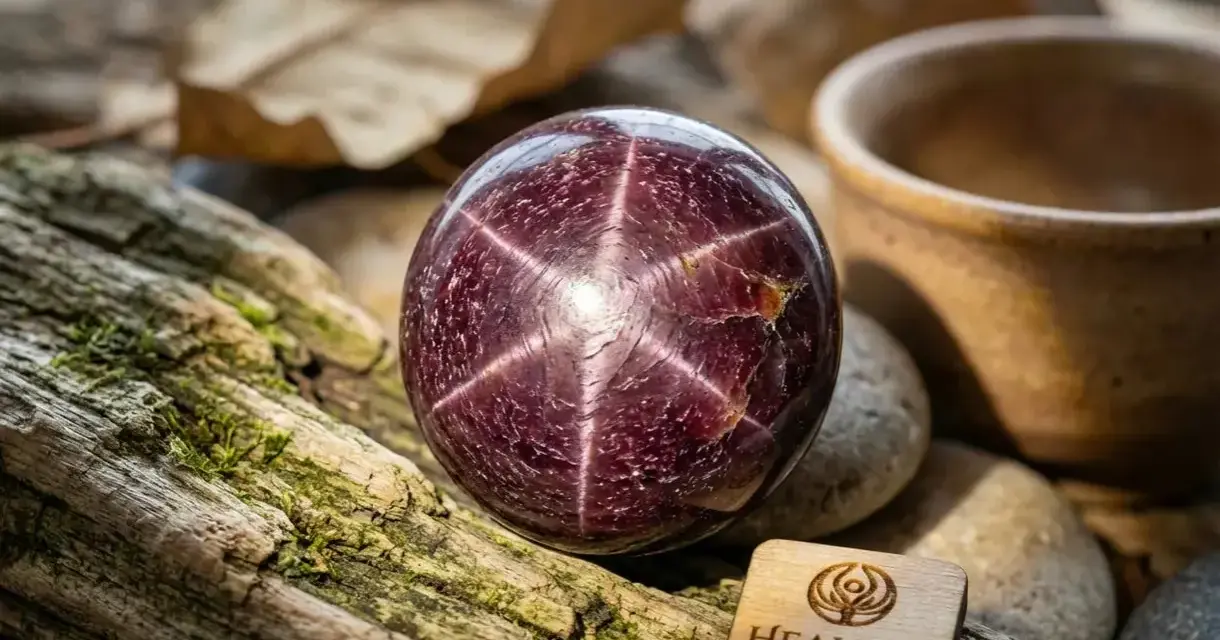
The appeal of star garnet Idaho lies in a rare optical effect, not in sparkle alone. These stones are valued because a dark, seemingly plain garnet can reveal a sharp star when it is cut and lit properly, and that makes them as much a story about geology as about jewellery. Here I focus on where Idaho’s star garnets come from, how the collecting site works, what makes a good stone, and how to care for one once it is set in jewellery.
Key facts to keep in mind
- Idaho’s star garnets are famous because they show a star-shaped optical effect called asterism.
- The best-known public collecting site is Emerald Creek Garnet Area in the Idaho Panhandle, near St. Maries.
- Visiting is reservation-only, with fixed time slots and tools provided on site.
- The star appears most clearly in a smooth cabochon cut, not in a faceted gem.
- For jewellery, star garnets are durable enough for regular wear, but they still need sensible care.
What makes Idaho’s star garnets different
I like to start with the part that actually creates the magic: the star is not surface decoration. It is an internal optical effect caused by fine rutile inclusions inside the garnet, and when light hits the stone at the right angle, those inclusions reflect a star-shaped pattern across the dome. That effect is called asterism, and it is the whole reason these gems feel so distinctive.
Most Idaho material is a deep burgundy, plum, or reddish-black rather than a bright red. That can fool people at first glance, because the rough stone often looks like a dull pebble. The star only becomes obvious after cutting and polishing, which is why the shape of the cut matters so much. A cabochon, meaning a smooth domed cut with no facets, gives the star room to appear. A faceted cut usually hides the effect.
The crystals themselves are often dodecahedral, which simply means they have 12 faces. That geometry is part of what makes garnet crystals so recognisable to collectors, but the real attraction is still the star. In practical terms, this is not a gemstone that wins on brilliance. It wins on character. That difference matters once you move from mineralogy to the collecting experience, because the place where these stones are found is just as unusual as the stones themselves.
Where you can actually find them in Idaho
The best-known collecting site is Emerald Creek Garnet Area in the Idaho Panhandle, near St. Maries. It is the only public place in Idaho where visitors can legally collect star garnets, and the reason it exists in this controlled form is environmental as much as historical. The Forest Service moved away from creek-bed digging and now supplies garnet-bearing gravel so people can sift and sluice without damaging water quality or habitat.
That managed setup is important, because it keeps the experience accessible while avoiding the kind of free-for-all prospecting that would quickly degrade the site. Idaho and India are the two places most often associated with star garnets in meaningful quantity, which is why the Idaho material has earned such a strong reputation among collectors. The stone is also Idaho’s state gem, so its identity is tied to place in a very direct way.
For a jewellery-minded reader, that locality matters because provenance adds weight to the story. A star garnet from Idaho is not just another dark garnet with a nice optical trick; it is a gem linked to a specific landscape, a specific collecting tradition, and a carefully managed public site. Once you understand that, the next question becomes practical: how do you actually visit, and what should you expect on the day?
How a visit to Emerald Creek works
This is where the experience becomes more structured than many first-time visitors expect. At present, access is reservation-only, tickets are sold in advance, and there are no walk-up permits. The site usually runs Thursday through Saturday from Memorial Day weekend to Labor Day weekend, with morning and afternoon sessions that last three hours. If you arrive late, you do not get extra time.
| What to expect | Practical detail | Why it matters |
|---|---|---|
| Booking | Reservation-only tickets | You need to plan ahead; spontaneous visits are not realistic. |
| Session length | 3 hours per visit | The experience is focused, so punctuality matters. |
| Equipment | Tools are provided on site | You do not need to bring shovels, buckets, or sifters. |
| Connectivity | Very limited or no mobile signal nearby | Download directions and keep your ticket accessible before you go. |
| Basics on site | No drinking water, limited shade, no pets | Bring water, sun protection, and a realistic plan for the conditions. |
| Parking | Parking is about half a mile from the site | Wear shoes you can comfortably walk in. |
Two small details are easy to miss but worth repeating. First, tickets are issued per person, and children still need their own ticket. Second, the site is much more comfortable if you treat it like a half-day outdoor excursion rather than a quick stop. I would bring water, a hat, and patience; the stones are the reward, but the process is part of the story. Once you are there, the real challenge is deciding which stones are worth keeping and which are better left in the gravel.
How to judge a stone worth keeping
When I evaluate a star garnet, I care less about raw size than about how cleanly the star presents itself. A larger stone with a weak, blurred star is usually less satisfying than a smaller cabochon with a centred, crisp pattern. That is one of the first lessons collectors learn, and it saves a lot of disappointment.
| Feature | What I want to see | What weakens the stone |
|---|---|---|
| Star sharpness | Clear rays with a defined centre | Fuzzy, broken, or wandering rays |
| Star position | Star centred on the dome | Off-centre or uneven placement |
| Body colour | Deep burgundy, plum, or dark red | Brown, muddy, or lifeless tones |
| Cut | Even cabochon dome | Flat dome or poor polish |
| Surface condition | Clean, smooth finish | Pits, scratches, or dull spots |
There is also a misconception worth clearing up: a six-rayed star is not automatically “better” than a four-rayed one. The best stone is the one that shows its effect cleanly and consistently in normal light. If I were buying one for jewellery, I would rather choose a modest cabochon with excellent symmetry than a larger piece that only works under a very specific lamp. That brings us to the part most readers care about once a stone leaves the gravel pile: how to wear and care for it properly.
How to wear and care for star garnet jewellery
Garnet is reasonably durable, with hardness ranging roughly from 6.5 to 7.5 on the Mohs scale, so it can absolutely be worn in jewellery. Still, durability is not the same thing as indestructibility. A star garnet cabochon has a domed surface, and domes can take impact more readily than flat, faceted stones if the setting is exposed or the ring gets knocked about.
For everyday wear, I prefer protective settings, especially bezels or low-profile mounts that shelter the stone’s edges. Earrings and pendants are easy wins because they take less impact than rings. If you do choose a ring, treat it as a real jewellery piece, not an all-day workhorse for gardening, gym sessions, or DIY.
Cleaning is simple: warm soapy water, a soft cloth, and a gentle brush if needed. I would avoid steam cleaning, and I would only use an ultrasonic cleaner if the stone is confirmed to be free of fractures and the setting is secure. That is not being precious; it is just sensible maintenance. Garnets are stable gems, but a little care goes a long way when you want the star to stay crisp and the polish to stay bright. With that in mind, the final thing to remember is what makes the whole subject worthwhile in the first place.
What I would remember before buying or planning a visit
The most useful way to think about Idaho’s star garnets is this: the value is in the combination of rarity, locality, and optical character. If you are visiting the dig site, book early, bring water, and arrive prepared for a managed outdoor experience rather than a casual tourist stop. If you are buying jewellery, look for a well-cut cabochon with a visible star under ordinary light, not just a stone that sounds impressive on paper.
That is why the gem still holds attention. It is not flashy in the usual sense, and that is exactly the point. The best examples feel almost quiet until the light finds them, and then they become memorable in a way that most gemstones do not.
If I were choosing between a souvenir rock, a polished collector’s piece, and a wearable cabochon, I would decide first how often I want to see the star. For a keepsake, rough material is fine. For jewellery, choose the stone that shows its best face without needing special pleading from the light.