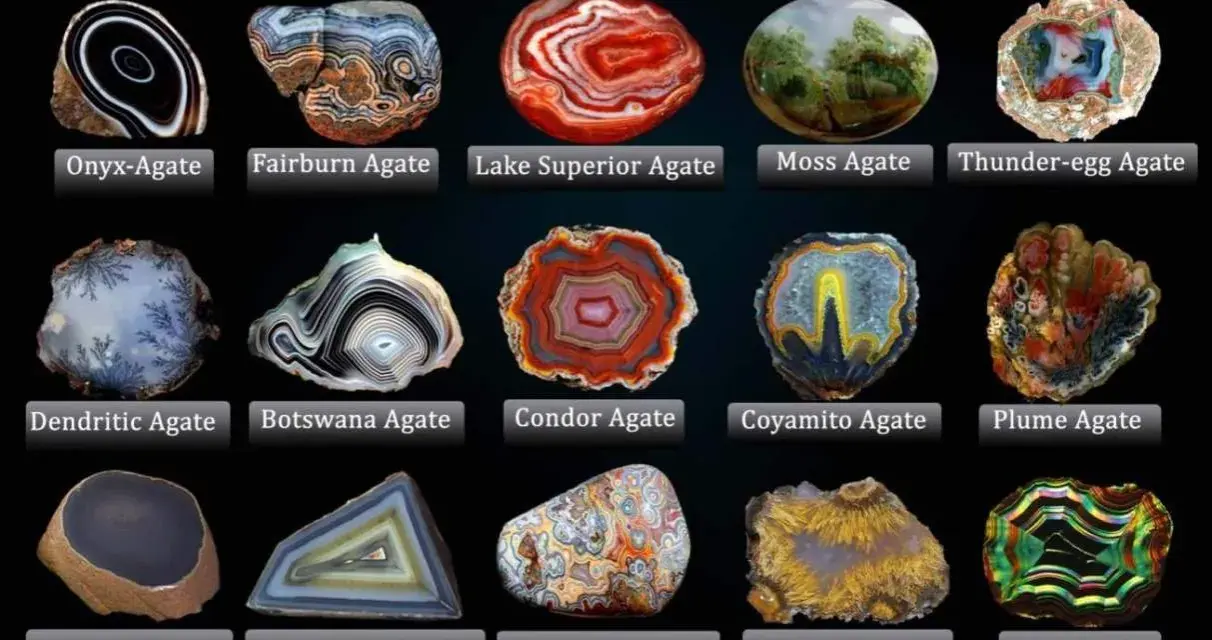
Agate is one of those gemstones that looks simple at first glance and then turns out to be far more varied than most people expect. The main types of agate differ by banding, colour, texture, and the way their patterns formed inside the stone, which is why one pendant can feel classic and another looks almost painterly. In this article I break down the major agate varieties, how I classify them, how to judge quality, and what matters most when you choose one for jewellery.
Here are the main things to know about agate varieties
- Agate is a banded form of chalcedony, which is itself a microcrystalline quartz.
- Most agate sits around 6.5 to 7 on the Mohs scale, so it is durable enough for regular wear but still deserves sensible care.
- Some names describe pattern, some describe place of origin, and some are trade names used rather loosely.
- Dyed agate is common in the market, especially when the colour looks unusually vivid.
- For jewellery, the best stone is the one whose pattern, cut, and treatment suit how you will actually wear it.
Agate, chalcedony, and jasper are close relatives
I like to start here because a lot of confusion disappears once the family tree is clear. Agate is a variety of chalcedony, and chalcedony is a microcrystalline form of quartz; jasper sits nearby in the same family but is usually opaque, while agate is typically translucent to semi-translucent and shows some kind of internal layering or banding. In other words, the name should tell you something about the structure of the stone, not just the colour.
That distinction matters in the jewellery trade because labels are not always used with geological precision. A seller may use “agate” for a banded stone, a moss-patterned stone, or a decorative cabochon with a strong visual effect, even when the strict mineralogical definition is a little narrower. I read the stone itself first and treat the name as a useful clue, not the final word.
The main types of agate and how they are classified
When I sort agate, I usually look at four things: the pattern, the optical effect, the place of origin, and whether the stone has been treated. That gives a much clearer picture than colour alone, because two grey agates can look completely different once you pay attention to banding, translucency, and the way the light behaves inside the stone.
- Pattern-based names describe what the eye sees first: banded, lace, moss-like, dendritic, plume, eye, or brecciated material.
- Optical varieties are valued for the way they interact with light, especially fire agate and iris agate.
- Locality names often hint at appearance as much as origin, which is why Botswana, Blue Lace, or Montana agate all feel so distinct.
- Treatment status is crucial, because dyed or heat-altered stones may be attractive but should be priced and described accordingly.
This is also where the category gets a little messy in a useful way. In trade language, some names are used broadly for visual effect, while a geologist may be more selective about what counts as “true” agate. For buyers, that usually means one practical rule: ask what the name is describing, because that tells you whether you are dealing with pattern, origin, or marketing shorthand.
The agate varieties I see most often in jewellery
These are the agate varieties I encounter most often in rings, pendants, beads, and collector pieces. The names below are worth knowing because they tell you something real about appearance and wearability, not just a catalogue label.
| Variety | What it looks like | Why it matters in jewellery |
|---|---|---|
| Banded agate | Layered, often concentric or parallel bands in contrasting colours | The classic agate look; works well in cabochons, slices, and signet-style pieces |
| Blue lace agate | Pale blue and white, with soft, wavy banding | Elegant and understated; ideal when you want colour without visual weight |
| Crazy lace agate | Dense, lively swirls and bands, often in cream, red, gold, and grey | Best for statement jewellery because the pattern already does most of the work |
| Moss agate | Milky or clear quartz with green, branch-like inclusions | Popular for nature-inspired rings and pendants; the appeal is in the landscape effect |
| Dendritic agate | Fine, tree-like or fern-like inclusions, usually black or brown | Quieter than moss agate, but often more refined and graphic |
| Plume agate | Feathery, cloud-like inclusions suspended in the stone | Highly decorative and often more collector-oriented than everyday commercial material |
| Botswana agate | Fine, regular bands, often in grey, pink, cream, and brown | A good choice when you want subtle colour and neat, even patterning |
| Fire agate | Brownish body colour with flashes of iridescent colour | Much rarer in top quality; the visual effect can be exceptional in the right cut |
| Iris agate | Very fine banding that can split transmitted light into spectral colours | Usually a specialist stone; it looks best when the banding is extremely tight and well cut |
| Brecciated agate | Broken fragments cemented together, often with bold colour contrast | Strong, dramatic character, but the look is more rugged than refined |
My own read is simple: if the pattern is the star, the stone can look far richer than its price suggests; if the pattern is weak, even a large stone may feel flat. That is why a small, well-cut agate often beats a bigger one with dull banding.
How I judge quality and value
Agate is not judged the way diamond or ruby is judged. The mineral itself is common enough that pattern quality, contrast, and finish usually drive value more than rarity at the species level. A fair-looking stone can still be an excellent buy if the cut is clean and the design uses its strengths well.
- Look for definition in the pattern. Sharply separated bands, crisp plume structure, or clearly formed dendrites usually read better than muddy, low-contrast material.
- Check translucency. Many attractive agates work because light travels through them. If a stone is too opaque for the style you want, the pattern may disappear.
- Inspect the polish. A good polish should feel even and glassy, without drag marks or dull patches.
- Watch for chips and fractures. Agate is tough, but edges can still chip, especially on thin slices and exposed ring settings.
- Separate natural appeal from treatment. Dyed stones can be perfectly acceptable, but vivid electric colours should make you ask questions.
In practical terms, I would rather buy a smaller untreated stone with honest colour and clean banding than a larger piece whose only advantage is saturation. That is especially true in jewellery, where proportion and wearability matter as much as visual drama.
Which agate works best for different pieces
The right agate depends on what the piece is supposed to do. A ring has to survive knocks, while a pendant has more freedom to be expressive, and bead strands need consistency more than a single dramatic focal point.
- Rings benefit from sturdier stones, lower profiles, and settings that protect the edges. Banded agate, Botswana agate, and some dendritic stones work well here.
- Pendants give you room for larger slices and more delicate patterns. Blue lace, plume, and fire agate can shine here because they do not take the same daily abuse as a ring.
- Earrings can carry bolder shapes without feeling heavy, so crazy lace and moss agate are often effective.
- Beads and bracelets are best when the stones are well matched in size and finish, even if the patterns vary slightly from bead to bead.
- Vintage-inspired pieces often suit darker banded stones or sardonyx-style looks, especially in silver or gold settings.
For the UK market, I most often see agate used in vintage-style jewellery, bead strands, and contemporary silver pieces, and that makes sense: the stone has enough personality to stand alone, but it also sits comfortably beside metal without looking overworked. If you want something you can wear often, I lean towards simpler, better-balanced material rather than the most visually crowded pattern.
Care, treatment, and the mistakes that damage agate
Agate is fairly durable, usually sitting at 6.5 to 7 on the Mohs scale, but durability is not the same as indestructibility. The most common problems are knocks to edges, scratches from careless storage, and disappointment caused by stones that were dyed or otherwise treated without clear disclosure.
My care routine is straightforward: I clean agate with lukewarm water, a little mild soap, and a soft cloth or brush; then I dry it thoroughly before storing it. I avoid harsh chemicals, ultrasonic cleaners for questionable stones, and steam cleaning when the piece may have dyes, fillers, or delicate fracture lines. If a stone is especially porous or vividly coloured, I treat sunlight and heat with a bit more caution, because colour can fade over time in some treated material.
One mistake I see repeatedly is people assuming that a hard stone cannot be damaged. Agate can still chip, and polished slices can be more vulnerable than they look. If you plan to wear it daily, a protective setting and separate storage matter just as much as the stone itself.
What I would check before buying agate in the UK
If I were choosing agate today, I would ask five practical questions before I paid for it. They save money, but more importantly they stop you buying the wrong stone for the way you actually live.
- Is the stone natural, dyed, stabilised, or heat-treated?
- Does the name describe the pattern, the place of origin, or just a trade description?
- Is the cut meant for display, or is it shaped to survive everyday wear?
- Are there visible fractures, glue lines, or edge chips that will matter once it is set?
- Does the pattern still look good at the size you plan to wear, or only in a close-up photo?
If I had to reduce the whole subject to one buying rule, it would be this: choose the agate whose structure makes sense for the job. A strong pattern, honest treatment, and a cut that suits the piece will always matter more than a flashy name on the label, and that is the difference between a stone you admire once and one you enjoy for years.