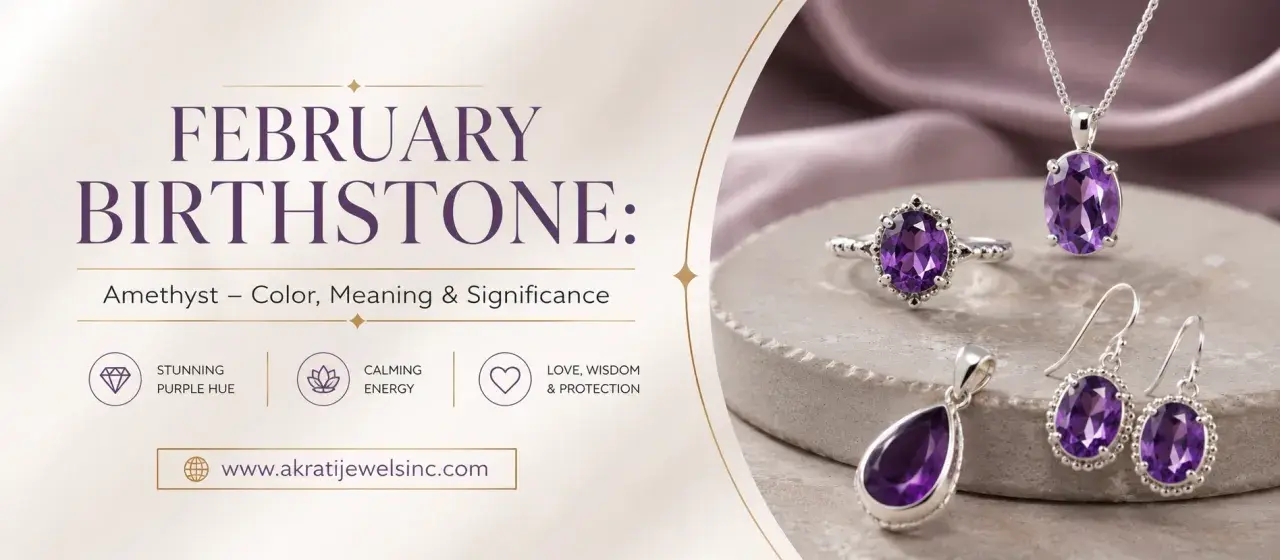
For anyone born on 18 February, the February 18 birthstone is amethyst, the purple variety of quartz that has carried both historic prestige and everyday wearability for centuries. I like this gemstone because it is easy to recognise, but still has enough variation in colour and cut to make each piece feel distinct. In this guide, I’ll show you what amethyst means, how to judge its quality, and how to choose jewellery that actually suits the person wearing it.
Key facts at a glance
- The standard gemstone linked to 18 February is amethyst.
- It is a purple variety of quartz and rates 7 on the Mohs scale.
- The best stones show a rich violet to deep purple colour without looking muddy or nearly black.
- Amethyst works well in rings, pendants, and earrings, but it still needs sensible care.
- Heat treatment and lab-created stones are both common, so clear disclosure matters when buying.
Why amethyst is the right answer for an 18 February birthday
The modern birthstone chart is simple here: February corresponds to amethyst. That means 18 February does not have a separate official gemstone of its own; it shares the month’s stone, just as every other February date does. I find that useful, because it gives a direct answer without turning a birthday gift into a puzzle.
Amethyst has stayed in the spotlight for good reasons. It is attractive, recognisable, and broad enough in tone to suit both subtle jewellery and more dramatic settings. From a practical point of view, it also sits in the sweet spot where the stone feels special without becoming difficult to wear or impossibly expensive.
That in turn matters when you start judging quality, because with amethyst the details are often what separate an ordinary piece from one that really looks polished.
What amethyst has meant in jewellery history
Amethyst has long been linked with royalty, religious regalia, and classical mythology. Its name comes from the Greek idea of being “not intoxicated”, which explains the old stories about clarity and sobriety, but the stronger reason it endured is simpler: the colour looks rich and distinctive even in modest sizes. In the UK, that royal association still feels fitting, because amethysts appear in the Crown Jewels and have a long-standing place in formal jewellery design.
For a birthday stone, that history adds weight without making the gem feel old-fashioned. It gives the stone a sense of heritage, which is why amethyst can work just as well in a clean modern pendant as in a more traditional ring. From there, the real question becomes how to tell whether one amethyst is actually better than another.How to judge amethyst quality before you buy
When I assess amethyst, I start with colour, then move to cut and clarity. Colour does the heavy lifting here: a good stone usually shows a strong, even purple with violet depth, while stones that are too dark can look nearly black in low light and very pale stones can lose their presence once they are set.
| What to check | What good looks like | What to avoid |
|---|---|---|
| Colour | Rich violet to deep purple with even saturation | Brownish, rusty, or almost-black appearance |
| Cut | Facet placement that brings out the stone’s colour | A cut that hides colour zoning or creates a pale centre |
| Clarity | Eye-clean or with only minor, non-distracting inclusions | Obvious fractures in a stone meant for regular wear |
| Disclosure | Clear information about heat treatment or lab-created origin | Vague descriptions that leave you guessing |
One term worth knowing is colour zoning, which simply means uneven colour distribution inside the crystal. A good cutter can minimise it, but if a loose stone already looks patchy in the tray, I would keep looking. Another useful term is windowing, which is a pale see-through patch in the centre of a cut gem that makes the stone look weak rather than luminous.
Heat treatment is common with amethyst and is not automatically a red flag. Lab-created amethyst is also legitimate amethyst in chemical terms; the real difference is origin, so the seller should tell you plainly which one you are buying. Because amethyst is relatively plentiful, I would rather pay for better colour and a cleaner cut than chase size for its own sake.
Once you know what good colour and cutting look like, the next step is making sure the stone wears well in real life.
How to wear and care for amethyst jewellery
Amethyst is durable enough for everyday jewellery, but I would not treat it like a diamond. At 7 on the Mohs scale, it can handle normal wear in rings, earrings, and pendants, yet it can still scratch if it sits next to harder stones or knocks against hard surfaces. If the stone is in a ring, the setting matters more than many people think.
- Clean it with lukewarm water, mild soap, and a soft brush.
- Store it separately from diamonds, sapphires, and other harder gemstones.
- Avoid steam cleaning, even if the piece looks sturdy.
- Keep it away from prolonged strong sunlight, which can dull colour over time.
- Be extra careful with pointed cuts and sharp corners, which are more vulnerable than rounded shapes.
If I had to choose the safest everyday format, I would usually pick a pendant or earrings first, then a ring only if the wearer is comfortable with a little extra care. That is why the setting and the wearer’s habits matter so much.
Which amethyst style suits the wearer best
If I were choosing a birthday piece, I would start with the person’s lifestyle rather than the gemstone itself. Amethyst is flexible enough to work in several formats, but each one solves a different problem, and the best choice depends on how the jewellery will actually be worn.
| Jewellery style | Best for | Why it works |
|---|---|---|
| Ring | Someone who likes to see the stone every day | Makes the birthstone feel immediate and personal, but needs the most care |
| Pendant | Daily wear with lower risk of knocks | Shows colour beautifully and usually ages well |
| Earrings | Quiet, polished styling | Easy to wear, low maintenance, and flattering in both silver and gold |
| Statement piece | Someone who enjoys bolder jewellery | A larger stone can show off amethyst’s colour without needing extreme rarity |
I usually think of amethyst as a stone where colour does most of the talking. A smaller gem with strong saturation can look more refined than a much larger one that feels flat or sleepy in daylight. Once the format is right, the last step is making the gift feel personal.
The small choices that make amethyst feel personal
The stone itself is easy to name, but the final impression depends on the details around it: shade, cut, metal choice, and the wearer’s taste. For a February birthday, amethyst is the clear answer, yet one stone can read quietly elegant while another feels dramatic and regal depending on how it is finished.
If you are buying for yourself, I would choose the colour you will genuinely enjoy seeing every day rather than chasing the biggest carat count in the case. If you are buying for someone else, a well-cut amethyst in a setting they can comfortably wear will usually feel more thoughtful than a large stone that stays in a box. In the end, that is what makes this birthstone work so well: it is personal, recognisable, and easy to live with.