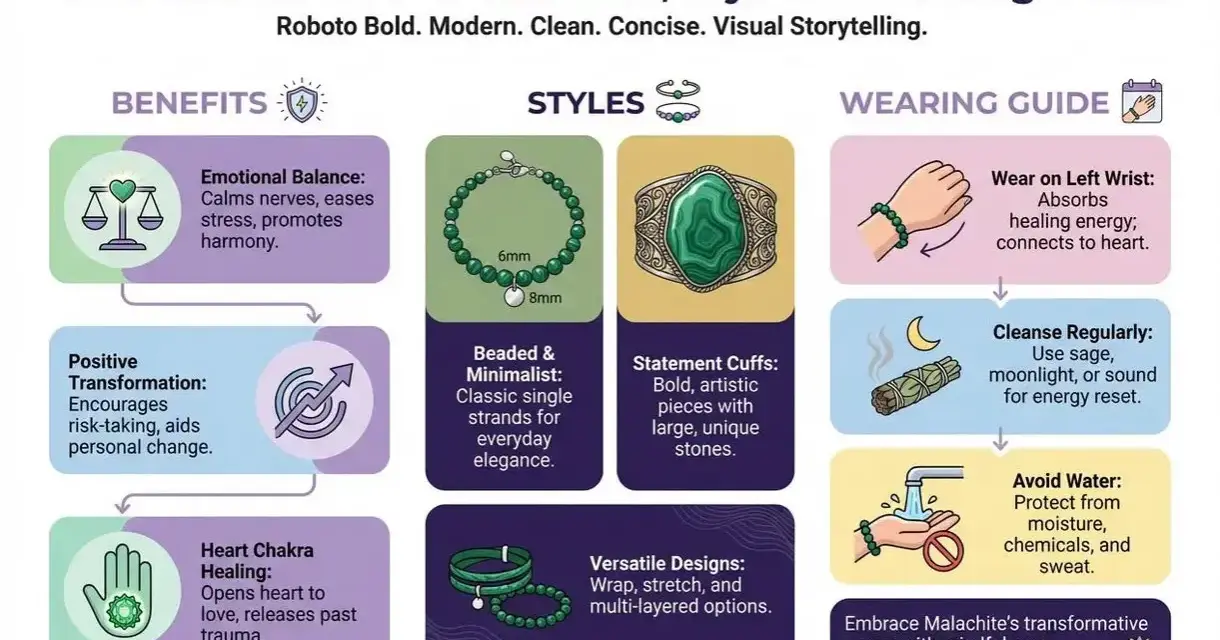
Malachite is one of those stones that earns attention for more than colour alone. The appeal of malachite benefits is mostly symbolic: people are drawn to its links with protection, growth, and a grounded kind of luxury, while jewellers value the stone for its unmistakable banding and rich green tone. In this article I focus on what those meanings really are, where the stone works best in jewellery, and how to wear it without dulling its character.
What matters most when you choose malachite in jewellery
- Its strongest appeal is symbolic, not medicinal: protection, renewal, and transformation are the recurring themes.
- The banding matters as much as the colour, because it gives each piece a geological, one-of-a-kind feel.
- Pendants, earrings, and brooches usually suit malachite better than high-wear rings.
- The stone is relatively soft at about 3.5-4 on the Mohs scale, so care is part of the purchase.
- In a UK context, its Bronze Age mining history at Great Orme adds an unusually local layer of meaning.
What malachite really adds to jewellery
At its core, malachite is a copper carbonate hydroxide mineral with a very clear visual identity: dense green, strongly banded, and impossible to mistake for a generic decorative stone. In jewellery, that matters because the stone does not just decorate a piece; it changes the mood of the whole design and gives it a more deliberate, almost ceremonial presence.
That is why I read malachite as a stone of character rather than a stone of subtlety. It can make simple gold feel more considered, soften sharp silver with a natural pattern, or turn a basic setting into something that feels collected rather than mass-produced. If you are looking for a piece with symbolic weight, its real value starts there.
I also think it helps to be honest about what the stone is and is not. I treat malachite's supposed healing powers as tradition and cultural belief, not as evidence-based fact. Once that is clear, the stone becomes easier to appreciate for what it genuinely does well, which is lead naturally into the meanings people attach to its colour.
The symbolism hidden in its green banding
Green does a lot of symbolic work on its own, but malachite adds texture to that meaning. The stone suggests growth, renewal, and continuity, yet the bands also hint at pressure, time, and transformation. That mix makes it feel less like a flat symbol and more like a story captured in stone.
When I look at malachite jewellery, I usually see five overlapping ideas:
- Protection, because the stone has long been worn like a talisman.
- Transformation, because the banding feels like change made visible.
- Renewal, because green still reads as fresh, seasonal, and restorative.
- Craft and status, because the patterning looks intentional and expensive even when the piece is modest.
- Memory, because the mineral appearance makes the stone feel older than fashion.
| Symbolic reading | What it suggests in jewellery | Best place to use it |
|---|---|---|
| Protection | A talisman-like feel, especially in pieces worn close to the body | Pendants, amulets, signet-style pieces |
| Transformation | A sense of change, movement, and personal reset | Milestone gifts and statement pieces |
| Renewal | Freshness and recovery without looking overly delicate | Layered necklaces and stackable accents |
| Craft | Strong visual identity that signals deliberate design | Cocktail rings, cufflinks, brooches |
For me, that is why malachite keeps returning in jewellery stories: the symbolism is broad enough to feel personal, but specific enough to feel believable. Once that meaning is in place, the next question is how the stone behaves in actual pieces you can wear.
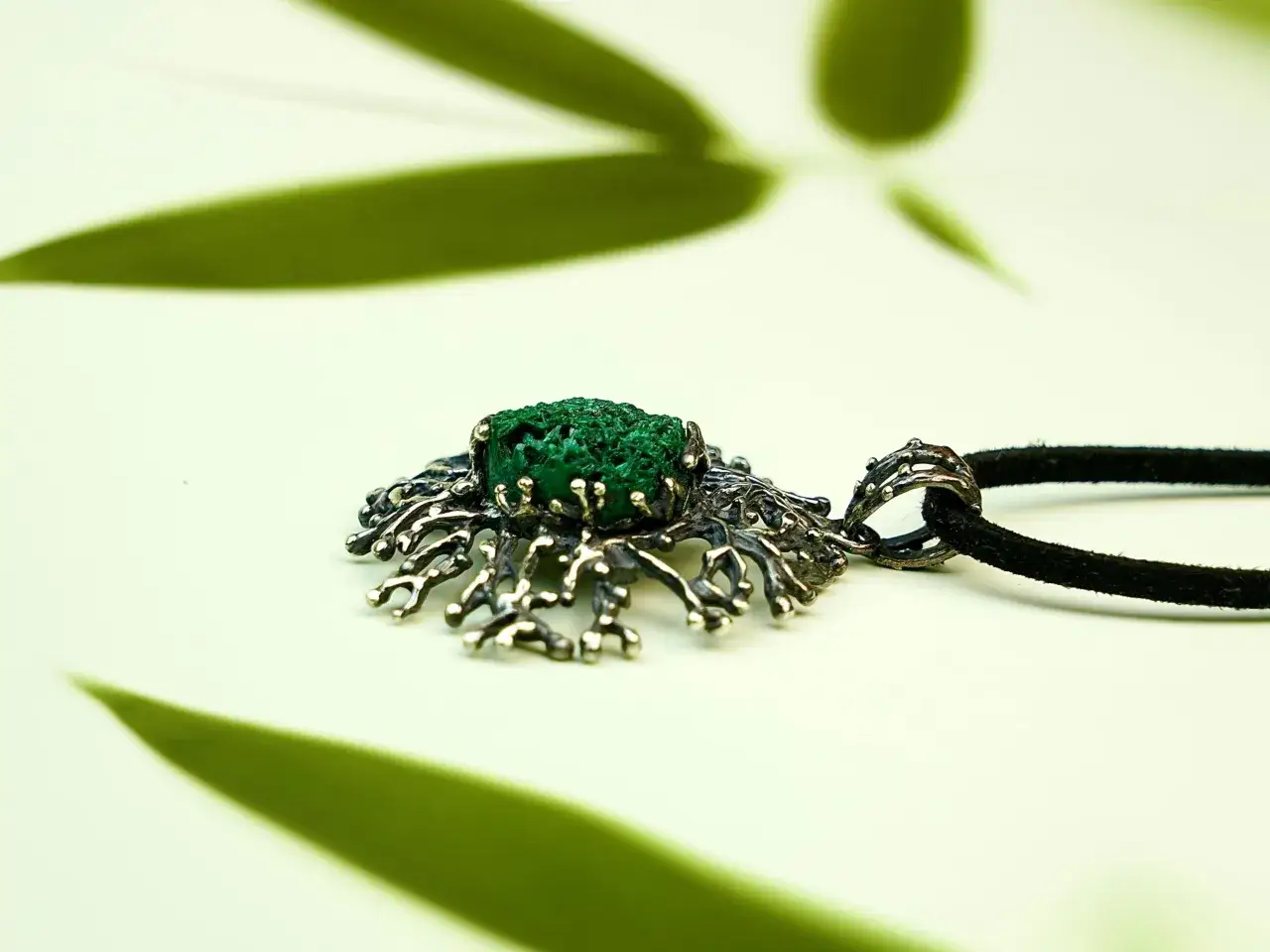
Why it works so well in contemporary pieces
Malachite has a built-in visual drama that suits modern jewellery very well. I like it most in pieces that let the banding breathe, because the stone is strongest when you can read it quickly and cleanly from a normal viewing distance.
A cabochon, which is a smooth domed cut rather than a faceted one, usually suits malachite better than a brilliant cut. The polished surface lets the bands move across the stone like a landscape, and that is what gives the gem its depth. Faceting tends to fight that effect instead of enhancing it.
| Piece type | Why it suits malachite | What I would watch for |
|---|---|---|
| Pendant | Shows the pattern clearly and sits safely away from constant knocks | Choose a setting that protects the edges |
| Earrings | Feels elegant without taking as much daily abrasion as a ring | Keep the size balanced so the stone does not feel heavy |
| Ring | Makes the strongest statement and puts the colour at hand level | Use a bezel or other protective setting |
| Brooch | Gives the stone a vintage, collectible feel | Check that the mount is sturdy, not decorative only |
In the UK especially, malachite often reads as vintage-luxury rather than flashy trend jewellery, which is why it pairs so well with tailored coats, knitwear, and restrained eveningwear. That visual versatility is useful, but it only works if the stone is treated with a bit of respect, which brings me to care.
How to wear malachite without damaging it
Malachite sits around 3.5-4 on the Mohs scale, so I would not treat it like a hard everyday gemstone. It scratches more easily than quartz, and because of its chemistry, acids, perfumes, harsh cleaners, and ultrasonic cleaning can all cause problems over time.
- Prefer pendants and earrings for regular wear if you want the stone to last.
- Choose rings with protective bezels rather than open, exposed settings.
- Keep malachite away from perfume, hairspray, vinegar, bleach, and strong household cleaners.
- Skip ultrasonic and steam cleaning entirely.
- Wipe it with a soft, dry cloth after wear and store it separately from harder stones.
GIA’s general advice on colored-gem care is useful in principle, but with malachite I would be even simpler and more cautious: fewer chemicals, less water, and no aggressive cleaning methods. That approach keeps the polish intact and preserves the stone’s deep colour, which matters if the piece is meant to carry symbolic weight rather than just function as decoration.
Why it has a particularly British historical pull
Malachite is not just an imported decorative green in a UK context. Museum Wales records malachite from Great Orme’s Head in Bronze Age copper workings, and the site was active about 3,800 years ago. That history gives the stone a local depth that many people miss when they think of it only as a “mystical” gemstone.
That background changes how the stone feels in jewellery. It is not only about colour or crystal lore; it also connects to mining, craft, trade, and the long habit of turning mineral material into ornament. For me, that makes malachite feel more grounded than a purely fashion-led stone.
It also explains why antique-inspired settings suit it so naturally. The stone already carries a sense of time, so when it appears in a brooch, a signet-style ring, or a structured pendant, the result feels coherent rather than costume-like. The last step is deciding what to check before you actually choose one.
What I would check before choosing a malachite piece
- Clarity of pattern: I want banding that looks natural, not printed or painted.
- Type of stone: I ask whether it is natural, stabilised, or composite, because that changes care and value.
- Strength of setting: I look for settings that protect the stone’s edges, especially in rings.
- Scale: I prefer a size that matches the piece’s role, whether that is everyday wear or a statement moment.
- Pairing: I like malachite most with yellow gold, brushed silver, black enamel, pearls, or other materials that let the green stay the focus.
If I had to keep only one rule, it would be this: choose malachite when you want a piece that says something, not just something that matches. The strongest examples balance symbolism, wearability, and honest construction, which is what makes the stone feel enduring rather than merely decorative.