Chalcedony is one of those gemstones that looks calm at first glance, yet carries more symbolism than many louder, more expensive stones. The chalcedony meaning is usually read as quiet strength, clarity, and emotional ease, but the interpretation changes with colour, setting, and historical context. In jewellery, that makes it especially interesting: the stone can feel serene, protective, romantic, or even authoritative depending on how it is used.
What chalcedony says in jewellery
- Chalcedony is usually linked with calm, balance, and understated confidence rather than dramatic symbolism.
- Its message changes noticeably with colour, especially in blue, green, red-orange, and black varieties.
- The stone’s soft glow comes from its microcrystalline structure, which is part of why it feels so gentle visually.
- Historically, chalcedony was used for seals, signet rings, and carved ornaments, so it also carries a sense of identity and protection.
- For everyday jewellery, a protective setting and clear treatment disclosure matter more than many buyers realise.
What chalcedony actually is and why that matters
Chalcedony is a microcrystalline form of quartz, which means its crystals are so fine that you cannot see them without magnification. That technical detail sounds dry, but it explains the stone’s personality: instead of sharp brilliance, you get a soft, almost velvety glow with a waxy lustre. I think that texture is a big part of why chalcedony feels emotionally different from faceted gemstones. It does not shout; it settles.
This matters because the stone’s symbolism is closely tied to how it looks and how it wears. A gem that reads as smooth, diffuse, and quietly luminous naturally lends itself to ideas like composure, peace, and restraint. It is also why chalcedony is often chosen for pieces that are meant to feel thoughtful rather than flashy. Once that is clear, the colour story becomes much easier to read.
How colour changes the message
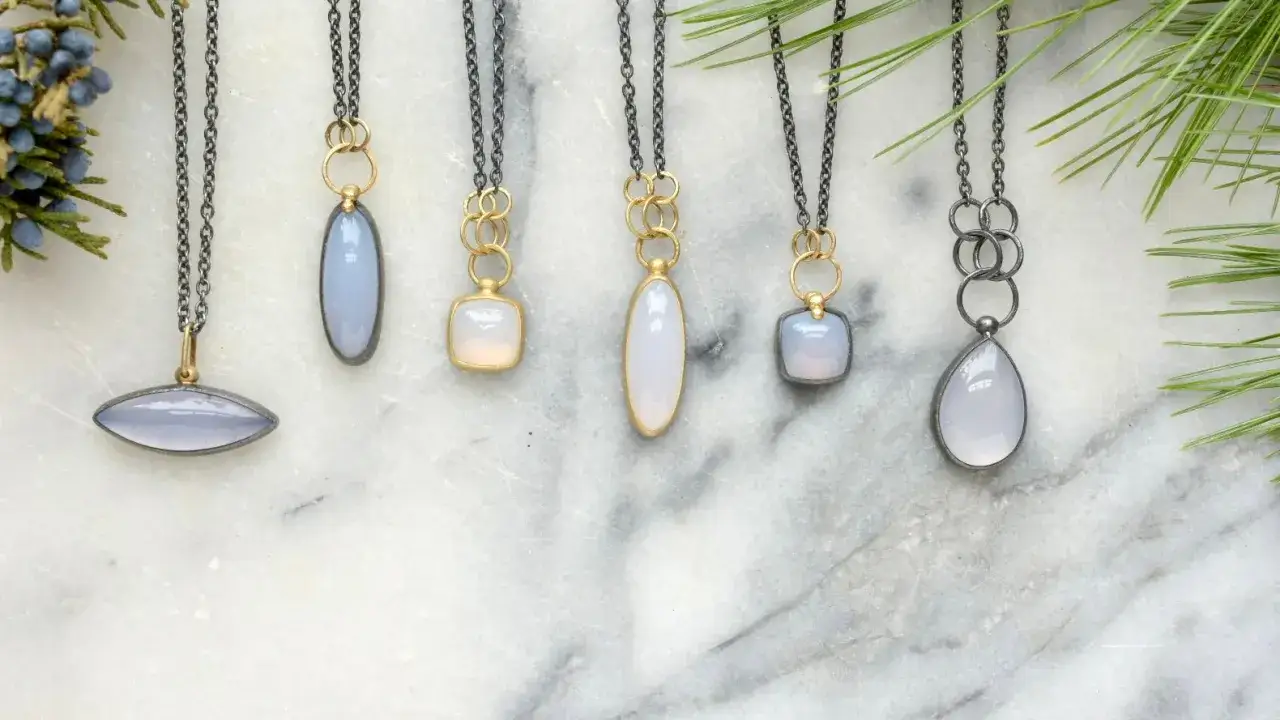
That is why chalcedony meaning shifts so much with colour. In jewellery, people often talk about the family as if it carries one fixed message, but the truth is more layered. Blue chalcedony does not communicate the same thing as carnelian, and black onyx does not feel like chrysoprase. The mineral family is shared; the emotional language is not.
| Colour or variety | Common symbolism | Best jewellery setting or use | What I would check |
|---|---|---|---|
| Blue chalcedony | Calm, clear communication, diplomacy, cool-headedness | Pendants, stud earrings, clean bezel-set rings | Even colour and whether the stone is natural or dyed |
| White or pale grey chalcedony | Balance, neutrality, simplicity, quiet elegance | Minimal daily wear, bridal-inspired pieces, layering jewellery | Surface polish and whether the tone feels intentional rather than chalky |
| Pink chalcedony | Tenderness, affection, softness, emotional openness | Romantic gifts, delicate necklaces, feminine signet-style pieces | Whether the colour is naturally soft or heavily enhanced |
| Chrysoprase | Renewal, optimism, growth, fresh starts | Statement rings, earrings, spring and summer jewellery | Colour saturation and any obvious treatment disclosure |
| Carnelian | Vitality, courage, motivation, warmth | Bold cabochons, vintage-style rings, warm metal settings | Whether the red-orange tone feels rich rather than too uniform |
| Black onyx | Grounding, discipline, reserve, formal strength | Signet rings, cufflinks, evening pieces, monochrome looks | Edge wear, polish, and whether the stone is dyed |
For me, the most useful way to read chalcedony is not to ask what it “means” in the abstract, but what the colour is doing in the piece. A pale blue cabochon in silver says something very different from a deep carnelian in gold. That distinction matters even more once you look at the stone’s history, because chalcedony has always been used for more than decoration.
What chalcedony has meant in jewellery history
Chalcedony has a long record in carved jewellery, seal stones, and ornamental objects because it takes a fine polish and can be worked cleanly. That practical quality gave it symbolic weight. When a stone is used for a seal, a signet ring, or an intaglio, it stops being just a pretty material and starts acting as a marker of identity, authority, family, or ownership. In other words, the stone was not only worn; it was used to speak.
That historical role still affects how chalcedony feels today. Antique-inspired pieces often carry a sense of discretion and inherited taste, especially in British jewellery where understated formality has always had appeal. I often see chalcedony work beautifully in settings that borrow from the past without looking old-fashioned: oval cabochons, engraved mounts, and slim rings that feel personal rather than ostentatious. That heritage is useful, because it shows that the stone’s symbolism has never been purely mystical. It has always been practical too, which leads naturally into how to choose a piece now.
How I choose a piece when symbolism matters
When someone wants the symbolic side of chalcedony to feel believable rather than decorative, I start with three decisions: colour, cut, and setting. Those three elements do more to shape the emotional tone of the jewellery than most people expect. A stone can be the same mineral and still read as gentle, formal, modern, or romantic depending on how those choices are handled.
- Choose blue chalcedony if you want calm, poise, or a subtle “I do not need to prove anything” kind of elegance.
- Choose green varieties such as chrysoprase if you want the piece to suggest growth, renewal, or fresh energy.
- Choose carnelian or warm-toned chalcedony if the gift is meant to feel encouraging, energising, or confident.
- Choose a cabochon if you want the stone to feel traditional and tactile; the domed shape suits chalcedony particularly well.
- Choose a bezel setting for rings and bracelets if the piece will be worn often, because it protects the edges better than an open setting.
- Ask about treatment if the colour is unusually vivid, because a dyed stone can still be beautiful, but the buyer should know what they are wearing.
Metal choice matters too. Silver tends to cool chalcedony down and make it feel more contemporary, which works beautifully in the UK market. Yellow gold warms the same stone and gives it a more intimate, antique feel. If I were buying chalcedony as a gift, I would think less about the stone in isolation and more about the story the whole piece is telling. That approach also helps when it comes to wearing and caring for it properly.
How to care for chalcedony without flattening its character
Chalcedony is reasonably durable, with a Mohs hardness of about 6.5 to 7, so it can handle regular wear better than many softer stones. That said, it is not indestructible. Rings are still the hardest-working jewellery items, and chalcedony rings deserve more care than pendants or earrings because they are more likely to hit hard surfaces. The stone’s polish is part of its appeal, so the aim is not just to avoid cracks, but to preserve that soft, even sheen.
My practical care rule is simple: keep it clean, keep it separated, and keep it away from unnecessary heat and chemicals. Lukewarm water, mild soap, and a soft cloth are usually enough for routine cleaning. I would avoid ultrasonic or steam cleaning for dyed pieces, and I would not leave coloured chalcedony in strong sunlight for long periods if the colour was enhanced. Solvents such as acetone or alcohol can also be a problem for dyed material. If you want the stone to keep its meaning visually, you have to protect the surface that carries that meaning.
Storage matters as well. Chalcedony can be scratched by harder gemstones and even by careless contact with metal clasps or rougher stones in the same box. A soft pouch or a lined compartment is a small habit that pays off over time. That kind of maintenance sounds dull, but it is what keeps a piece from losing the very character that made you choose it in the first place.
Why chalcedony still fits a modern British jewellery wardrobe
What makes chalcedony feel current is not trendiness; it is restraint. In a market that often swings between very quiet basics and very loud statement pieces, chalcedony sits in a useful middle ground. It has enough colour to feel intentional, enough softness to remain wearable, and enough history to make it interesting. That combination is rare.
It also adapts well to the way many people in the UK actually dress. A blue chalcedony pendant can look polished with a shirt and blazer. A black onyx signet ring can carry a formal edge without appearing heavy. A chrysoprase ring or pair of earrings can bring colour to a neutral wardrobe without feeling seasonal in a narrow way. I like stones that can move between everyday wear and a more considered occasion, and chalcedony does that better than its reputation sometimes suggests.
If I had to give the stone one clear interpretation, I would call it calm with structure. That is the most accurate way to read its symbolism, and it is why chalcedony remains such a strong choice for jewellery that needs to feel personal, elegant, and quietly meaningful.