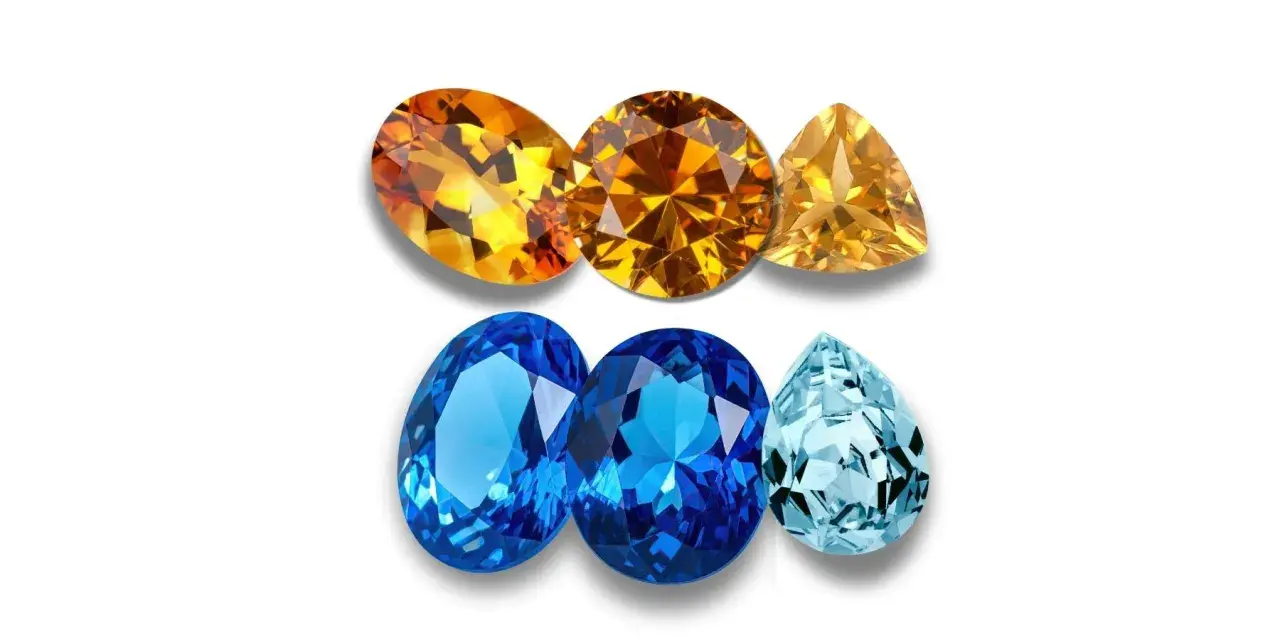
The topaz birthstone story is richer than a simple calendar label. I use topaz as a good example of a gem that is both beautiful and practical: it comes in a wide colour range, it has a few treatment-related quirks, and it carries enough history to make a gift feel meaningful without becoming overdone. This guide explains why topaz is linked to November, how its colours and varieties differ, how it compares with citrine, and what to look for if you are buying one in the UK.
The essentials if you want the right topaz
- Topaz is most strongly linked with November, while blue topaz also appears separately in December guides.
- The most important buying question is not just colour; it is whether the stone is natural, treated, or coated.
- Imperial topaz is the rarest and most valuable colour range, while blue topaz is the most accessible in everyday jewellery.
- Topaz rates 8 on the Mohs scale, but its cleavage means sharp knocks and ultrasonic cleaning are poor choices.
- In the UK, topaz jewellery often makes the most sense in sterling silver or 9ct gold, with price driven more by the setting than by the stone alone.
Why topaz is tied to November
GIA lists precious topaz as November's birthstone, while blue topaz appears separately in December guides. That split explains a lot of the confusion people run into. Historically, the name "topaz" was used much more loosely than it is now, and yellow stones were often grouped together under the same label even when they were not the same mineral.
For a birthstone article, that matters because it changes how you read the stone. If you want a November piece, you are usually looking at the warm yellow, orange, or reddish-orange end of the spectrum. If you see a bright sky-blue stone in a modern jewellery case, you are more likely looking at a treated colourless topaz that has been turned blue for the market. Both can be lovely, but they do not tell the same story.
I think this is the first decision point most buyers should make: do you want the traditional November look, or do you want the modern blue version that is easier to wear with almost anything? Once that is clear, the rest of the choice becomes much easier, because the colour range in topaz is wider than most people expect.
The colours and treatments that change topaz’s value
Topaz has one of the widest colour ranges in gemmology. Natural stones can be colourless, yellow, blue, brown, pink, orange, red, green, or purple, but not every colour has the same rarity or the same role in jewellery. In practice, I separate topaz into the versions you wear every day and the versions people collect or gift for their rarity.
| Variety | Appearance | What to know | Best use | My take |
|---|---|---|---|---|
| Precious topaz | Yellow to orange-red | The traditional November stone, with warmer shades generally more prized | Pendants, rings, classic gifts | Best if you want the historical association |
| Blue topaz | Sky blue, Swiss blue, or London blue | Often treated colourless topaz; very common in the market | Everyday jewellery, gifts, stacking pieces | Best value and easiest to match |
| Imperial topaz | Golden orange to pinkish red | The rarest and most valuable topaz range | Fine rings, collector pieces | The most luxurious choice |
| Pink or red topaz | Pink to red | Natural examples are rare, and treatment disclosure matters | Statement jewellery | Buy only when the colour story is clearly explained |
| Mystic topaz | Iridescent rainbow finish | A coated stone rather than a natural colour range | Trend pieces | Fun, but not the best pick for long-term wear |
Many of the bright blue stones on the market start as colourless topaz and are then treated to create the colour. That is normal trade practice. The point is not to avoid treated stones, but to know what you are paying for. If a seller is honest about the treatment, the stone can still be a smart buy.
There is one important exception: coated stones such as mystic topaz. The colour effect is appealing, but the surface layer can be more vulnerable to wear, so I would not choose it for someone who wants a low-maintenance daily ring. If you like the look, fine. Just treat it as fashion jewellery rather than something you expect to stay perfect through heavy use.
If you remember only one thing from this section, make it this: colour in topaz is not just a style choice. It is often the clue that tells you whether you are buying a natural rarity, a treated everyday stone, or a surface-coated fashion piece. That leads directly to the most common comparison buyers make, which is topaz versus citrine.
Why topaz and citrine are often compared
Topaz and citrine sit next to each other on November birthstone lists, and they can look close enough in warm tones that people confuse them at a glance. They are different minerals, though, and that difference is worth paying attention to if you care about durability, colour, and price.
| Factor | Topaz | Citrine |
|---|---|---|
| Mineral | Aluminium fluorosilicate | Quartz |
| Colour range | Very wide, from blue through yellow to imperial orange-red | Narrower, usually pale yellow to brownish orange |
| Buyer appeal | More variety and a few rare collector colours | Warm consistency and often a gentler price |
| Best fit | If you want flexibility or a stronger birthstone story | If you want a warm, uncomplicated alternative |
My rule of thumb is simple: choose topaz when you want the stone to do more than sit politely in a setting. Choose citrine when the brief is simple warmth and a smaller budget. I find that split especially useful in November, because it stops buyers from thinking they have to pick one "correct" stone when the better question is which one suits the person.
That is also why old trade names still cause problems. Labels like "quartz topaz" or "Spanish topaz" can be misleading, because they were often used for citrine rather than true topaz. If a shop uses a historical name, I would ask what the gem actually is before I buy.
Once you know which stone suits the brief, the buying decision becomes much more straightforward, especially if you are choosing a piece for daily wear in the UK.
How I would choose topaz jewellery in the UK
In the UK, the strongest everyday topaz pieces are usually the ones that match the stone to the setting. I would not choose a delicate high-set ring for someone who works with their hands, even if the stone is beautiful. Topaz is hard, but hardness is not the same as toughness.
| Piece | Typical UK price band | Why it lands there |
|---|---|---|
| Sterling silver blue topaz ring | About £129 to £250 | Entry-level setting, smaller stone, fewer extras |
| 9ct gold pendant or ring | About £165 to £700 | Metal weight and stone size drive the jump |
| Designer or diamond-accented piece | About £900 to £1,650+ | Brand, finish, and accent stones add most of the value |
| Imperial topaz ring | About £1,000 to £3,500+ | Rarity and natural colour premium |
These are practical shopping bands, not fixed rules. What pushes a piece up the scale is usually the metal, the carat weight, the presence of diamonds, and whether the stone is a common treated blue or a rarer natural imperial shade. In other words, topaz can be affordable, but it is not always cheap once the design becomes more refined.
- Choose a pendant if the wearer is active and you want the safest everyday option.
- Choose a low-profile ring if daily wear matters more than dramatic height.
- Choose 9ct gold or sterling silver if you want a gift that feels polished without chasing collector pricing.
- Choose blue topaz if you want the broadest style compatibility.
- Choose imperial topaz if the gift is meant to feel rare and memorable.
If I were buying for regular wear, I would usually favour a pendant or a low-profile ring, especially in 9ct gold or sterling silver. That keeps the piece wearable without making the stone feel overprotected, and it suits the way many people in the UK actually wear birthstone jewellery. Once you own one, care is what protects the purchase.
How to care for topaz without dulling it
Topaz rates 8 on the Mohs scale, so it resists scratches well, but its cleavage makes it vulnerable to sharp impact. GIA's care guidance is straightforward: warm soapy water is the safest routine, and steam or ultrasonic cleaning should be avoided.
That means I treat topaz like a gem that likes gentle handling but not harsh shortcuts. I would remove a ring before sport, gym work, DIY, or anything involving sudden temperature changes. I would also keep coated stones, especially mystic topaz, away from abrasive cloths and aggressive polishing, because the surface finish is part of the look.
- Clean it with warm water, mild soap, and a soft brush.
- Dry it with a lint-free cloth.
- Store it separately from harder gems such as diamond or sapphire.
- Avoid steam cleaners and ultrasonic machines.
- Take rings off before sports, heavy cleaning, or DIY tasks.
- Be extra careful with coated stones and any piece with visible chips near facet edges.
That routine is boring, but boring is what keeps a topaz looking bright. It also helps explain why this gem works well in pendants and earrings, where it gets the spotlight without taking the daily knocks that a ring has to absorb.
What topaz has meant over time
Topaz has gathered a long list of associations: calm, warmth, friendship, clarity, and, in some traditions, protection. I treat those as cultural meanings rather than promises, but they help explain why the stone keeps turning up in gifts and milestone jewellery.
Its appeal is partly visual and partly narrative. The warm imperial colours feel autumnal and intimate; the blue stones feel crisp and modern; the large crystal sizes make the gem accessible without looking plain. That mix gives topaz a useful role in birthstone jewellery: it can be personal without feeling overly formal.
For me, that is where topaz becomes more interesting than a simple coloured stone. It can look classic in a yellow gold pendant, clean in a white gold ring, or quietly luxurious in a well-cut imperial piece. Few gems move across those styles so easily, and that is part of why it has stayed relevant for so long.
Those meanings become more useful when you apply them to a real purchase, because sentiment only works when the piece is something the wearer will actually enjoy wearing.
What I would check before buying one as a gift
Before I buy topaz in the UK, I check five things: the colour name, whether the stone is treated, the metal and hallmark, the setting style, and whether the piece matches how the recipient actually wears jewellery. That last point sounds obvious, but it is the one people skip most often.
- Choose imperial or precious topaz if the gift is about tradition and rarity.
- Choose blue topaz if the gift needs to be versatile, affordable, and easy to wear.
- Choose a pendant or earrings if the wearer is active and does not want to baby the stone.
- Choose a low-profile ring if daily wear matters more than dramatic height.
- Ask the jeweller to confirm whether the stone is natural, treated, or coated.
- Check whether the metal is 9ct gold, 18ct gold, sterling silver, or platinum so you can judge the value honestly.
If I wanted the safest all-round choice, I would usually lean toward a blue topaz pendant or a low-set precious topaz ring, because both balance sentiment with wearability. That is the practical side of choosing a birthstone well: the right piece is the one that fits the person, the metal, and the way they live, not just the one that looks best in a photo.