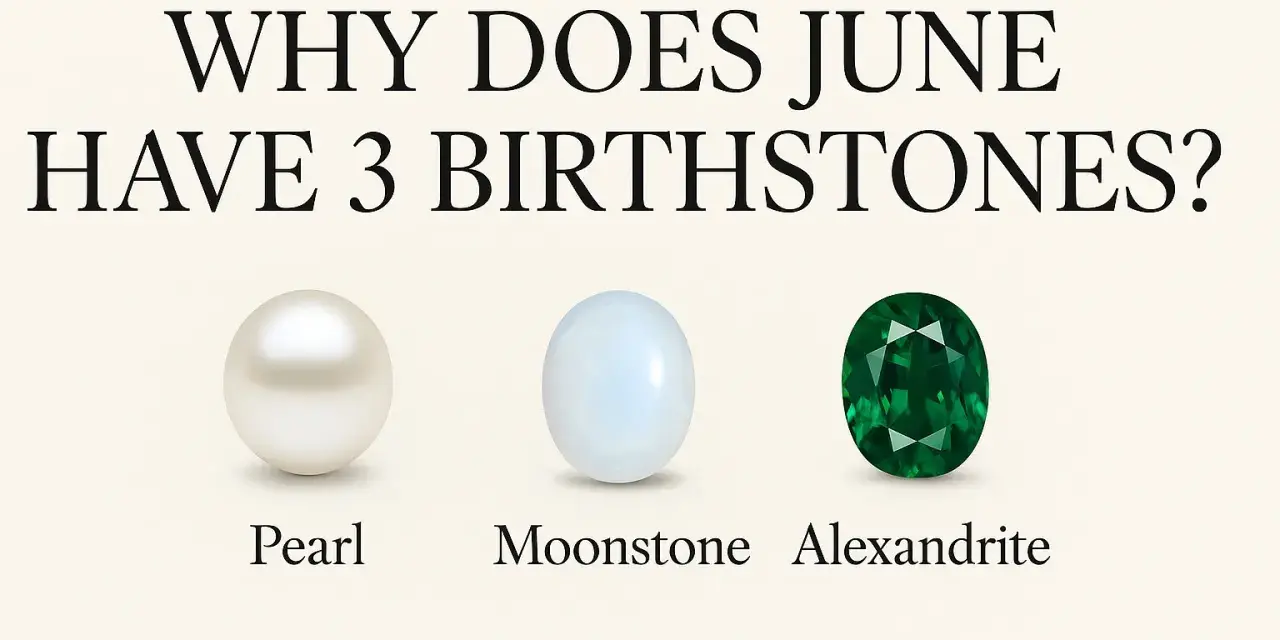
A June 30 birthday gives you one of the more flexible birthstone stories in jewellery: the date belongs to June’s stone family, not to a separate gem reserved for that exact day. The June 30th birthstone is usually treated as pearl, with moonstone and alexandrite as the other recognised June options. In the sections below, I’m looking at what each stone means, how they differ in real wear, and how to choose the one that actually suits the person and the piece.
June gives you three birthstones, and pearl is the classic answer for 30 June
- Pearl is the most traditional June choice and the safest single answer for a June birthday.
- Moonstone brings a softer glow and a more romantic, atmospheric look.
- Alexandrite is rare, colour-changing and the most durable of the three.
- June is unusual because it has three birthstones, so style and budget matter more than a fixed rule.
- Pearl and moonstone need gentler care than alexandrite.
What a June 30 birthday means for birthstones
Birthstones are assigned by month, not by exact day, so there is no separate gem reserved only for 30 June. That is why the answer is broader than people expect: June birthdays are linked to pearl, moonstone and alexandrite, and pearl is the classic starting point if you want the most traditional reading. I like this part of birthstone jewellery because it gives you room to choose a stone that fits the wearer instead of forcing everyone into the same look.
The Gemological Institute of America lists those three stones for June, and that matters because it frames the month as a choice between three very different personalities: soft and organic, glowing and dreamlike, or rare and colour-changing. Once you understand that, the real question becomes which of those personalities feels right for the person wearing it.
Why June gives you more than one option
June’s birthstone list has evolved over time as different traditions and jewellery markets put more weight on different stones. In practice, that means June has three usable answers instead of one rigid rule, which is excellent for gifting but slightly confusing if you were expecting a single official gem.
The practical upside is simple: you can match the stone to the occasion. A classic strand of pearls feels very different from a moonstone pendant, and both sit far below alexandrite in rarity and price. The American Gem Society describes June as a month with multiple birthstones for exactly this reason: there is more than one valid way to celebrate it. Once you know that, the comparison becomes much easier.
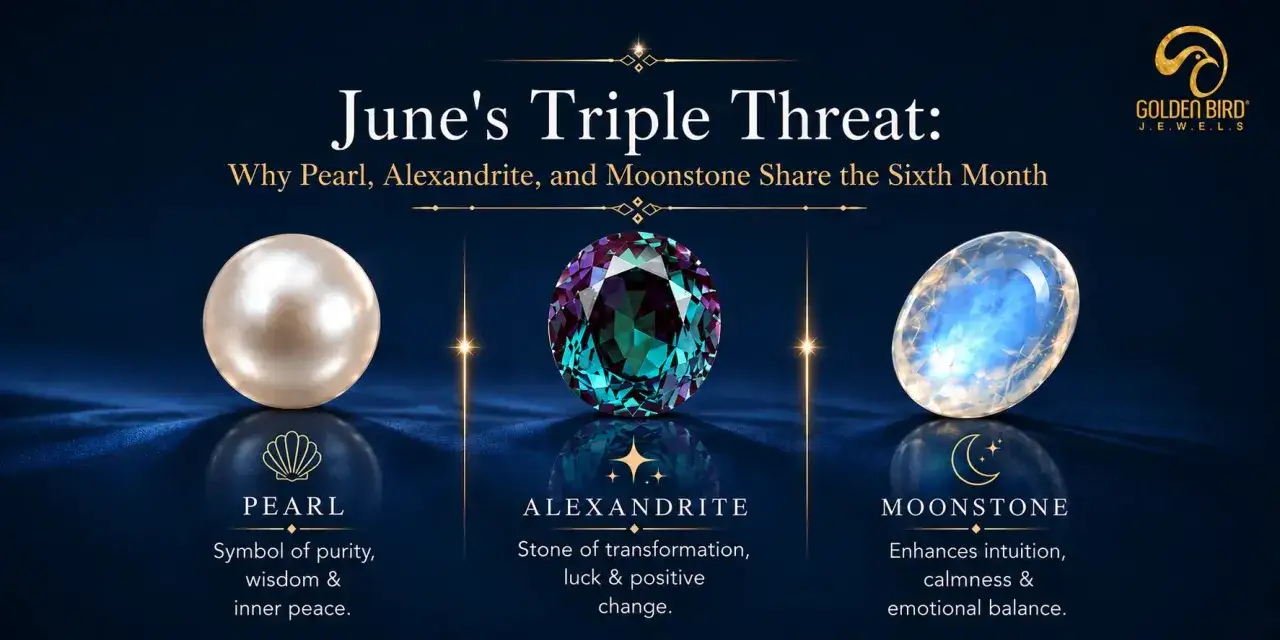
How pearl, moonstone and alexandrite compare in real jewellery
If you are choosing for wearability, the differences are bigger than the month label suggests. Pearl is an organic gem, moonstone is a feldspar, and alexandrite is a colour-change variety of chrysoberyl. That sounds technical, but the practical result is straightforward: each stone behaves differently on the wrist, neck or hand.
| Stone | Look | Mohs hardness | Best use | Watch-outs |
|---|---|---|---|---|
| Pearl | Soft lustre, smooth and luminous | 2.5-3.0 | Necklaces, studs, bridal pieces, heirloom jewellery | Scratches easily and dislikes perfume, hairspray and harsh cleaners |
| Moonstone | Floating glow, often with adularescence | 6.0-6.5 | Pendants, earrings, low-profile rings | Can chip or scratch, especially in daily wear |
| Alexandrite | Green in one light, red in another | 8.5 | Statement rings, heirloom pieces | Rare, costly and worth buying only from a trusted seller |
I find this the clearest way to look at it: pearl is the most elegant, moonstone is the most atmospheric, and alexandrite is the most dramatic. Moonstone’s adularescence is the milky light effect that seems to move just under the surface, and it is the reason the stone feels so ethereal. In budget terms, pearls and moonstone are usually the easier buys, while fine alexandrite is the one that can jump sharply in price. From here, the decision is less about the right birthstone and more about which stone suits the way the piece will actually be worn.
How I would style each stone for different occasions
Style is where June’s trio really starts to separate. Pearl reads polished and familiar, so it works beautifully with tailored clothing, wedding looks and everyday studs. Moonstone has a softer, more romantic feel, which makes it ideal for fluid dresses, silver settings and pieces that are meant to feel a little more personal than formal.
For everyday wear
If I wanted a June stone for regular use, I would usually lean towards alexandrite first, then pearl in protected settings such as studs or a pendant. Alexandrite handles daily wear far better than the other two, while pearl only works well if you are disciplined about removing it before cosmetics, exercise and showering.
For a softer, more intimate look
Moonstone is the one I reach for when I want the jewellery to feel quiet rather than showy. It looks especially good in cabochon cuts, which are smooth domes rather than faceted stones; that shape lets the light slide across the surface instead of flashing sharply. Set in white gold or sterling silver, it can look modern without losing its vintage edge.
For a rare gift or heirloom piece
Alexandrite is the obvious choice when the brief is “something unforgettable”. Because it changes colour in different light, it has a built-in sense of theatre that no pearl or moonstone can copy. I would keep the design simple so the colour change stays visible, especially in rings and pendants where the stone can catch both daylight and indoor light.
Once you see how differently these stones wear, the next step is care, because the wrong cleaning method can undo even a well-chosen piece.
How to care for June birthstone jewellery without damaging it
Care is where many people make expensive mistakes. The headline rule is easy: pearl and moonstone need a light touch, while alexandrite gives you more flexibility, though it still benefits from sensible handling. The differences come down to hardness, toughness and how each stone reacts to heat, chemicals and impact.
For pearls, I always recommend a soft cloth, separate storage and a strict last-on, first-off routine. Put perfume, hairspray and makeup on before the jewellery, not after it. Pearls are soft enough that I would never put them in an ultrasonic or steam cleaner, and they can pick up scratches if they are stored next to harder gems.
Moonstone needs a similar respect for gentleness. Warm soapy water is usually enough, but ultrasonic and steam cleaners are poor choices because moonstone can crack or chip if it is hit or overheated. It is better suited to pendants and earrings than to rings that take knocks all day.
Alexandrite is the most robust of the trio. It can usually be cleaned with warm soapy water, and ultrasonic and steam cleaners are usually safe for the stone itself, although I would still check the setting first. Even a hard gemstone can be marred by careless mounting, rough wear or the wrong setting.
If you remember only one thing, make it this: matching the care routine to the stone matters more than polishing it more often. That is what makes a piece last, and it leads neatly into the final decision of what to buy in the first place.
What I would choose for a June 30 gift
If I were buying for a June birthday, I would start with the wearer, not the marketing label. A pearl pendant is the safest all-rounder, moonstone gives the most character for a softer budget, and alexandrite is the one I would choose when the brief is rarity. Most pearls sold today are cultured, which is standard, so I would judge them by lustre, shape and surface rather than by whether they are “natural”.
For a June 30th birthstone piece, I would usually choose pearl first if the goal is timelessness, moonstone if the goal is romance, and alexandrite if the goal is a true heirloom. When buying in the UK, I would ask for clear details about origin, treatment and setting, because all three stones look better when the seller is transparent rather than vague.If the piece feels right in natural light and still looks good when worn with real clothes, it is probably the right choice. That is the standard I would trust for a birthday gift, and it is the easiest way to turn a birthstone into something the wearer will actually use.